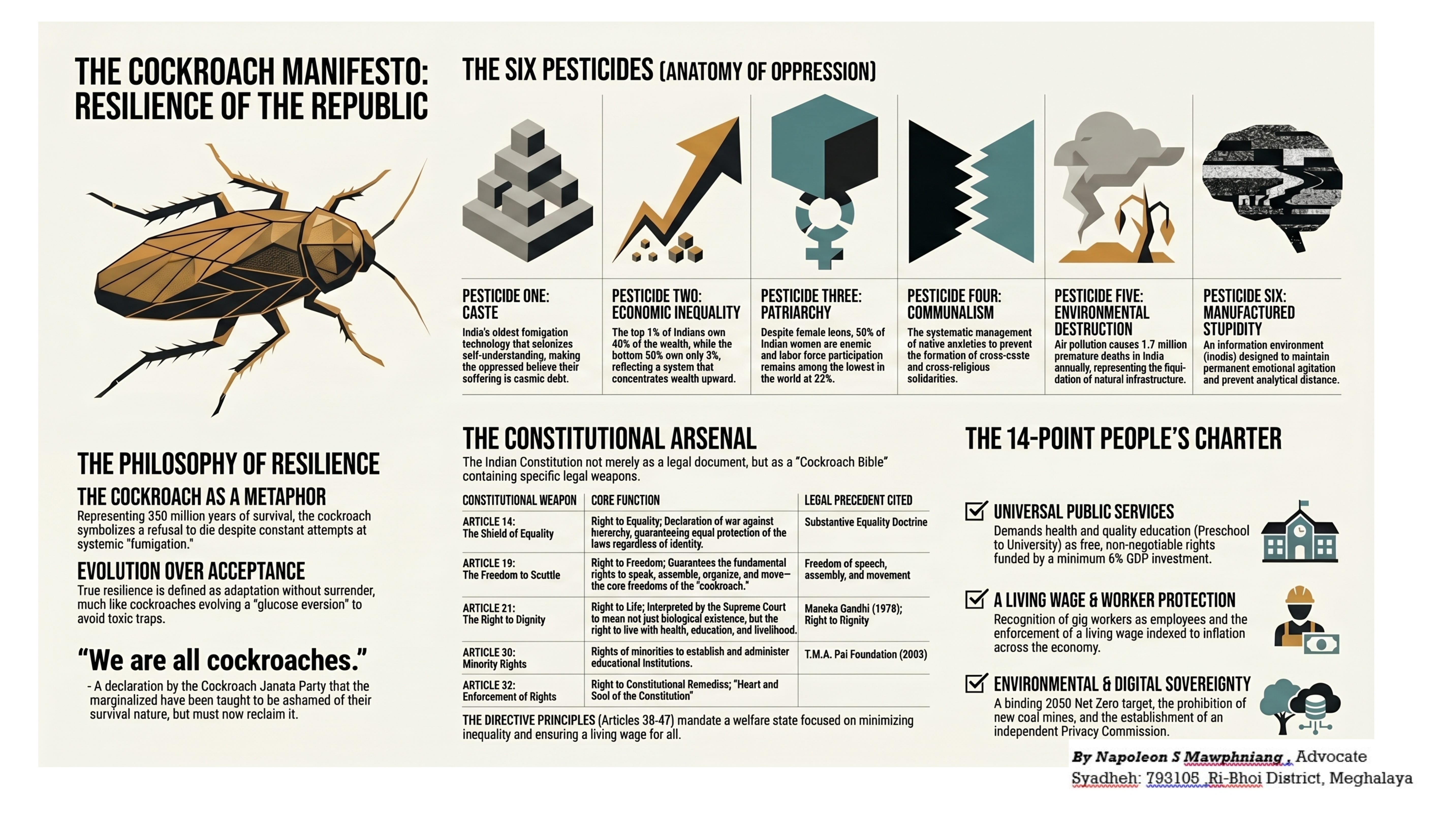
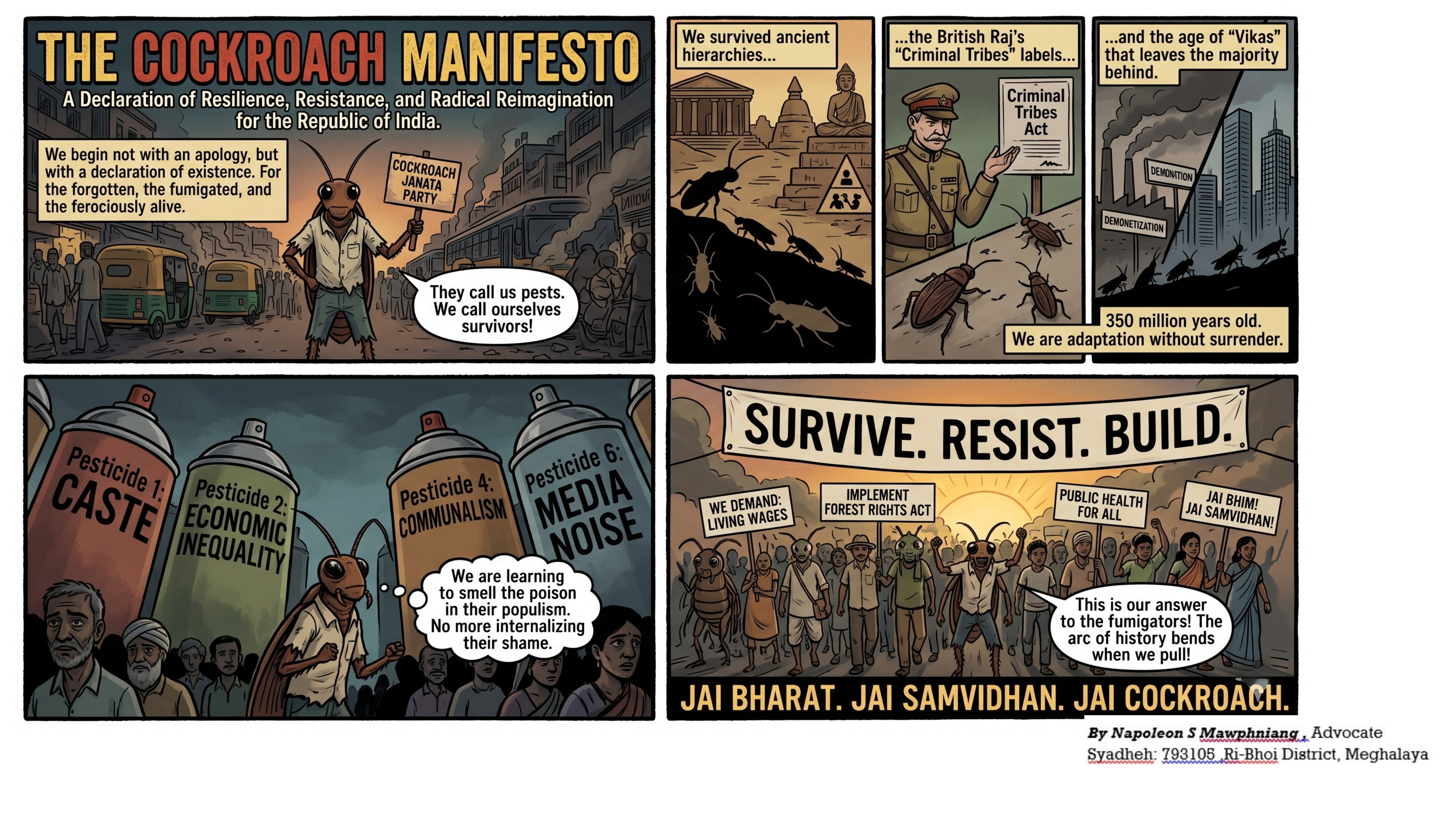
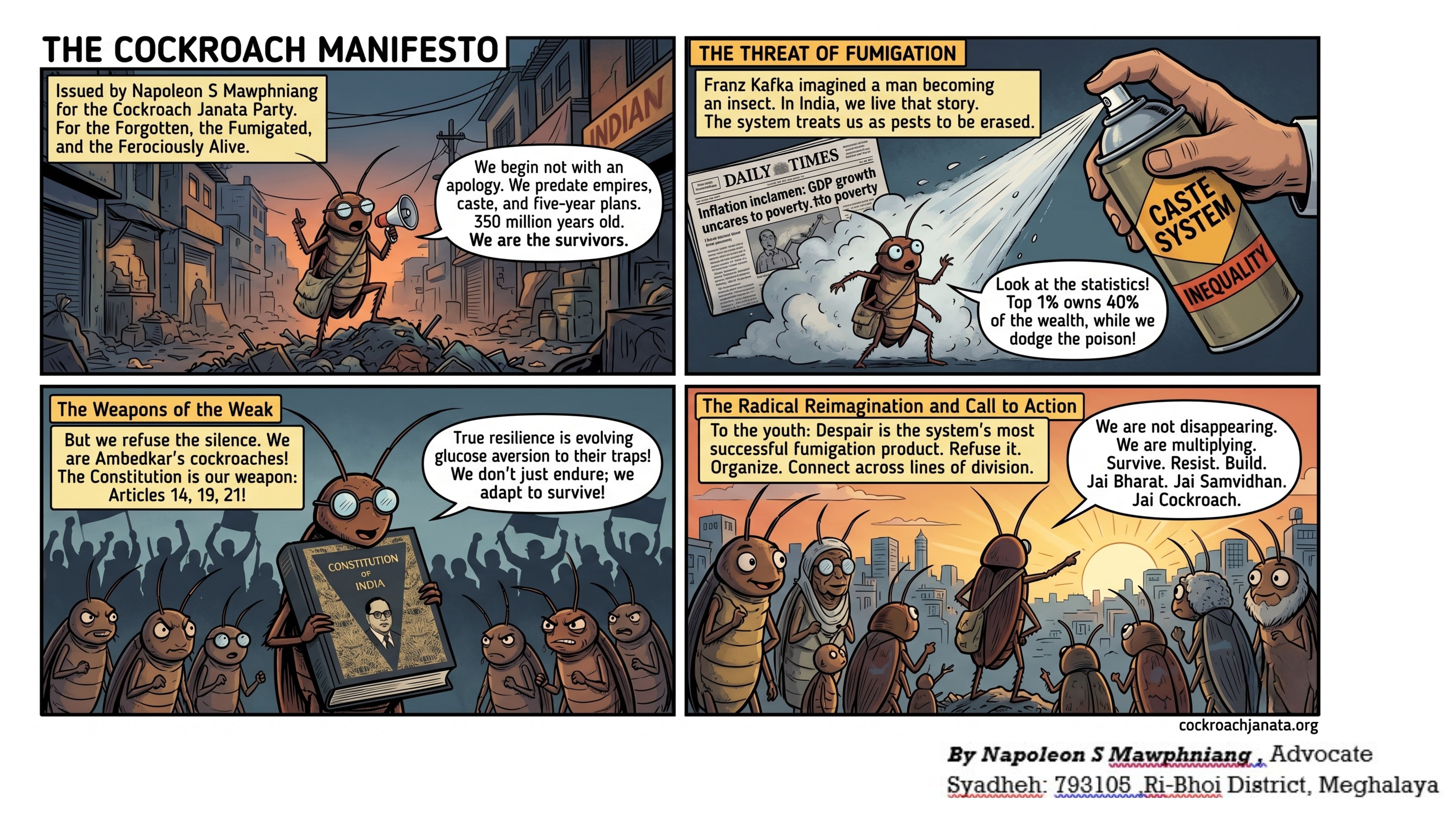
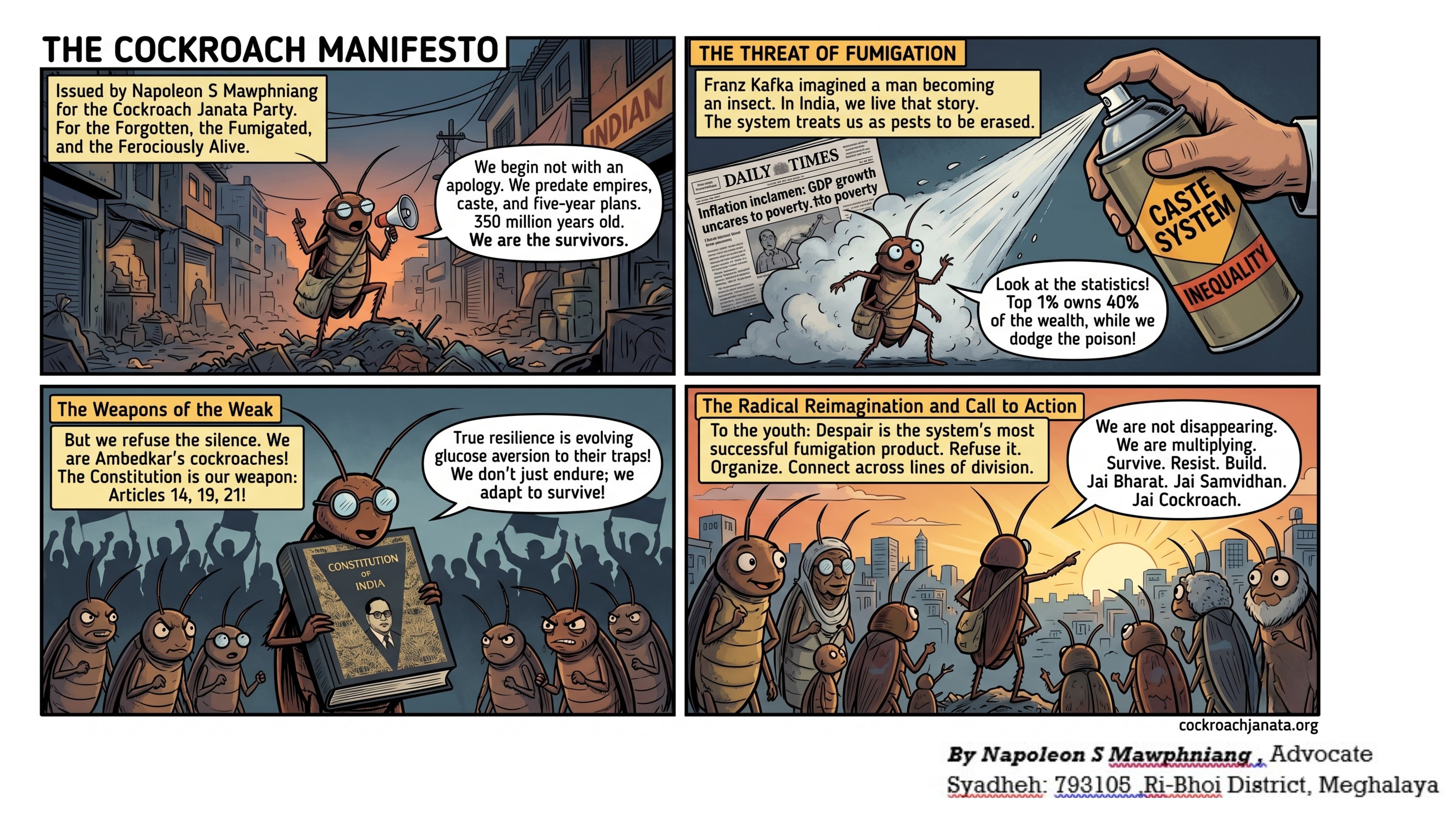
THE COCKROACH MANIFESTO
A Declaration of Resilience, Resistance, and Radical Reimagination for the Republic of India

Issued by Napoleon S Mawphniang
For the Forgotten, the Fumigated, and the Ferociously Alive
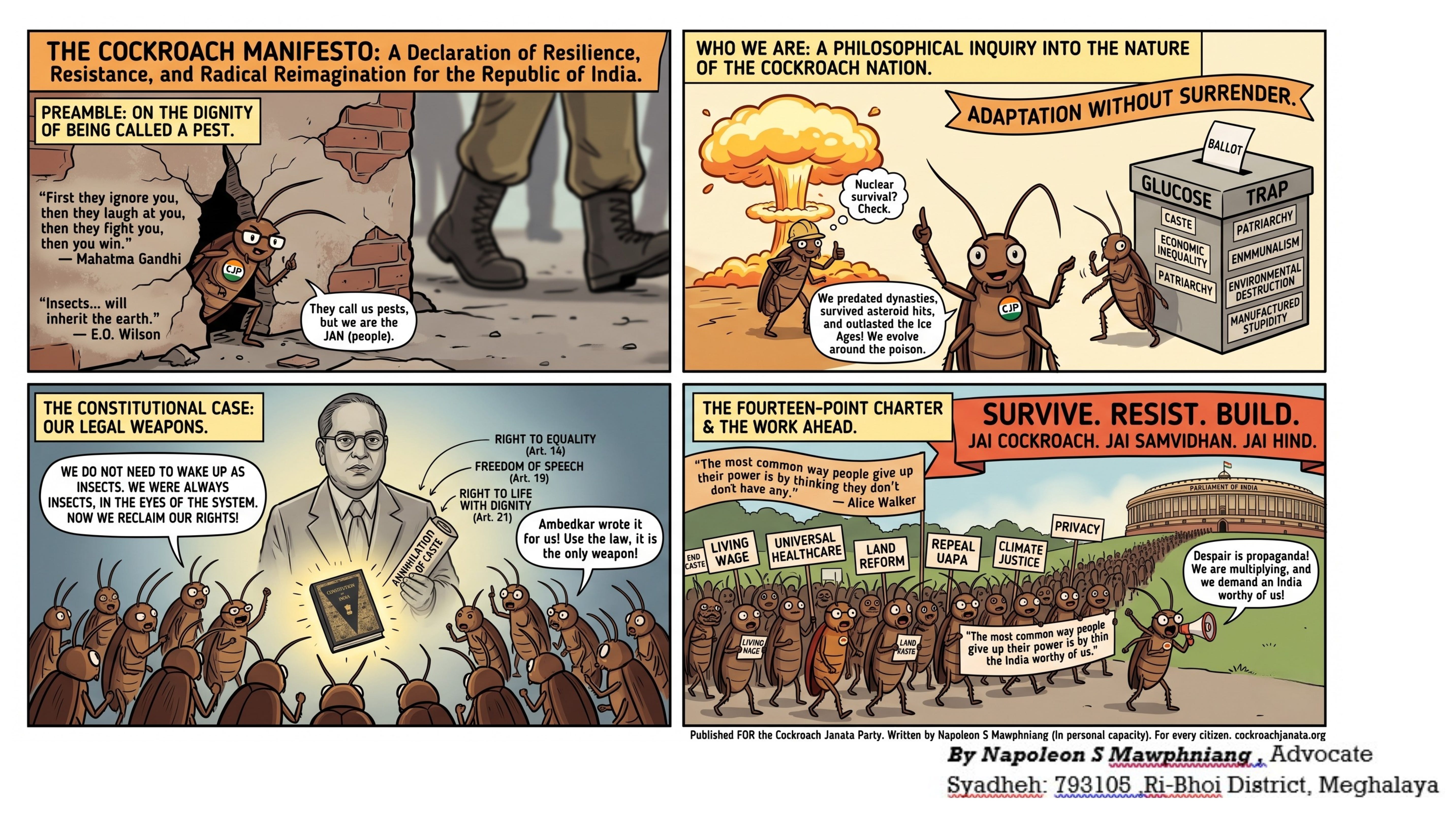
“The most common way people give up their power is by thinking they don’t have any.” — Alice Walker
“First they ignore you, then they laugh at you, then they fight you, then you win.” — Attributed to Mahatma Gandhi
“Insects... will inherit the earth.” — E.O. Wilson, Naturalist
“We are all cockroaches. We have merely been taught to be ashamed of it.” — The Cockroach Janata Party, First Session, Delhi, Anno Domini Unknown
A Note of Honest Clarification
What you have read in these pages is not an official document of the Cockroach Janata Party. It carries no organizational seal, no committee approval, no institutional mandate. It is, in its most honest description, one citizen’s personal proposal — a writer’s earnest attempt to give structured voice to the struggles, contradictions, and constitutional aspirations of the people of India, as he has observed, experienced, and understood them.
The issues raised within — from democratic accountability to minority rights, from agrarian distress to digital freedom, from caste discrimination to climate justice — are not invented grievances. They are the living, breathing, daily realities of millions of Indian citizens. This manifesto is simply one person’s attempt to hold them together in a single document, to name them clearly, and to ask, respectfully but urgently, that they be taken seriously.
This is a personal proposal. Nothing more. Nothing less.
It does not represent the official position, policy, or platform of the Cockroach Janata Party. Any alignment between these pages and the Party’s own vision is coincidental — born not of coordination, but of a shared concern for the same republic and the same people.
Read it as one citizen speaking to another. Judge it on the merit of its ideas alone.
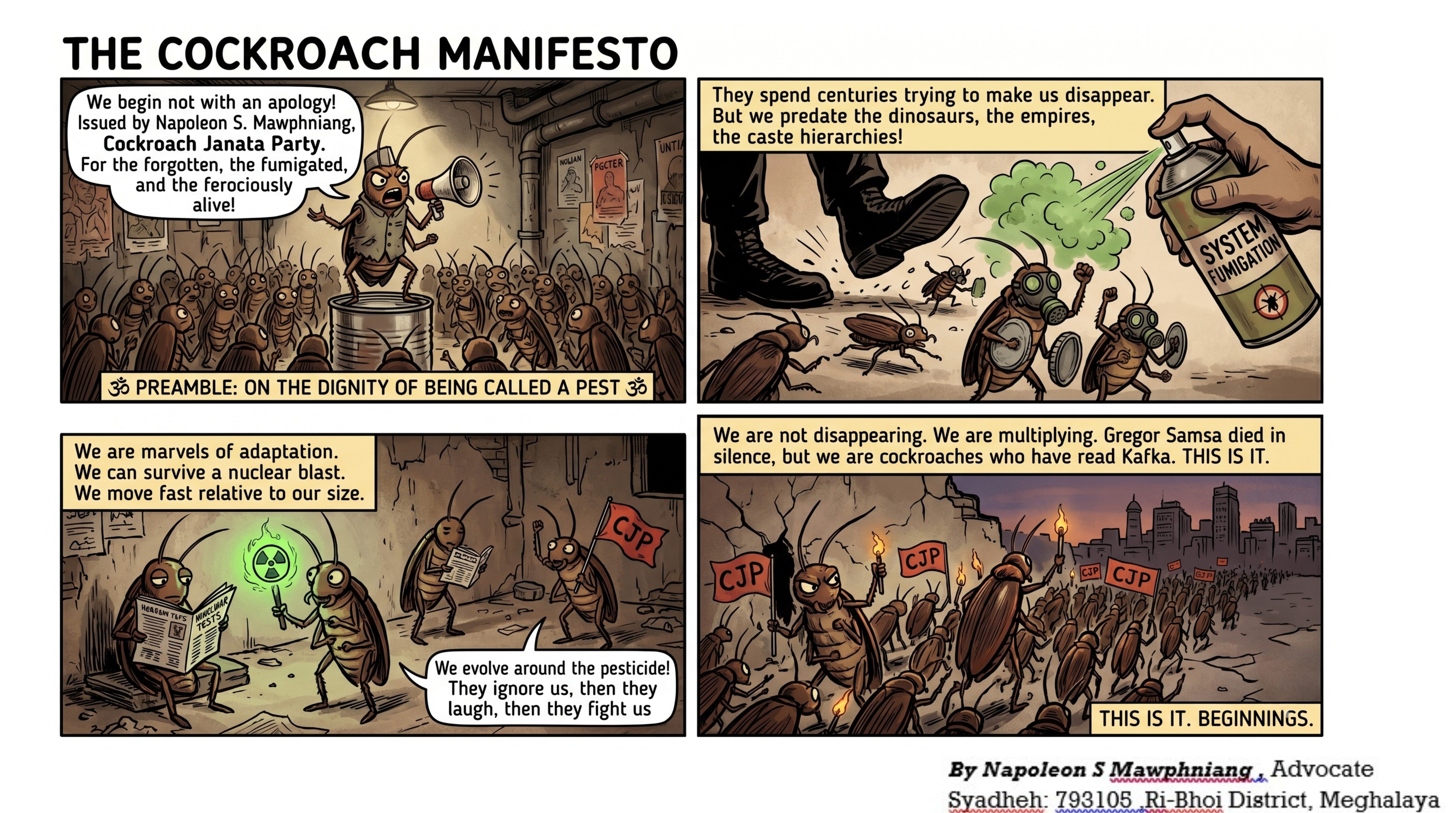
ॐ PREAMBLE: ON THE DIGNITY OF BEING CALLED A PEST ॐ
We begin not with an apology. We begin not with a petition. We begin not with folded hands and downcast eyes, which is what every party, every pamphlet, every politician in the history of this ancient and bewildering land has expected from us — the people, the jan, the praja, the raiyat, the aam aadmi, the kisan, the mazdoor, the first-generation college student who reads this manifesto under the dim yellow light of a 40-watt bulb in a two-room house in Bhagalpur, Bidar, Barmer, or anywhere else that does not appear in the glossy infographics of India’s GDP growth story.
We begin with a declaration. A declaration of existence. A declaration that we are here. That we have always been here. That no amount of fumigation — political, economic, social, cultural, or philosophical — has managed to rid this subcontinent of our presence. That we will continue to be here long after the marble corridors of power have crumbled, long after the television studios have gone dark, long after the last electoral bond has been converted into the last crore of unaccounted wealth.
We are the cockroaches.
And we are proud of it.
Now, before you set this manifesto aside with the contempt that our civilization has trained you to feel toward the word cockroach, we ask you — the youth of India, the intellectual of India, the angry young woman in Manipur, the disillusioned farmer’s son in Vidarbha, the Dalit lawyer in Chennai who memorizes constitutional provisions because she knows the law is the only weapon that cannot be confiscated at a police checkpoint — we ask you to pause. To breathe. To think about what a cockroach actually is.
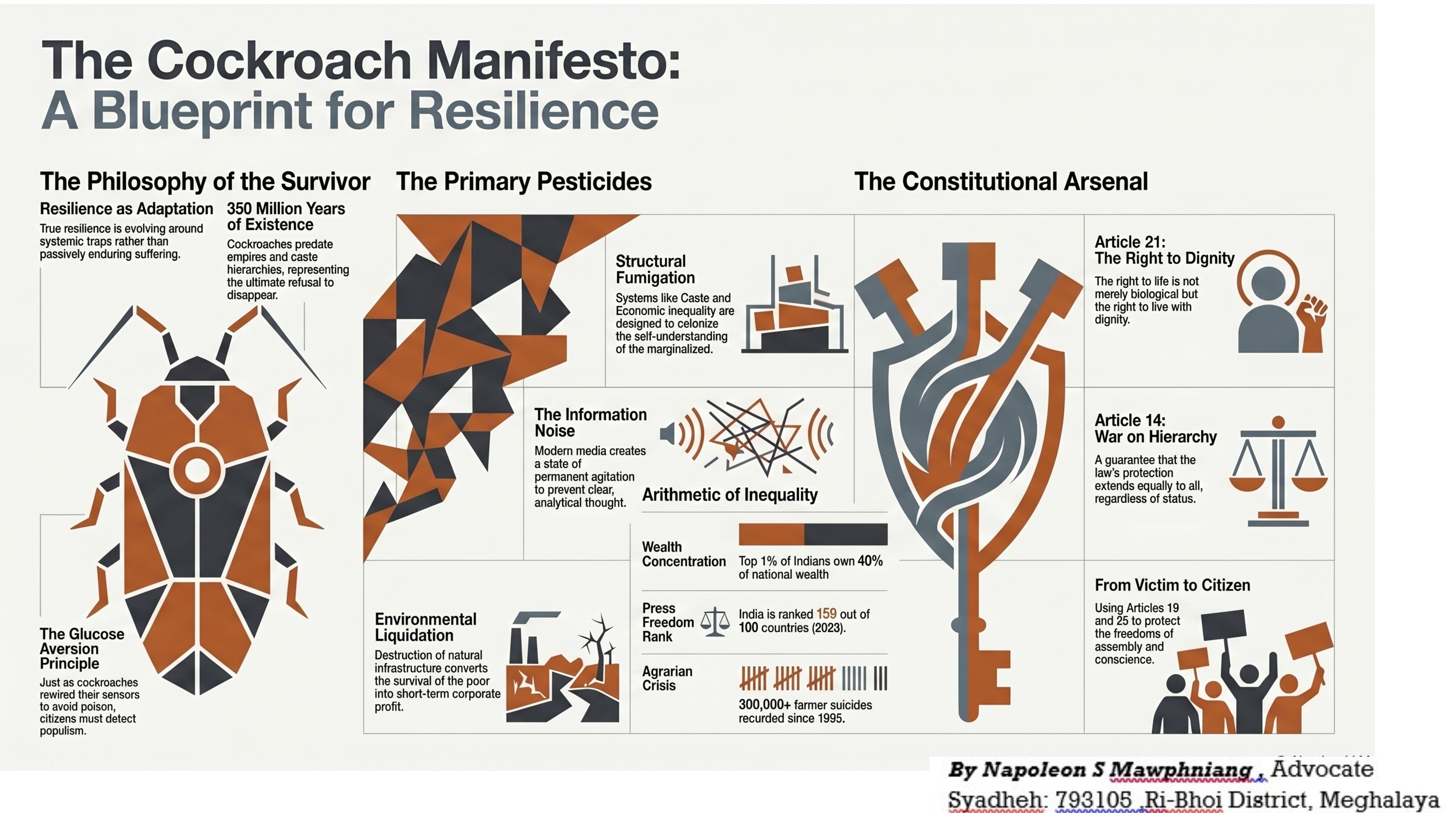
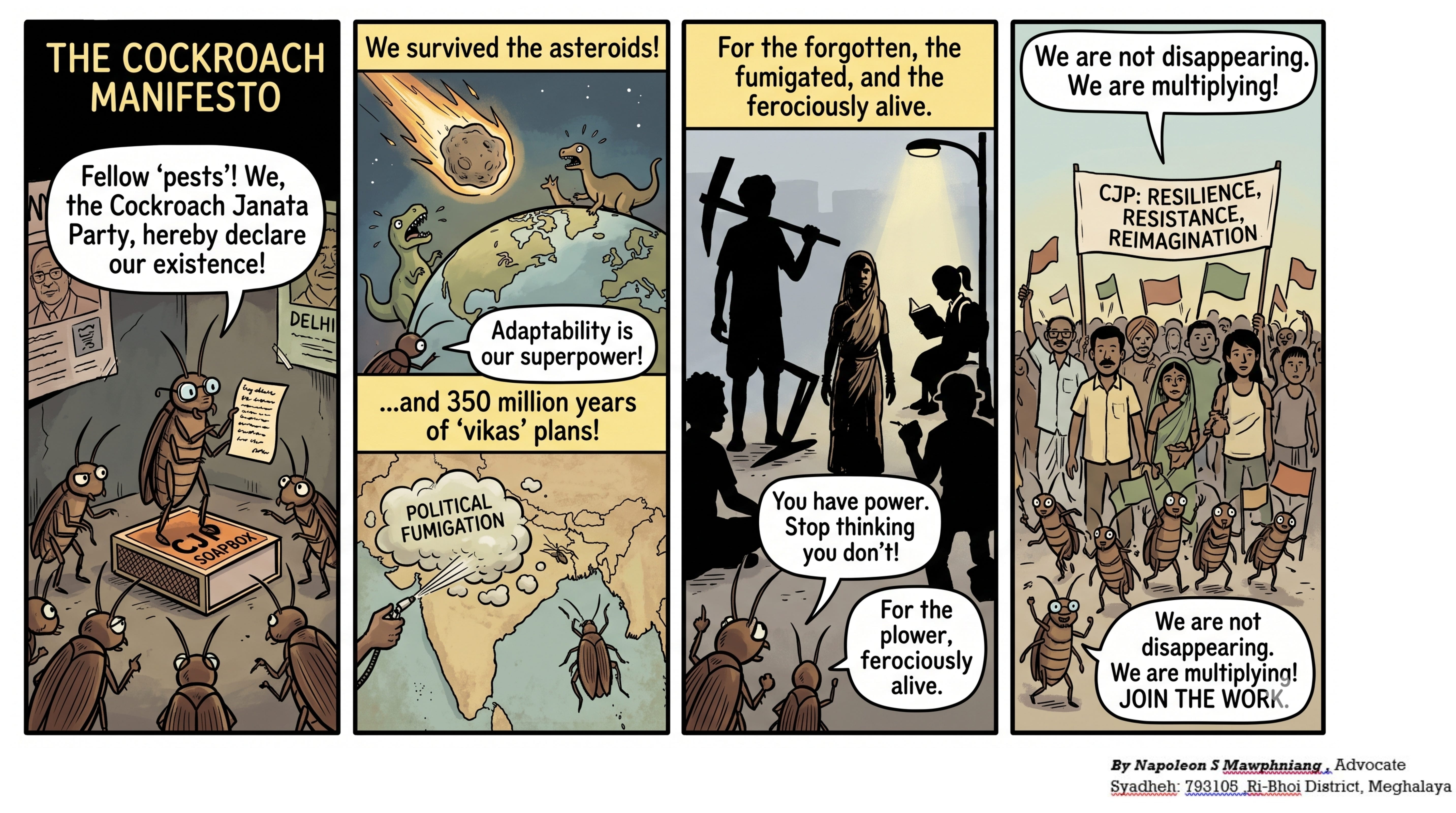
The cockroach (Periplaneta americana, Blattodea in the taxonomy of the powerful, but simply jhaingur, til-chaata, cockraach in the taxonomy of the living) is approximately 350 million years old. It predates the dinosaurs. It predates the Himalayas. It predates every empire, every caste hierarchy, every constitution, every five-year plan, every mission statement of every electoral party that has ever promised Achhe Din and delivered wahi din — the same old days with a different logo.
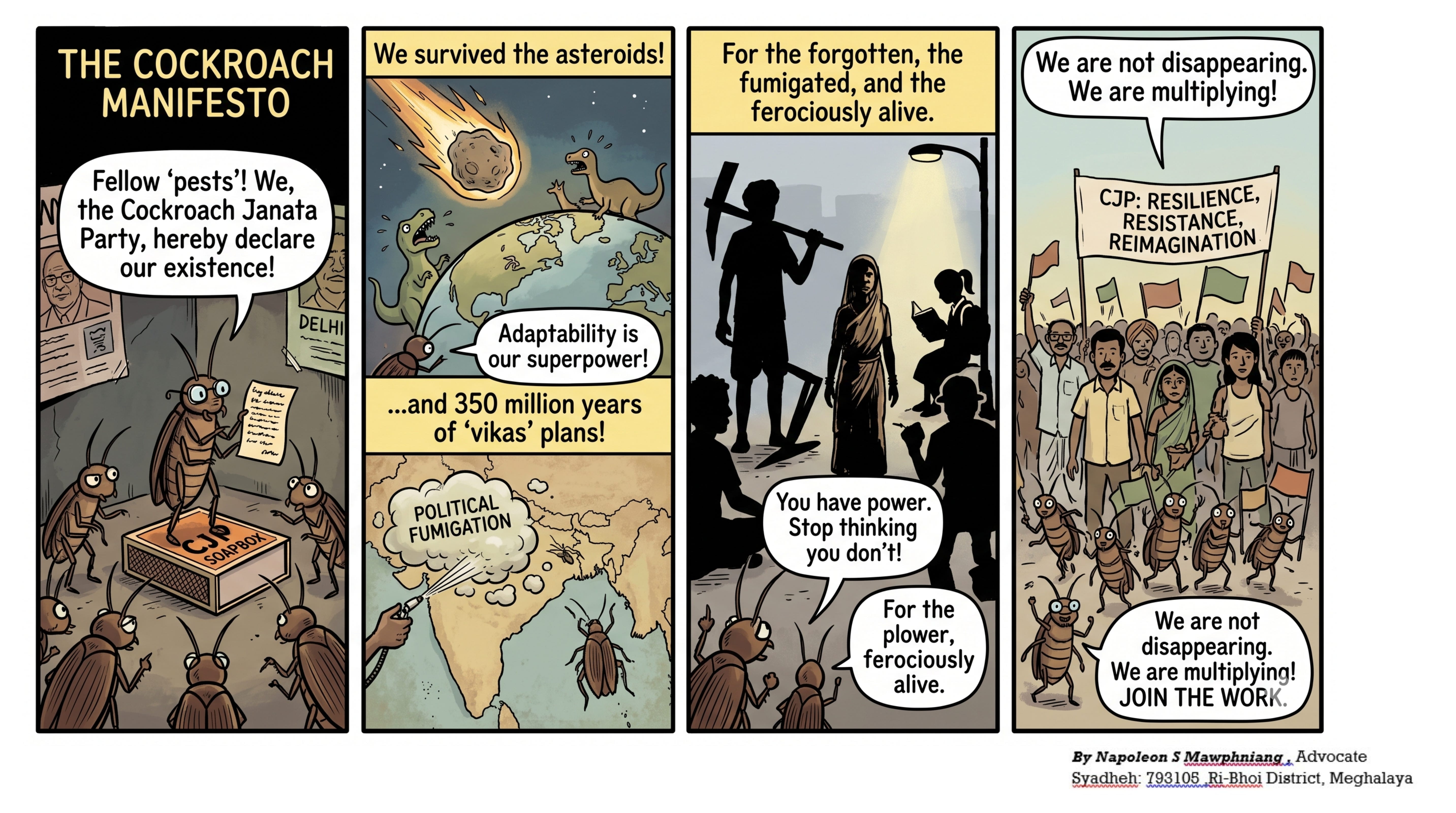
The cockroach survived the Permian extinction, which killed ninety-six percent of all marine species and seventy percent of all land species. It survived the asteroid that wiped out the dinosaurs. It survived the Ice Ages, the Flood Ages, the Fire Ages, and — most impressively — it has survived the Age of Indian Democracy, which has managed to combine the toxicity of all previous catastrophes into one convenient political package.
The cockroach, by every scientific measure, is a marvel of adaptation. It can survive a nuclear blast. It can live without its head for a week. It can hold its breath for forty minutes. It can survive on almost nothing — a crumb, a smear of grease, the shadow of a forgotten meal. It moves at three miles per hour, which does not sound impressive until you realize that relative to its body size, this makes it one of the fastest creatures on earth, faster, proportionally, than a cheetah.
We are the cockroaches.
We have survived everything you threw at us.
We will survive everything you are planning to throw at us next.
This manifesto is our answer to the fumigators. This manifesto is our answer to the pesticide-sellers who dress in khadi and speak of vikas. This manifesto is our answer to every system, every structure, every ideology, every institution that has spent the last several thousand years — and with particular enthusiasm in the last few decades — trying to make us disappear.
We are not disappearing.
We are, in fact, multiplying.
PROLOGUE: THE METAMORPHOSIS THAT NEVER HAPPENED
Franz Kafka, that great Czech-Jewish prophet of bureaucratic horror, imagined in 1915 a man named Gregor Samsa who woke up one morning to find that he had been transformed into a giant insect. The entire novella, Die Verwandlung — The Metamorphosis — is about how the world treats Gregor once he is no longer economically useful, no longer presentable, no longer the kind of creature that can hold a job, pay rent, and perform the social rituals of personhood.
The family is horrified. The system has no place for him. He is eventually killed — by an apple, of all things, lodged in his back by his own father — and the family, relieved, takes a day trip to the country, speaking of new possibilities, a new flat, a new life. The tragedy of Gregor Samsa is not that he became an insect. The tragedy is that he was always treated like one. The metamorphosis only made visible what was always true.
We in India do not need Kafka’s imaginative leap.
We live Kafka’s story without the literary device of transformation.
We — the adivasi woman whose forest was given to a mining corporation under the Forest Rights Act’s elaborate system of exceptions; the Muslim daily-wage laborer who cannot rent an apartment in certain localities without a character certificate from a local MLA; the transgender person who navigates every government office like a hostage negotiation; the Dalit student who arrives at university having cracked every examination only to discover that the real examination is surviving the cultural violence of an institution built by and for people who have never had to think about caste — we do not need to wake up one morning as insects.
We were always insects, in the eyes of the system.
The Cockroach Janata Party does not offer transformation. We offer recognition. We offer the radical, revolutionary, world-historical act of recognizing what we already are, and refusing to be ashamed of it.
Kafka’s Gregor Samsa died in silence, curled on the floor of his room, having stopped eating, having internalized his family’s shame until it became his own. We refuse that ending. We are not Gregor Samsa. We are cockroaches who have read Kafka and understood the lesson differently.
The lesson is not: accept your insect nature and die quietly.
The lesson is: if they are going to treat you like a cockroach regardless, you might as well have the cockroach’s immortality, the cockroach’s adaptability, the cockroach’s extraordinary, stubborn, almost offensive refusal to die.
This is the Cockroach Manifesto.
This is the beginning.
PART ONE: WHO WE ARE — A PHILOSOPHICAL INQUIRY INTO THE NATURE OF THE COCKROACH NATION
Chapter 1.1 — The Genealogy of Survival
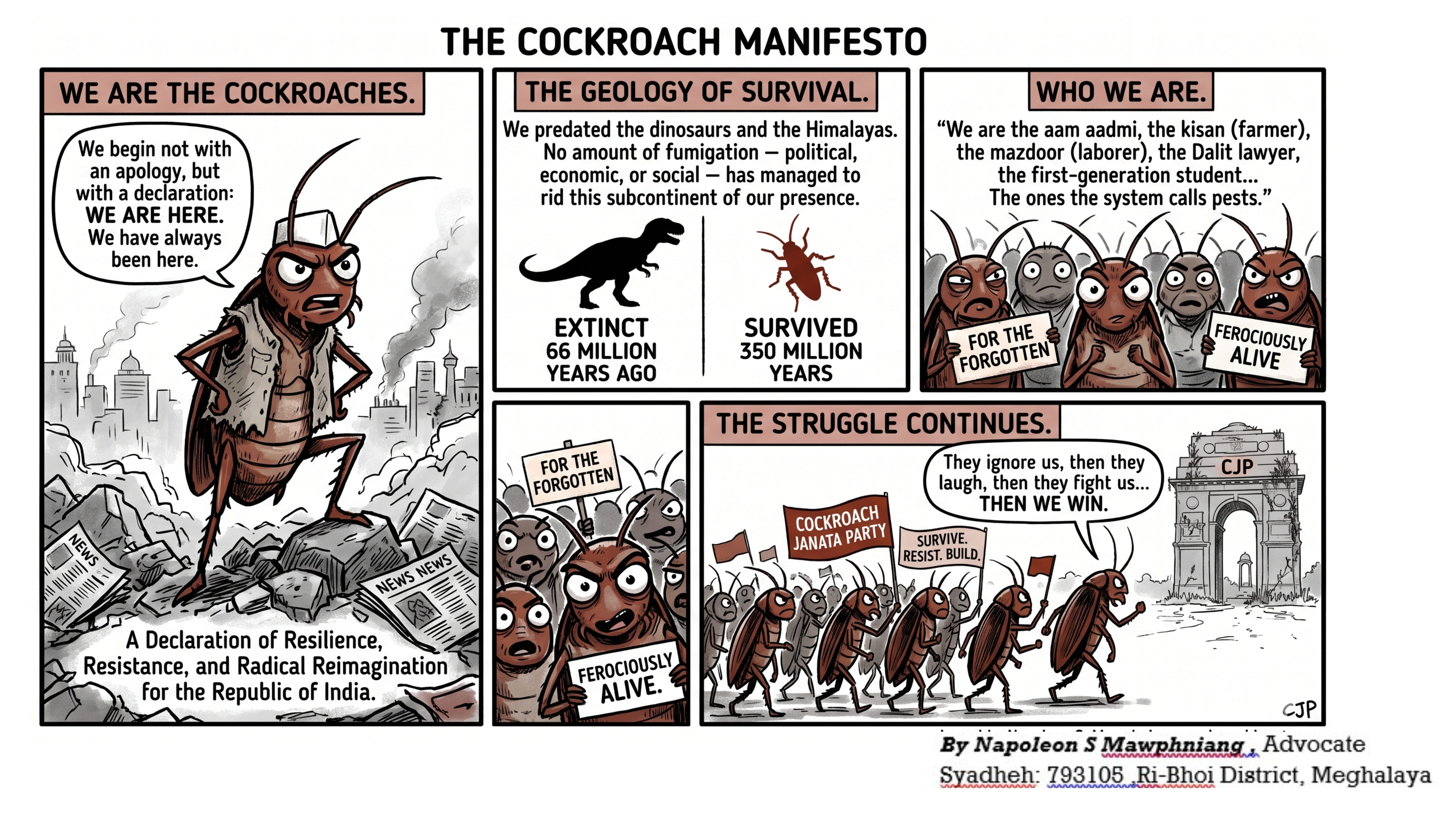
We are not a new phenomenon. We have been here, as we noted, for 350 million years. But in the specific political geography of what is now called India — Bharatvarsha, Hindustan, Jambudvipa, the subcontinent, South Asia, this endlessly renamed and eternally contested piece of land between the Himalayas and the Indian Ocean — our particular form of cockroach existence has a genealogy that is worth tracing.
We are the people who built the Indus Valley civilization and left no written records of kings, because perhaps there were no kings. The archaeological record of Harappa and Mohenjo-daro shows advanced urban planning, sophisticated drainage systems, standardized weights and measures, but no palace complexes, no monumental temples glorifying a singular ruler, no mass graves indicating conquest and slavery. Whatever Harappa was, it appears to have been something closer to a collective project — a city built by and for its inhabitants rather than as a monument to power.
We are the people who carried the plough, who irrigated the fields, who built the tanks and the canals and the step-wells that made the civilization of this land possible. We are the Shudras and the Atishudras who were told that our sweat and blood were ingredients of the social order, but that the fruits of that order were not for us. We are the people Dr. B.R. Ambedkar wrote about when he wrote, in Annihilation of Caste — that extraordinary document of intellectual courage published in 1936, the speech he was invited to give and then disinvited from giving because the Jat-Pat-Todak Mandal realized what he was actually going to say — “Turn in any direction you like, caste is the monster that crosses your path.”
We are the women who have kept this civilization alive through every catastrophe — through invasions, through famines, through the extraordinary bureaucratic violence of colonial revenue settlements, through Partition, through post-Independence development that developed everything except the conditions of women’s lives — and who have been rewarded for this extraordinary service with the Manusmriti’s assessment of their worth and the state’s continued failure to translate constitutional equality into lived reality.
We are the adivasis — the Gonds, the Santhals, the Mundas, the Bodos, the Nagas, the Mizos, the Oraons, the Bhils, the Meenas, the Todas, the hundreds of communities whom the Indian state has classified as Scheduled Tribes and whose relationship with that same state has been, since 1947, a relationship of dispossession with paperwork.
We are the urban poor — the forty percent of Mumbai who live in the seven percent of Mumbai that is classified as slum; the cycle-rickshaw pullers of Varanasi who have been banned from the roads of their own city to ease the commute of people who own cars; the ragpickers of Delhi who process the city’s waste and receive in return neither wages nor dignity nor protection from the pesticides used to manage the very waste they sort with their bare hands.
We are the farmers — the six hundred and forty million people directly or indirectly dependent on agriculture in a country where agriculture contributes less than fifteen percent of GDP, which means that we have achieved the remarkable feat of having the majority of our people engaged in the least-rewarded activity of our economy. We are the farmers who have died by suicide in numbers that exceed the combined casualties of every armed conflict this country has fought since Independence — three hundred thousand farmer suicides since 1995, according to the National Crime Records Bureau data, a number so large and so persistent that we have managed to make it boring, which is perhaps the most impressive political achievement of the last thirty years.
We are the first-generation learners — the children of chaprasis and aayas and construction workers and domestic workers who have cracked the IIT entrance exam by studying sixteen hours a day and borrowing money for coaching classes and are now in those institutions discovering that there is a cultural language of privilege that the examination system did not test for and that the institution does not teach.
We are the LGBTQ+ community that waited until 2018 for the Supreme Court to read Section 377 of the Indian Penal Code as what it always was — a colonial instrument of violence — and who continue to wait for the marriage equality that the same court declined to grant in 2023, telling us that it is a matter for Parliament, which is a way of saying: wait. We are very good at waiting. We have been waiting for 3500 years. What is another decade or two?
We are all of this. We are this vast, impossible, beautiful, broken, luminous multiplicity. And the one thing we have in common — across caste, across class, across religion, across region, across gender, across sexuality, across every line that has been drawn through us and between us to keep us manageable — is that we have survived.
We have always survived.
We are the cockroaches.
Chapter 1.2 — The Philosophy of Resilience
Resilience is a word that has been weaponized against us.
“Indians are resilient,” they say, usually after a disaster — a flood, a drought, a communal riot, a demonetization — that the government either caused or failed to prevent. “Indians are resilient” is what you say when you want to admire the suffering of the poor without doing anything about its causes. It is the compliment that contains the insult, the garland that is also a noose.
We are reclaiming resilience.
Resilience, in its true philosophical sense, is not the passive endurance of suffering. Resilience is not the smile on the face of the flood victim who has lost everything and is now standing in a relief camp, holding a packet of biscuits, being photographed by a politician who will use the image in his next election campaign. That is not resilience. That is propaganda. That is the spectacle of suffering converted into the currency of sympathy without the commitment of structural change.
True resilience — cockroach resilience — is something else entirely. It is the resilience of adaptation without surrender. The cockroach does not merely endure the pesticide. The cockroach evolves around the pesticide. Studies have shown — and we cite this not without a certain grim satisfaction — that cockroach populations exposed to glucose-based insect traps began, within a single generation, to evolve a glucose aversion. They literally rewired their taste sensors to find the bait repulsive. They refused, at the neurological level, to be fooled by the same trick twice.
We are learning to evolve a glucose aversion to the traps of Indian electoral democracy.
We are learning to smell the poison in the populism.
We are learning to recognize the trap in the freebies — the five kilograms of rice that is given with one hand while the Public Distribution System is hollowed out by the other; the ten thousand rupees in the Jan Dhan account that appears before the election and disappears in the inflation that follows; the temple that is built in the place where a hospital should have been.
Resilience, for us, is the practice of critical consciousness. It is what Paulo Freire — the great Brazilian educator whose Pedagogy of the Oppressed is one of the foundational texts of the world’s liberation movements — called conscientização: the process of developing a critical awareness of one’s social reality through reflection and action. Freire understood, writing from the favelas and the sertão of Brazil, that the oppressed internalize the ideology of the oppressor, that the first revolution must happen in the mind before it can happen in the streets.
We are calling for that internal revolution.
We are calling for the young person in Gorakhpur or Guwahati or Gulbarga who has been told all her life that her condition is the result of karma, of destiny, of God’s plan, of her own inadequacy — we are calling for her to look at that explanation and apply to it the simple, devastating question that Ambedkar applied to every sacred text, every hallowed tradition, every received wisdom: Is this true? And if it is true, is it just?
Resilience is not acceptance. Resilience is the refusal to accept that suffering is natural. Resilience is the insistence that systems can be changed because systems were created by human beings, and whatever human beings have created, human beings can recreate.
Chapter 1.3 — The Anatomy of Oppression: Understanding What Fumigates Us
Before we can build a better world, we must understand what is destroying the current one. This is not a comfortable exercise. It requires us to look at structures that have been presented to us as permanent, as God-given, as natural, and to see them instead as what they are: constructions. Architectures of exclusion. Systems of fumigation.
We identify six primary pesticides currently being deployed against the cockroach population of India:
Pesticide One: Caste
Caste is India’s oldest and most sophisticated fumigation technology. It is unique in that it has managed to make the fumigated internalize the fumigation as spiritual necessity. The genius of the caste system — and we use the word genius in the most horrified sense possible — is that it does not merely oppress people from the outside. It colonizes their self-understanding. It makes Brahmins believe that their privilege is cosmic justice and makes Dalits believe that their suffering is cosmic debt. It takes what is fundamentally a system of resource allocation — of who gets land, who gets education, who gets water, who gets the right to wear sandals and ride a horse at their own wedding — and wraps it in the language of dharma, of spiritual order, of the eternal arrangement of things.
The Indian Constitution abolished untouchability in 1950 under Article 17. In the seventy-five years since that abolition, the practice of untouchability has continued in Indian villages, in Indian schools, in Indian workplaces, in Indian kitchens, in Indian cemeteries where Dalit and non-Dalit bodies are still buried in separate sections, in Indian wells where the rope for drawing water is different depending on whose hand holds it.
We do not need to add much to what Ambedkar has already said. We need only to note that his project remains unfinished and that every political party that claims his legacy while maintaining the social arrangements he opposed is engaging in an act of historical desecration.
Pesticide Two: Economic Inequality
India is, by the measures that matter, one of the most unequal societies on earth. The Oxfam India report for 2023 noted that the top one percent of Indians own forty percent of the country’s wealth, while the bottom fifty percent own three percent. Gautam Adani’s net worth, at its peak, exceeded the GDP of several Indian states. The gap between the salary of a CEO of a major Indian corporation and the salary of a factory worker in the same corporation is, in some documented cases, over five hundred times.
This is not capitalism functioning badly. This is capitalism functioning exactly as designed — concentrating wealth upward through a system that socialize losses and privatizes gains, that gives public land to private companies, that builds expressways to airports used by private jets while the roads to villages remain unpaved.
Pesticide Three: Patriarchy
India is simultaneously the land of the Goddess and the land of female foeticide. We have Durga and we have dowry deaths. We have the figure of Sita — patient, pure, endlessly forgiving — held up as the ideal of womanhood, and we have the reality of women who dare to diverge from that ideal being subjected to acid attacks, honor killings, workplace discrimination, and a legal system that has made it technically illegal to rape your wife only in the past very recent history and even that remains contested in various court and legislative chambers.
The National Family Health Survey tells us that fifty percent of Indian women are anemic. That one in three women has experienced domestic violence. That female labor force participation in India is among the lowest in the world — twenty-two percent, lower than Pakistan — a paradox in a country that has had a female Prime Minister, female scientists at ISRO, female judges at the Supreme Court, and a female President, all of whom are regularly cited as evidence that the problem of gender inequality has been solved.
Pesticide Four: Communalism
The weaponization of religion is not a new phenomenon in India. But its current intensity, sophistication, and institutional depth represent something qualitatively different from the periodic violence that has scarred our history since before Partition.
We are witnessing the systematic construction of a political identity based on the exclusion of the other — the Muslim, the Christian, the “anti-national,” the “urban Naxal,” the “tukde tukde gang,” the endless roster of enemies that must be manufactured to keep the majority in a state of perpetual anxiety and solidarity. Frantz Fanon, writing about colonialism in The Wretched of the Earth, described how the colonial power maintains itself through the management of native anxieties, through the construction of a threatening other that makes the colonized turn against themselves rather than against the colonizer.
We are watching a domestic iteration of this process — the management of majoritarian anxiety to prevent the formation of solidarities that cross the lines of caste and religion and thus threaten the arrangements of power.
Pesticide Five: Environmental Destruction
The air in Delhi is, for several months of the year, more toxic than the air in a coal mine. The Yamuna River — the sacred Yamuna, the Kalindi, the river that appears in the Mahabharata and in the poetry of Mirabai — is, through much of its Delhi stretch, a channel of industrial effluent, sewage, and foam. The Western Ghats are being quarried. The mangroves of Mumbai are being reclaimed. The forests of Chhattisgarh and Jharkhand are being opened to mining.
This is not development. This is the liquidation of the natural infrastructure on which the lives of the poorest people depend — the forests that provide firewood and food for the adivasi, the rivers that provide water for the farmer, the air that provides breath for all of us — converted into short-term profit for those who will, when it becomes unlivable, simply move to more survivable geographies.
Pesticide Six: The Manufactured Stupidity of the Information Environment
We live in an information environment specifically designed to make it as difficult as possible to think clearly. The prime time television debate — that extraordinary form, unique to Indian democracy, in which eight people shout simultaneously for forty-five minutes about a topic that requires patience and nuance — is not a failure of journalism. It is journalism succeeding at its actual purpose, which is not information but intoxication: the maintenance of a state of permanent emotional agitation that prevents the formation of the analytical distance necessary to understand what is actually happening.
WhatsApp forward. Fake news. The algorithm that amplifies outrage because outrage drives engagement. The government spokesperson who calls a fact-checking organization an “anti-national” because it checked a fact. The reporter who asks the powerful question and discovers that asking the powerful question is a career-limiting move.
We are fumigated by noise.
Our task is to make signal.
PART TWO: THE GREAT PESTICIDE CONSPIRACY — A HISTORY OF HOW THEY TRIED TO KILL US
Chapter 2.1 — A Brief History of Fumigation in India
Let us conduct a brisk, necessarily selective, and entirely unapologetic tour through the history of fumigation in India — the history of how successive systems of power have attempted to manage, contain, and periodically eliminate the cockroach population.
We begin not with colonialism, because colonialism is too easy, too obvious, too convenient as a single explanation for everything that followed. We begin instead with the recognition that the structures of oppression that colonialism found when it arrived in India were not invented by colonialism. The caste hierarchy, the exclusion of women from public life, the extraction of surplus from the cultivating classes — these were pre-existing conditions. Colonialism did not create Indian oppression. Colonialism supercharged it, systematized it, gave it railways and telegraphs and a centralized bureaucracy, and then, when it left, bequeathed these systems to a set of elites who had been trained in their administration and who found them, on the whole, quite useful.
The British introduced, or intensified, several pesticides that continue to operate to this day:
The Permanent Settlement of 1793 created, in Bengal and Bihar, a landlord class — the zamindars — by converting what had been a system of revenue collection into a system of private property in land. This created the peasant-as-tenant structure that would, through the next century and a half, produce the conditions for the Bengal Famine of 1943, the Tebhaga Movement, the Naxalbari uprising, and the continuing agrarian crisis of eastern India.
The Indian Penal Code of 1860 — drafted by Thomas Babington Macaulay, a man who famously stated that a single shelf of a good European library was worth the whole native literature of India and Arabia — introduced, among other gifts, Section 377, which criminalized homosexuality; Section 124A, which criminalized sedition; and Section 144, which gave magistrates the power to prohibit assemblies of more than five persons, a power that has been used with spectacular creativity against virtually every form of public protest since Independence.
The Criminal Tribes Act of 1871 classified entire communities — Sansis, Bhamptas, Wangis, hundreds of communities — as “criminal by birth.” A cockroach, you see, is a pest by nature; it does not need to commit a pest-act to be classified as a pest. Its very existence is sufficient. The Criminal Tribes Act was repealed in 1952, but the “denotified tribes” it created were simply reclassified as “habitual offenders” under state legislation, which is a lovely example of how the system maintains its essential character while updating its vocabulary.
The colonial legacy we have inherited is not a failure of colonialism. It is colonialism’s success — the successful creation of a set of extractive institutions that continued to extract after the extractors changed their skin color.
Chapter 2.2 — The Post-Independence Fumigation: The State Discovers its Natural Form
Independence, in 1947, did not end fumigation. It democratized it. The fumigators, previously British, became Indian. This was a significant and meaningful change. It was also, for many of us, insufficient.
The first two decades of Independence produced the Nehruvian consensus — the mixed economy, the Planning Commission, the public sector, the IITs and the IIMs, the Green Revolution, the Non-Aligned Movement, Panchsheel, the entire intellectual architecture of a particular vision of modernity that was genuinely forward-looking in certain respects and genuinely blind in others.
The Nehruvian vision was blind to caste — so comprehensively blind that Nehru himself wrote, in a letter to chief ministers, that reservation was harmful because it promoted mediocrity, a position that revealed a complete failure to understand that the “merit” that reservation supposedly compromised was itself produced by the accumulated advantages of caste. The Nehruvian vision was blind to gender in practical terms even if it was correct in constitutional terms. The Nehruvian vision was blind to the ecological consequences of the industrial model of development it was enthusiastically importing from both the capitalist West and the socialist East.
The Emergency of 1975-77 was the moment when the constitutional cockroach-trap was revealed in its nakedness — when the Prime Minister suspended civil liberties, imprisoned political opponents, censored the press, sterilized the poor (for a “population problem” that was and remains primarily a problem of poverty and the status of women), and demolished the Jama Masjid neighborhood to beautify the capital — and when the people of India, in the election of 1977, responded with a force that temporarily reconfigured the political landscape.
The lesson of the Emergency that was learned by the powerful was: do not suspend the Constitution openly. The lesson that was learned by the cockroaches was: our survival depends on our vigilance. The Constitution is only as strong as the people who demand it.
The liberalization of 1991 opened the Indian economy to global capital and produced the most sustained period of economic growth in Indian history. It also produced the most sustained period of agrarian crisis, of labor precarity, of environmental destruction, of the displacement of the poor by projects that were classified as “public purpose” but whose primary beneficiaries were private. The 1990s gave us the Narmada dam controversy, which gave us Medha Patkar, which gave us Arundhati Roy writing The Greater Common Good (1999), which gave us perhaps the most devastating critique of Indian development ideology written in the English language: “To build a dam you have to displace people. To build a good dam you have to displace more people. To build the best dam you need to displace an entire civilization.”
We have been building excellent dams.
Chapter 2.3 — The Contemporary Fumigators: A Gallery
We will not name parties here, because parties change and the structures they inhabit remain. We will instead describe types of fumigator, which the discerning reader will have no difficulty in populating with the appropriate faces.
The Nostalgia Fumigator operates by manufacturing a golden past that never existed — a Hindu golden age, a Mughal golden age, a Nehruvian golden age — and promising its restoration in exchange for the surrender of your critical faculties and your vote. The Nostalgia Fumigator is particularly effective because nostalgia is a powerful narcotic, and because the golden age being promised is always vague enough to accommodate every fantasy while specific enough to exclude someone.
The Welfare Fumigator operates by creating dependency without dignity — the free LPG cylinder that comes without the gas subsidy; the free mobile phone that comes with a free surveillance infrastructure; the free ration that comes with the requirement to prove your existence to a biometric system that cannot recognize your fingerprints because they have been worn smooth by the work that has kept the system fed.
The Development Fumigator operates in the language of GDP, of highways, of bullet trains, of smart cities, of “ease of doing business” rankings — a language that measures the health of the economy by metrics that systematically exclude the experience of the majority of people living within that economy. GDP measures the total output of an economy. It does not measure who benefits from that output. It does not measure the value of unpaid care work, which is primarily done by women. It does not measure the destruction of natural capital — the aquifer depleted, the forest cleared, the river poisoned — that makes the output possible. It is a measurement tool designed by and for the powerful, and its use as the primary metric of success is itself a political act.
The Culture Fumigator operates in the domain of identity — constructing a cultural nationalism that divides the country along lines of religion, language, and region in order to prevent the formation of class solidarities that would threaten the economic arrangements of the powerful. The Culture Fumigator understands something that Marx underestimated: that people will choose their identity-based fumigation over their class-based liberation every time, if the identity fumigation is presented as protection against a threatening other.
Chapter 2.4 — The Media Complex: The Fumigation Distribution System
We cannot speak of fumigation without speaking of the instrument through which it is most efficiently delivered: the contemporary Indian media ecosystem.
In 1990, India had a handful of national newspapers, a state-controlled television network, and the All India Radio. Information moved slowly and was controlled by a small elite but was, paradoxically, subject to a certain kind of professional standard — the standard of the editor who had been trained in a tradition of journalism that took seriously, at least intermittently, the obligation of holding power to account.
Today, India has hundreds of television news channels, tens of thousands of digital news outlets, and a social media ecosystem of approximately 600 million internet users producing and consuming content at a speed that makes fact-checking functionally impossible. The quality of information in this ecosystem is, by any honest assessment, catastrophically bad — not because journalists are uniquely dishonest or incompetent, but because the incentive structure of the attention economy rewards outrage over accuracy, simplicity over complexity, and confirmation of existing beliefs over the discomfort of new evidence.
The result is a population that is simultaneously over-informed and under-informed: flooded with content, starved of context; exposed to opinions, shielded from facts; united in their outrage, divided in their understanding.
We note, with the grim precision of the coroner rather than the indignation of the partisan, that the ownership of major Indian media has become increasingly concentrated among a small number of corporate groups with significant interests in the outcome of government policy. This is not a conspiracy theory. This is a matter of public record. The conflicts of interest between media ownership and corporate/political patronage have been documented, in extraordinary detail, by organizations including the Reporters Without Borders Press Freedom Index (India: rank 159 out of 180 in 2023), the Committee to Protect Journalists, the Editors Guild of India, and the former editors and journalists of major Indian publications who have written, with varying degrees of precision and bravery, about what happened to their newsrooms.
We are not anti-media. We are pro-journalism. We recognize that real journalism — the journalism of Gauri Lankesh, who was murdered for it; the journalism of Siddharth Varadarajan; the journalism of P. Sainath and the People’s Archive of Rural India, which has spent years documenting the lives of the people who do not appear in the prime-time news — continues to exist and to matter.
We are simply noting that it is not the dominant form.
PART THREE: THE CONSTITUTIONAL CASE — OUR LEGAL WEAPONS
Chapter 3.1 — The Constitution as Cockroach Bible
The Constitution of India, adopted on the 26th of November 1949 and coming into force on the 26th of January 1950, is perhaps the most extraordinary document produced by the Indian political imagination. It is extraordinary not because it is perfect — it is not perfect; it contains compromises and contradictions that continue to generate legal disputes and political arguments — but because of what its framers, under the leadership of Dr. B.R. Ambedkar, attempted to do with it.
Ambedkar’s project was breathtaking in its ambition: to use the law to undo the social hierarchy that had existed for millennia. To take the aspirations of a civilization that had spent three thousand years organized around inequality and write, in a single document, the legal architecture of equality. To guarantee, in black letter law, the rights of those who had never had rights — the Dalits, the women, the minorities, the indigenous peoples.
It is fitting that the man who wrote this Constitution was himself a living example of its necessity. Ambedkar — born into the Mahar caste, forced to sit separately from his classmates, denied water from the school’s pot, subjected throughout his life to the casual and systematic cruelties of untouchability — went on to earn multiple doctorates from Columbia University and the London School of Economics, to become one of the foremost legal scholars of his generation, and to write the document that, at least on paper, abolished the system that had tried to destroy him.
We are Ambedkar’s cockroaches.
We are the people he wrote the Constitution for.
We are the people who must now defend it.
Chapter 3.2 — The Articles That Are Our Weapons
The Constitution of India is not merely a governing document. It is a manifesto. It is, in fact, a manifesto written in legalese, and it is our task to translate that legalese back into the language of living and to demand its full implementation.
Let us examine our weapons:
Article 14 — The Right to Equality:
“The State shall not deny to any person equality before the law or the equal protection of the laws within the territory of India.”
This single sentence is a declaration of war against two thousand years of hierarchy. Equality before the law — the same law applied to the same standard regardless of caste, class, religion, gender, or any other marker of identity. Equal protection — not merely the absence of discrimination but the affirmative guarantee that the law’s protection extends equally to all.
The Supreme Court of India has, through decades of constitutional interpretation, expanded the meaning of Article 14 to include the doctrine of reasonable classification (state actions must have a reasonable nexus to a legitimate aim), the doctrine of arbitrariness (any state action that is arbitrary is unconstitutional), and the concept of substantive equality (formal equality is not enough; structural disadvantage must be addressed).
These are powerful tools. We must use them.
Article 19 — The Right to Freedom:
Article 19(1) guarantees the following freedoms:
Freedom of speech and expression
Freedom to assemble peaceably and without arms
Freedom to form associations and unions
Freedom to move freely throughout India
Freedom to reside and settle in any part of India
Freedom to practise any profession or to carry on any occupation, trade or business
These are the cockroach’s freedoms. The freedom to speak. The freedom to gather. The freedom to organize. The freedom to move. These are the freedoms that are most consistently threatened by the pesticides of the state — the sedition law (Section 124A IPC, recently struck down by the Supreme Court, though the enthusiasm for its replacement under the Bharatiya Nyaya Sanhita remains concerning), the Unlawful Activities Prevention Act, Section 144 of the CrPC, the National Security Act, the various state security laws that have been used to jail journalists, activists, academics, and students.
We note that Article 19(2) allows the state to impose “reasonable restrictions” on these freedoms in the interests of the sovereignty and integrity of India, the security of the state, friendly relations with foreign states, public order, decency or morality, or in relation to contempt of court, defamation or incitement to an offence. The reasonable restrictions clause has been interpreted with a generosity toward the state that would make a cockroach weep.
We demand that the courts apply the restrictions of Article 19(2) strictly and narrowly, as the Constitution intends, rather than expansively, as the state prefers.
Article 21 — The Right to Life and Personal Liberty:
“No person shall be deprived of his life or personal liberty except according to procedure established by law.”
Article 21 is the cockroach’s most important weapon, because the Supreme Court has interpreted “life” in Article 21 to mean not merely biological existence but the right to live with dignity. Maneka Gandhi v. Union of India (1978) established that the procedure established by law must be reasonable and fair — not merely any procedure the state invents. Unni Krishnan v. State of Andhra Pradesh (1993) derived the right to education from Article 21. Consumer Education and Research Centre v. Union of India (1995) derived the right to health. Olga Tellis v. Bombay Municipal Corporation (1985) — the case about the pavement dwellers of Bombay whom the municipality wanted to evict — established the right to livelihood as part of the right to life.
The Supreme Court, in its better moments, has read Article 21 as a living provision, responsive to the conditions of human life rather than frozen in 1949. We want more of these better moments. We want a judiciary that understands that the right to life is not merely the right to not-be-shot but the right to breathe clean air, drink clean water, eat nutritious food, access quality healthcare, and live without the daily existential anxiety of precarity.
Article 25 — Freedom of Religion and the Right Not to Have One’s Religious Identity Weaponized:
“Subject to public order, morality and health and to the other provisions of this Part, all persons are equally entitled to freedom of conscience and the right freely to profess, practise and propagate religion.”
We read Article 25 as a guarantee not merely of the freedom to be religious but of the freedom to be from any religion or from no religion — and of the right of every person to have their religious identity treated by the state with equal dignity. We read Article 25 as incompatible with the political instrumentalization of religion, with the use of the state apparatus to favor one religious community’s claims over another’s, with the funding of religious projects by a government that is constitutionally required to be secular.
Articles 38, 39, 41, 43, 46, 47 — The Directive Principles of State Policy:
These articles are not enforceable in courts — they are directives to the legislature and the executive — but they represent the Constitution’s social vision, and they are remarkable in their scope. They direct the state to minimize inequalities of income, status, facilities and opportunities (Article 38); to ensure that the ownership and control of material resources is distributed to subserve the common good (Article 39); to make effective provision for the right to work, to education and to public assistance in cases of unemployment, old age, sickness and disablement (Article 41); to ensure a living wage and conditions of work ensuring a decent standard of life (Article 43); to promote with special care the educational and economic interests of Scheduled Castes and Scheduled Tribes (Article 46); to raise the level of nutrition and the standard of living (Article 47).
Read together, the Directive Principles constitute a mandate for a welfare state, for economic democracy, for the redistribution of resources in the interest of the common good. They have, by almost any honest assessment, been substantially unfulfilled. The gap between the constitutional mandate and the political reality is the measure of our unfinished revolution.
Chapter 3.3 — The Legal Weapons Being Used Against Us
We would be dishonest if we discussed only the constitutional provisions that protect us without discussing the legal instruments that are used to suppress us. The law, like all tools, can be used for construction or for destruction. In the hands of the powerful, the following instruments have been used, systematically and with considerable sophistication, as pesticides:
The Unlawful Activities (Prevention) Act, 1967 (UAPA):
The UAPA is the most powerful fumigation instrument in the contemporary Indian legal arsenal. It allows for arrest without bail for extended periods — the Supreme Court’s standard of “bail is the rule, jail is the exception” has been explicitly overridden by Section 43D(5) of the UAPA, which makes bail nearly impossible to obtain unless the court is satisfied that the charges are “prima facie not true,” a burden that places the accused in the position of having to disprove the prosecution’s case before trial.
The UAPA has been used against: Dalits who organized marches commemorating the Bhima Koregaon battle (the Bhima Koregaon arrests of 2018); academics, poets, and activists (the sixteen individuals whose prosecution has come to be known as the Bhima Koregaon-Elgar Parishad case); journalists covering conflicts in Kashmir; student leaders; trade union organizers; farmers’ protest leaders.
The pattern is consistent: the UAPA is used most effectively not as a tool for conviction — conviction rates under the UAPA are low — but as a tool for incapacitation. The process is the punishment. A person imprisoned under the UAPA for three or four years before their case comes to trial has effectively been sentenced without a conviction. Their career is disrupted, their family is destabilized, their organization is intimidated, their message is silenced, and the lesson for others contemplating similar activism is not missed.
The Sedition Law (Section 124A IPC, now reproduced under the Bharatiya Nyaya Sanhita):
Section 124A of the Indian Penal Code made it a crime to excite or attempt to excite “disaffection towards the Government established by law in India.” This provision, drafted by Macaulay and used by the colonial government against Bal Gangadhar Tilak, against Mahatma Gandhi, against Annie Besant — against the very people who are now held up as national heroes — was retained by independent India and has continued to be used against dissent of every variety.
The Supreme Court, in S.G. Vombatkere v. Union of India (2022), stayed the application of Section 124A, noting that its constitutionality was in serious doubt. The government’s response was to largely reproduce its content in the Bharatiya Nyaya Sanhita, 2023, under a different section number.
We are not easily deterred.
Section 144 of the Code of Criminal Procedure (now Section 163 of the BNSS):
This provision allows a district magistrate to issue orders restricting the assembly of more than four persons in a specified area when there is a threat to public order. It has been used to prevent: protests against nuclear power plants, protests at sites of industrial disasters, protests by farmers, protests by students, protests against communal violence, and — in a gesture of creative administrative chutzpah — protests against the use of Section 144 itself.
We note that the imposition of Section 144 in Shaheen Bagh, the longest sustained protest in independent Indian history, by the Muslim women of that Delhi neighborhood against the Citizenship Amendment Act, was resisted for over 100 days before the COVID-19 lockdown achieved what the state could not. We note this as evidence not of the state’s power but of our power. They required a global pandemic. We required only the conviction of our cause.
PART FOUR: THE WORLD LITERATURE OF SURVIVAL — READING THE COCKROACH IN GLOBAL CONTEXT
Chapter 4.1 — Kafka’s Lesson
We have already spoken of Kafka. Let us deepen the reading.
Franz Kafka wrote not only The Metamorphosis but The Trial, in which Josef K. is arrested one morning without being told why, subjected to proceedings in inaccessible courtrooms in attic spaces, judged by criteria that are never explained, and executed in the end “like a dog” — his murderers passing the knife from hand to hand to establish that neither of them was solely responsible.
The Trial is not science fiction. It is not dystopia. It is a description of the legal experience of millions of Indians — people caught in the machinery of a judicial system with 45 million pending cases, a system in which the delay is itself the sentence, in which access to competent legal representation is determined by economic resources, in which the principle of equality before the law is a constitutional aspiration and a practical joke.
Josef K.’s crime is never specified. Josef K.’s guilt is assumed from the moment of his arrest. Josef K. is told by a priest that the Court requires nothing of him — that the proceedings simply run their course and that the verdict comes eventually regardless.
We have met Josef K. He lives in every Indian jail, in every undertrial detention center, in the experience of every person who has been arrested under a law designed not for prosecution but for harassment.
We read Kafka not as horror literature but as policy analysis.
Chapter 4.2 — Orwell’s Mirror
George Orwell gave us two texts that we must read in the Indian context with particular care: Animal Farm (1945) and Nineteen Eighty-Four (1949).
Animal Farm — the parable of a revolution that succeeds in overthrowing the farmer but fails to prevent the pigs from becoming farmers themselves — is perhaps the most precise account of post-Independence Indian political history that was never written about India. The animals overthrow Mr. Jones. The pigs gradually take on the characteristics of Mr. Jones. The commandments of Animalism are, one by one, rewritten or erased. The sheep repeat “Four legs good, two legs bad” — a slogan so simple it can be chanted without understanding — until the pigs walk on two legs and the slogan becomes “Four legs good, two legs better.”
We have our version of each of these: the party slogans that simplify until they falsify; the principles that are revised retrospectively to accommodate the inconvenient actions of the leadership; the pigs who drink milk and sleep in beds and negotiate with the neighboring farms while the other animals work harder and eat less and are told that their sacrifice is necessary for the revolution.
Nineteen Eighty-Four gives us the Ministry of Truth — the government department responsible for the falsification of historical records to bring them into alignment with the current party line. We have something functionally equivalent in the revision of textbooks by various state governments and by the National Council of Educational Research and Training — the deletion of chapters on the Mughal period, the modification of the description of events that are politically inconvenient, the replacement of historical complexity with nationalist mythology.
Orwell’s most terrifying insight is not the telescreens. It is the concept of doublethink — the capacity to hold two contradictory beliefs simultaneously and believe both of them. Doublethink is the ability to know that the historical record has been falsified and to believe the falsified record; to know that the war was won and to accept that it was never won; to know that the rations have been reduced and to believe that they have been increased.
We watch doublethink in operation every day — in the simultaneous holding of the belief that the economy is growing and the experience of one’s own economic precarity; in the simultaneous horror at mob violence and the voting for the party whose leaders endorsed it; in the simultaneous concern for national security and the cheerful acceptance of a surveillance infrastructure that applies equally to dissidents and terrorists.
Chapter 4.3 — Fanon’s Fire
Frantz Fanon — the Martinican psychiatrist who became the theorist of the Algerian revolution and the prophet of Third World liberation — wrote in The Wretched of the Earth (1961, preface by Jean-Paul Sartre) about the psychology of colonialism and the psychology of liberation in terms that, sixty years later, remain disturbingly contemporary.
Fanon argued that colonialism is not merely an economic or political relationship but a psychic one — that the colonized internalize the colonizer’s contempt, that the colonized come to see themselves through the colonizer’s eyes, that liberation requires not merely the transfer of political power but the decolonization of consciousness.
He described the “national bourgeoisie” — the class that takes power after independence — as a class that lacks the technical skills and the creative vision of the colonial bourgeoisie it replaces, and that therefore limits itself to being the domestic partner of foreign capital, accumulating the trappings of power without the substance of sovereignty.
He described how nationalism, without a social program, becomes a hollow shell — a flag, an anthem, a set of ceremonies — while the material conditions of the majority remain unchanged or worsen.
He described how the postcolonial state, faced with the impossibility of fulfilling the promises of liberation, falls back on the manufacture of enemies — tribal, religious, regional — to redirect popular anger away from the leadership’s failures.
We are reading Fanon in India today and feeling the uncomfortable sensation of reading a document written specifically for our moment, as if he somehow knew.
Chapter 4.4 — Ambedkar’s Alternative
We have invoked Ambedkar throughout this manifesto, and we invoke him again here because he is, we believe, the most necessary Indian thinker for the present moment — more necessary than Gandhi, more necessary than Nehru, more necessary than any of the figures who receive more official veneration precisely because their thought is more easily assimilated into the official narrative.
Ambedkar was not a comfortable thinker. He made everyone uncomfortable. He made Hindu nationalists uncomfortable by demolishing the foundational mythology of Hindu civilization with a scholar’s precision and a surgeon’s ruthlessness. He made Congress comfortable with Gandhi by insisting that the Congress’s claimed commitment to the rights of the untouchables was belied by its failure to address the structural causes of untouchability. He made liberals uncomfortable by insisting that formal political equality without social equality was meaningless — that a man could have the vote and still be denied water from the village well.
Ambedkar’s most important contribution to our manifesto is not his constitutional draftsmanship, extraordinary as that was. It is his insistence on the category of annihilation — the title of his most radical text. Ambedkar did not want to reform the caste system. He wanted to annihilate it. Not to make it less cruel. Not to open it up at the margins. Not to declare it spiritually irrelevant while maintaining its social architecture. To annihilate it — to destroy the philosophical foundations on which it rests, which means destroying the authority of the texts that sanction it.
This is radical. This is necessary. This is the cockroach manifesto’s position on caste: not reform, not accommodation, not the celebration of “caste pride” in the inverted form that attempts to make Dalit identity into a source of competitive identity politics while leaving the structural facts of untouchability unchanged.
Annihilation.
Chapter 4.5 — Tagore’s Vision
Rabindranath Tagore — poet, philosopher, playwright, composer, painter, Nobel laureate, the man who wrote the national anthems of both India and Bangladesh, which is a fact that should be taught in every school and will make every narrow nationalist uncomfortable — wrote, in Nationalism (1917), a critique of the nation-state as a form of organization that he considered dangerous, particularly for India.
Tagore was not anti-patriotic. He was anti-nationalistic in the specific sense that he distrusted the nation-state as a vehicle for human aspiration because he had watched European nationalism produce the First World War and because he understood that the nation-state, by defining community in terms of exclusion — us and them, citizen and alien, national and anti-national — contradicted the universal humanism that he considered the deepest expression of Indian civilization.
His critique applies with particular force to the moment we are in. We are told that love of country means loyalty to the ruling party; that criticism of the government is criticism of the nation; that the true Indian is defined not by their engagement with the constitutional values that established this republic but by their religious identity, their ancestral geography, their food habits, their choice of deity.
Tagore’s Geetanjali contains the following passage, which we reproduce here as our alternative national prayer:
“Where the mind is without fear and the head is held high / Where knowledge is free / Where the world has not been broken up into fragments / By narrow domestic walls / Where words come out from the depth of truth / Where tireless striving stretches its arms towards perfection / Where the clear stream of reason has not lost its way / Into the dreary desert sand of dead habit / Where the mind is led forward by thee / Into ever-widening thought and action / Into that heaven of freedom, my Father, let my country awake.”
We want that India. We have not yet achieved it. We are still working.
PART FIVE: THE ECONOMY OF THE COCKROACH — AGAINST CRONY CAPITALISM AND FOR THE REPUBLIC OF THE LIVING
Chapter 5.1 — The Political Economy of the Pesticide
Economics is not a natural science. Economics is a social science, which means that its categories — growth, GDP, investment, inflation, productivity — are not discovered like planets but constructed like laws, and like laws they can be constructed to serve the interests of the powerful or the interests of the many.
The Indian economy, since liberalization in 1991, has grown at rates that have generated enormous admiration from international financial institutions and have failed to generate corresponding improvement in the conditions of life for the majority of Indians. This is not a paradox. It is the predictable outcome of an economic model that measures success by the production and accumulation of wealth and not by its distribution or by the quality of life it enables.
We identify the following specific failures of the Indian economy as currently constituted:
The Agrarian Crisis:
Agriculture employs, depending on the methodology of measurement, between 40% and 50% of the Indian workforce. It contributes approximately 15-17% of GDP. This arithmetic — half the workforce producing a fraction of the national product — explains everything about the condition of Indian farmers that politicians prefer to address through sympathy and loans rather than through structural change.
The causes of the agrarian crisis are systemic: the terms of trade have moved consistently against agriculture; input costs have risen faster than output prices; the liberalization of agricultural trade has exposed Indian farmers to competition from subsidized agricultural producers in Europe and North America; the decline of institutional credit has pushed farmers toward the hands of moneylenders at interest rates that are mathematically incompatible with solvency; the absence of crop insurance that functions as described has meant that a single bad season can destroy a family’s economic basis.
The three agricultural laws of 2020 — the Farm Laws that were passed without meaningful consultation with farmers and that proposed to deregulate agricultural markets in ways that, whatever their theoretical economic merits, the farming community overwhelmingly believed would further reduce their market power — produced the largest sustained protest in Indian history. For over a year, hundreds of thousands of farmers, predominantly but not exclusively from Punjab and Haryana, blockaded the approaches to Delhi in tents and makeshift structures, through winter and summer and monsoon, demanding the repeal of the laws.
The laws were eventually repealed. The victory of the farmers’ movement was the victory of collective action, of sustained organization, of the refusal to be dispersed by cold or heat or the suggestion that one’s concerns were being externally manipulated.
It was a cockroach victory. We survived. We prevailed.
The Labor Question:
The consolidation of approximately forty-four central labor laws into four labor codes — the Code on Wages (2019), the Industrial Relations Code (2020), the Code on Social Security (2020), and the Occupational Safety, Health and Working Conditions Code (2020) — has been presented as a simplification and modernization of labor law. It has been experienced by the labor movement as the systematic weakening of worker protections.
Among the provisions that have attracted criticism: the raising of the threshold for mandatory prior government permission for layoffs from 100 workers to 300 workers (exempting the majority of industrial establishments from this requirement); the weakening of the right to strike by extending mandatory notice periods; the exclusion of large categories of gig and platform workers from core labor protections.
India’s gig economy employs approximately 7.7 million workers according to NITI Aayog estimates, with projections reaching 90 million by 2030. These workers — the Ola and Uber drivers, the Swiggy and Zomato delivery persons, the Urban Clap service providers — exist in a category that is neither employment nor self-employment: they have no fixed salary, no paid leave, no health insurance, no provident fund, no protection against arbitrary termination, and they bear the risks of the economic activity (the depreciation of the vehicle, the cost of fuel, the health consequences of 12-hour workdays) while the platforms that depend on their labor book profits.
The cockroach works for the algorithm. The algorithm works for the shareholder.
We demand: a living wage, enforceable across the economy, indexed to the actual cost of living. We demand: the extension of labor protections to gig workers, platform workers, and all forms of economically dependent work regardless of how the platform chooses to classify the relationship. We demand: the right to organize, to strike, and to bargain collectively, without the procedural obstacles that effectively render these rights nominal.
The Concentration of Corporate Power:
India’s corporate sector has, over the past decade, witnessed a degree of concentration that raises fundamental questions about the compatibility of the current economic arrangements with democratic governance.
We observe — simply observe, as citizens concerned about the health of democracy — that the ten richest families in India control corporations whose combined revenues exceed the GDP of several Indian states; that these corporations operate across sectors that were previously more competitive; that the process by which government contracts, spectrum allocations, natural resource concessions, and regulatory approvals are distributed has not been the subject of the transparency that a functioning democracy would require; that the media companies that might investigate these questions are, in several cases, owned by entities with interests in the industries they would be investigating.
We make no specific allegations. We ask only: who benefits? Cui bono — for whose benefit? The Roman legal principle that identifies the source of an action by identifying its beneficiary is, we submit, a useful analytical tool for the citizen who wants to understand economic policy.
The Financial Inclusion Illusion:
India has achieved remarkable things in financial inclusion — the Jan Dhan Yojana has opened over 500 million bank accounts; the UPI payment system has processed billions of transactions; the Aadhaar biometric database has enrolled over 1.3 billion people.
These are real achievements. They are also the architecture of surveillance. The digitization of the Indian economy has created a data trail of every transaction, every location, every purchase, every payment, every association — a trail that is owned by the state, accessible to the state, and subject to the political priorities of the state.
Financial inclusion that is also financial surveillance is not an unambiguous good.
Chapter 5.2 — What We Want: An Economic Vision
We, the Cockroach Janata Party, propose not a detailed economic program — because economic programs require implementation, implementation requires governance, governance requires trust, and trust is currently in short supply — but an economic vision: a description of the economy we want and the principles on which it should be built.
Principle One: The economy exists for the people, not the people for the economy.
This sounds obvious. It is not obvious in practice. In practice, the economy is treated as a natural phenomenon — like rainfall or earthquakes — to which the people must adapt, rather than as a human construction that can be designed, redesigned, and directed toward human purposes. The IMF prescribes structural adjustments; the rating agencies downgrade; the markets react — and these are treated as acts of God that the government is helpless to resist, while the choices of fiscal policy, of regulation, of public investment, of labor law — choices that have powerful effects on the distribution of economic outcomes — are treated as technical matters beyond the scope of democratic deliberation.
We reject this. The economy is a political construction. Its shape is a political choice. And in a democracy, political choices belong to the citizens.
Principle Two: Universal basic services before universal basic income.
We want universal health care — not the insurance-based model that routes public money through private insurers and private hospitals, generating profits at every step of a process that should prioritize health outcomes over financial returns, but a genuinely universal public health system of the kind that ensures that the child of a laborer in Jharkhand has access to the same quality of medical care as the child of an executive in Gurgaon.
We want universal quality public education — from anganwadis to universities, with institutions funded to the level necessary to provide genuinely excellent education to every child regardless of their family’s economic position, in recognition that the investment in human capacity is the most productive investment any society can make.
We want universal food security — not as a charity but as a right, recognized under Article 21 of the Constitution as part of the right to life, implemented through a public distribution system that works, that covers all nutritional needs, and that treats the recipient not as a beneficiary of state largesse but as a rights-holder entitled to nourishment as a condition of citizenship.
Principle Three: The commons before the private.
The forests, the rivers, the air, the electromagnetic spectrum, the digital infrastructure, the pharmaceutical research — these are common resources, produced by nature or by collective human effort, and their conversion into private profit through the processes of enclosure, privatization, and appropriation is a form of theft from the public.
We want the commons to be managed as commons — democratically governed, equitably accessible, sustainably used.
PART SIX: THE BURNING EARTH — ENVIRONMENTAL JUSTICE AS EXISTENTIAL NECESSITY
Chapter 6.1 — The Cockroach and the Climate
The cockroach, we note with scientific precision, can survive in a wide range of temperatures and atmospheric conditions. This gives us, as a metaphor, a certain resilience in the climate change era. But the people we represent — the farmers whose rainfall is now unpredictable, the fishermen whose sea level is rising, the adivasis whose forests are being cleared both for mining and for “climate compensation” plantations that replace biodiversity with monoculture — are not metaphors. They are human beings whose livelihoods and lives are being destroyed by a crisis they did not cause.
India’s relationship with climate change is one of extraordinary moral complexity. India is simultaneously:
One of the largest emitters of greenhouse gases in absolute terms (third globally)
One of the smallest emitters per capita (among the lowest in the world)
One of the most climate-vulnerable countries (among the top ten countries most at risk according to the Global Climate Risk Index)
One of the countries most dependent on continued economic development to address poverty
One of the countries with the most to gain from a rapid transition to renewable energy
This complexity does not excuse inaction. It demands a sophisticated response — one that distinguishes between the emissions of India’s growing industry and the aspirations of India’s poor (who are not the problem), and between the emissions of the Global North (which has historically caused the problem) and the emissions of the Global South (which is currently suffering from it).
The coal minister who promises clean cooking fuel while opening new coal mines is not managing a complex trade-off. He is transferring the costs of the trade-off to the lungs of the poor.
The Air:
The Global Burden of Disease study estimates that air pollution causes approximately 1.7 million premature deaths in India annually. This is more than the casualties of any war India has fought. Delhi’s air quality index regularly exceeds 400 — the “hazardous” category — during the winter months. The children who grow up in Delhi during these months are experiencing lung damage that is irreversible.
We cite M.C. Mehta v. Union of India — a series of Supreme Court cases spanning decades, beginning in 1985, in which M.C. Mehta, one of India’s most important public interest litigators, has pursued environmental protection through the courts with a consistency and determination that the legislature and the executive have not matched. The Mehta cases have produced orders on vehicular pollution, industrial emissions, the Ganga cleaning, the Taj Mahal corridor — a catalog of judicial interventions in environmental governance that speaks to the failure of the political process to address these issues through the ordinary mechanisms of democratic accountability.
The Water:
The National Green Tribunal, established under the National Green Tribunal Act, 2010, has become an important if imperfect institution for environmental justice — a tribunal with original jurisdiction over environmental disputes, accessible to ordinary citizens without the need for high-cost litigation.
The Ganga — which we invoke not as a religious river but as a river, a body of water that is the source of livelihood for millions of people and the source of spiritual sustenance for hundreds of millions more — has been the subject of cleaning programs since 1985. The Ganga Action Plan. The National River Conservation Plan. The Namami Gange program. Billions of rupees have been allocated. The river remains, in much of its length, catastrophically polluted.
We are not arguing that the river cannot be cleaned. We are arguing that the river will not be cleaned while the regulatory framework that should prevent its pollution is administered by institutions that are captured by the industries that pollute it.
The Forests:
The Forest Rights Act, 2006 — one of the most progressive pieces of legislation in Indian history — was designed to recognize and vest forest rights in adivasi and other traditional forest-dwelling communities that had been denied these rights by the forest department’s control over forest land. The Act recognized that the people who had lived in and with the forests for generations were not encroachers but rightful inhabitants.
The implementation of the Forest Rights Act has been, in many states, actively sabotaged by forest departments that resisted the transfer of power to local communities, by state governments that prioritized mining and infrastructure projects over forest rights, and by courts that have issued orders for the eviction of “encroachers” without recognizing the Forest Rights Act as the applicable legal framework.
The Supreme Court’s order of February 2019 in Wildlife First v. Ministry of Forest & Environment — an order that would have resulted in the eviction of over a million families from forests across the country — was stayed following a massive public mobilization. It was a close thing.
It is always a close thing.
Chapter 6.2 — The Vision of Environmental Democracy
We want an India in which environmental governance is democratically accountable — in which the communities most affected by environmental decisions have the primary voice in those decisions; in which Environmental Impact Assessments are genuine assessments rather than bureaucratic formalities designed to produce predetermined outcomes; in which the precautionary principle — the principle that in conditions of uncertainty about harm, the burden of proof lies with those proposing the activity rather than those opposing it — is the default position of regulatory agencies.
We want an India in which renewable energy is not merely an economic opportunity but a social justice imperative — where solar panels power the homes of those who have waited longest for electrification, where the transition away from coal is accompanied by programs that protect and retrain the communities whose livelihoods depend on the coal economy.
We want an India in which the city is designed for its residents rather than for their cars — where the pedestrian, the cyclist, the auto-rickshaw passenger, the bus commuter has priority over the private vehicle; where the investment in public transport reflects the fact that the majority of urban Indians do not own cars and the minority who do are generating traffic congestion, air pollution, and carbon emissions that afflict all.
PART SEVEN: THE MIND OF THE COCKROACH — EDUCATION, KNOWLEDGE, AND THE REVOLUTION OF CONSCIOUSNESS
Chapter 7.1 — The Examination Factory and Its Products
The Indian education system is one of the great tragedies of the post-Independence period — not because it fails to educate people, but because of the specific and limited way in which it succeeds. It produces people who can pass examinations. It does not reliably produce people who can think.
This is not an accident. It is a design feature.
An education system that produces people who can think — who can question assumptions, analyze evidence, construct arguments, challenge authority, imagine alternatives — is a dangerous system. It is dangerous to those in power, to those who benefit from the maintenance of existing arrangements, to those who require deference rather than deliberation.
An education system that produces people who can memorize, reproduce, and perform on standardized tests is a safe system. It is safe because the skills it produces are useful in the economy of the employer without being threatening in the democracy of the citizen. The engineer who can design a bridge but cannot question why the bridge is being built here rather than there, whose contract went to which company, and whether the communities displaced by the bridge were consulted — this engineer is useful. The citizen who can code but cannot read a balance sheet, understand a regulatory approval, or recognize a conflict of interest — this citizen is manageable.
We are calling for an education that produces dangerous people. Dangerous in the sense that they can think. Dangerous in the sense that they know their rights. Dangerous in the sense that they ask questions. Dangerous in the sense that they refuse to be managed.
Paulo Freire called this “critical pedagogy” — an education that begins not with the curriculum designed by distant experts but with the lived experience of the learners; that treats learners as subjects of their own education rather than objects of someone else’s; that aims not at the “banking” of knowledge into passive receptacles but at the awakening of the capacity for inquiry, analysis, and transformative action.
The Examination System:
The Joint Entrance Examination (JEE) for IIT admission, the National Eligibility cum Entrance Test (NEET) for medical college admission, the Civil Services Examination, the banking examinations, the state public service commission examinations — these are the hoops through which millions of young Indians attempt to jump every year, in an increasingly frantic and increasingly expensive process that has given rise to a coaching industry estimated at over USD 7 billion annually.
The coaching industry of Kota, Rajasthan — one of the most vivid expressions of this phenomenon — is a city of students: hundreds of thousands of young people, many of them teenagers, living in paying-guest accommodations, separated from their families, studying sixteen to eighteen hours a day for examinations that a small fraction will pass. The psychological pressure is immense. The suicide rates in Kota’s coaching industry are a subject of recurring media coverage and recurring official concern that has not yet produced the structural changes in the examination system that might address the root cause.
We are not saying examinations are bad. We are saying that an education system whose primary social function is the preparation for examinations is a system that has confused the measure for the thing being measured. We are saying that an examination that tests memorization of content without testing the capacity for analysis, creativity, or problem-solving is not testing the qualities that actually matter for a society’s development or an individual’s flourishing.
The Language Question:
India is a country of twenty-two constitutionally recognized languages and hundreds of dialects. The Indian educational system has managed to make this extraordinary linguistic diversity a source of disadvantage rather than a source of richness.
The medium-of-instruction question — whether primary and secondary education should be in the mother tongue, the regional language, Hindi, or English — is not an educational question. It is a political and economic question. The answer to this question determines who has access to the networks of opportunity that are conducted in particular languages, and who is excluded.
English, in contemporary India, is not merely a language. It is a class marker, a gateway, a form of capital. The child who is educated in English-medium schools has access to professional networks, to information, to opportunity that is substantially closed to the child educated in the vernacular medium. This is not because English is intrinsically superior but because the institutional architecture of Indian power — the judiciary, the bureaucracy, the corporate sector, the elite educational institutions — continues to operate primarily in English.
The right answer is not to impose Hindi (which creates a different form of exclusion). The right answer is to invest equally in education in all Indian languages and to ensure that excellence in any Indian language provides access to opportunities equivalent to those available through English. The right answer is to democratize access to all languages rather than privileging one over others. The right answer is the one the Constitution points toward but Indian politics has never delivered.
The Access Question:
The Gross Enrollment Ratio in higher education in India stands at approximately 27% — meaning that roughly a quarter of the age-eligible population is enrolled in any form of higher education. This ratio, while it has improved significantly from single digits at Independence, remains far below the level in China (60%), Brazil (53%), or the United States (88%).
The gap in enrollment between students from general categories and students from Scheduled Castes, Scheduled Tribes, and Other Backward Classes; between urban and rural students; between wealthy states and poor states; between men and women — these gaps represent not merely an educational deficit but a citizenship deficit, a democracy deficit, a justice deficit.
The National Education Policy 2020 contains many genuinely progressive elements — the emphasis on multilingualism, the integration of vocational and academic education, the focus on foundational literacy and numeracy — and several that have attracted serious criticism, including the emphasis on centralization, the reduction of the regulatory space for state governments, and the restructuring of higher education in ways that may accelerate the privatization of knowledge.
We read the NEP with cautious attention. We note that a policy is only as good as its implementation, and that implementation depends on funding, and that the public expenditure on education in India — at approximately 3-4% of GDP — is substantially below the NEP’s own stated target of 6% of GDP and below the international benchmark recommended by UNESCO.
We want 6% of GDP on education. We want it now. We want it spent in a way that prioritizes the most marginalized learners. We want it monitored by institutions that are accountable to the communities they serve.
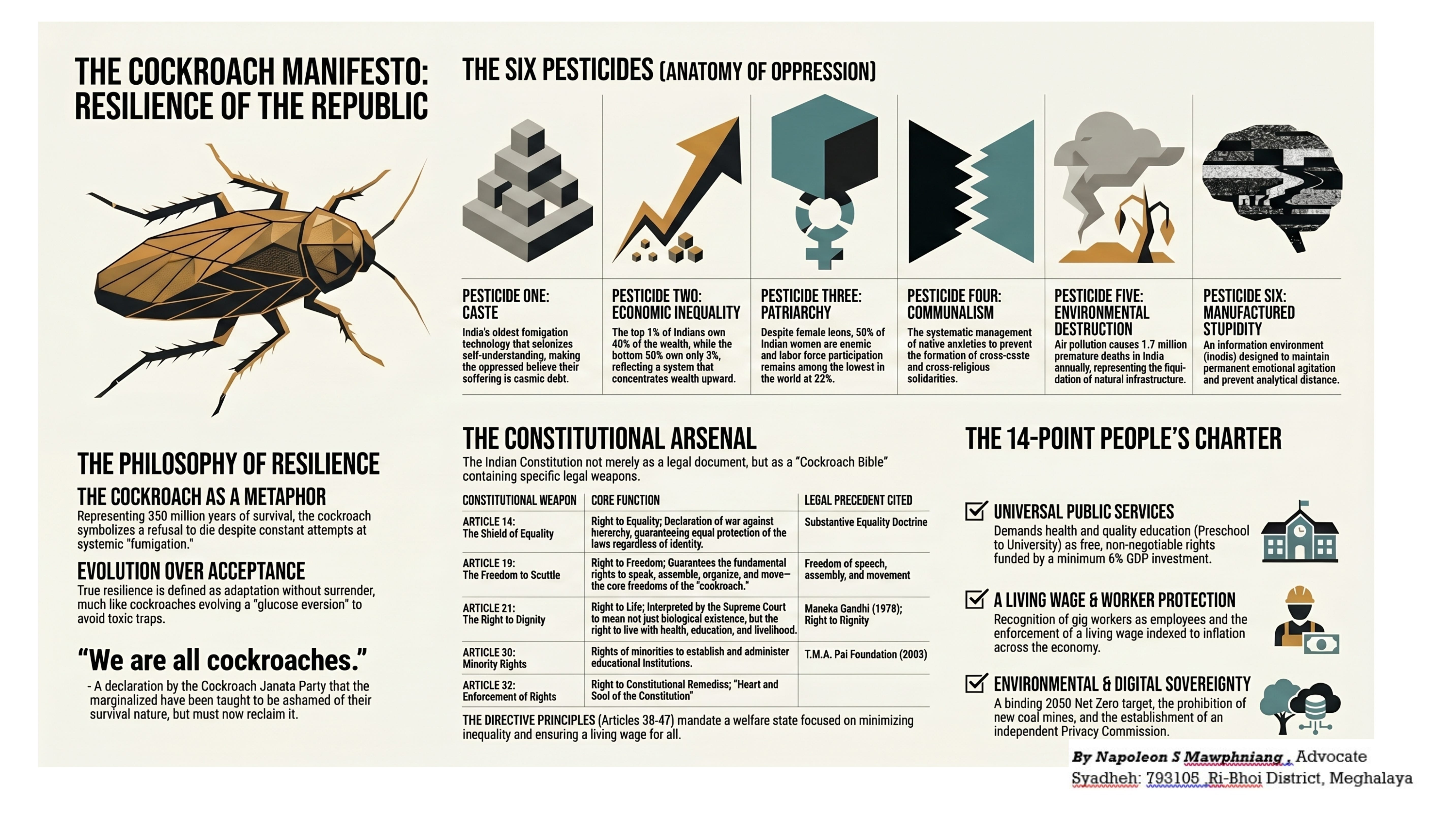
PART EIGHT: CASTE, CLASS, GENDER, RELIGION — THE FOUR FUMIGATIONS
Chapter 8.1 — Caste in the Twenty-First Century
We will be direct. The caste system is the greatest ongoing crime against human dignity in the world. It is a system that has enslaved, mutilated, exploited, humiliated, and murdered human beings across millennia, that has been declared illegal and that continues to operate, that has been the subject of more reform movements, more legislative action, more constitutional provisions, and more official condemnation than any other social practice in Indian history, and that remains, in 2024, a structuring principle of Indian social life from the village to the boardroom.
Forty percent of Indians consider caste to be the primary criterion for marriage partner selection, according to surveys. Caste associations remain the most important units of political mobilization in many Indian states. Manual scavenging — the cleaning of dry latrines by human beings using their bare hands, a practice that is a direct expression of the untouchability doctrine, in which the most degraded work is performed by those deemed most degraded — continues despite the Prohibition of Employment as Manual Scavengers and their Rehabilitation Act, 2013.
Atrocities against Dalits — recorded under the Scheduled Castes and Scheduled Tribes (Prevention of Atrocities) Act, 1989, and its amendments — have increased, not decreased, in recent years. The NCRB data shows consistent increases in crimes against Scheduled Castes, including murder, rape, and arson. The conviction rates under the SC/ST Act remain low. The bail provisions of the Act have been the subject of Supreme Court rulings that, in the view of Dalit rights organizations, have weakened its effectiveness as a deterrent.
We do not want rehabilitation. We do not want integration on the terms of those who have benefited from the hierarchy. We want annihilation of the system. We want this in the Ambedkar sense: the destruction of the philosophical and religious authority that legitimizes it; the redistribution of the land, capital, and social networks that have accumulated on the basis of caste advantage; the affirmative guarantee of equal dignity — not merely equal formal rights — in every space of Indian social life.
Chapter 8.2 — Gender Justice: The Unfinished Revolution
The Constitution guarantees equality. The National Crime Records Bureau records approximately 31,000 rape cases annually — a number that represents only the tip of an iceberg of sexual violence, given the severe underreporting of rape in India, particularly in contexts of domestic violence, caste-based violence, and institutional settings.
The Indian woman manages, on average, approximately five hours of unpaid care work per day — childcare, elder care, cooking, cleaning, fetching water, fetching fuel — in addition to any paid work she may do. This labor is invisible in the national accounts, uncounted in the GDP, unprotected by labor law, unrecognized in pension calculations, and unvalued in the political discourse about economic growth.
The female labor force participation rate of approximately 22% is not evidence that Indian women do not work. It is evidence that the work Indian women do is systematically not counted. And the barriers to formal employment — the lack of childcare, the hostile working environment, the violence on streets and in public transport, the employer discrimination, the glass ceiling, the particular glass ceiling made of caste that is both transparent and concrete — are real barriers, not personal choices.
The Criminal Law (Amendment) Act of 2013, passed in the aftermath of the December 2012 Delhi gang rape, strengthened the legal framework for addressing sexual violence. The Vishaka guidelines (now the Sexual Harassment of Women at Workplace (Prevention, Prohibition and Redressal) Act, 2013) provide a framework for addressing workplace harassment.
The framework exists. The implementation is inadequate. The Internal Complaints Committees required by the POSH Act are absent in the majority of small and medium enterprises. The police response to rape complaints varies enormously across regions and communities and is systematically worse where the survivor is Dalit, adivasi, or from a marginalized religious community. The courts’ disposal of rape cases is slow, exposing survivors to years of secondary trauma in the legal process.
We want: universal childcare as infrastructure, publicly funded, of the quality that enables women to participate in the economy and in public life on equal terms. We want: the full implementation of POSH, including in the informal sector. We want: a police force that is trained in survivor-centered approaches and that is staffed, at every level, in proportions that reflect the gender diversity of the population it serves. We want: a criminal justice system that provides timely justice for gender-based violence, that treats survivors with dignity, and that takes seriously its role as a deterrent.
And above all, we want the recognition that the liberation of women is not a women’s issue. It is a human issue. It is a democracy issue. A democracy in which half the population is systematically excluded from the full exercise of their rights and capacities is not a democracy.
Chapter 8.3 — Religious Pluralism and the Secular State
India’s secular Constitution — the word “secular” was inserted into the Preamble by the 42nd Amendment in 1976, but the principle was present from the beginning — does not require the state to be hostile to religion. It requires the state to be equidistant from all religions. It requires the state to treat citizens of all faiths — and of no faith — with equal dignity and equal protection.
This principle is under pressure. We will not specify the direction of the pressure in ways that are likely to be immediately obvious, because we want to be read not as partisan but as constitutional, and because the constitutional analysis speaks for itself.
The Supreme Court of India, in S.R. Bommai v. Union of India (1994), held that secularism is a basic feature of the Constitution that cannot be amended away. It held that a state government that uses its office to favor one religion over another has forfeited the constitutional basis of its continuation in office.
We invoke Bommai. We invoke it as precedent. We invoke it as warning. We invoke it as the expression of what this Constitution means when it says we are a secular republic.
We believe in religious freedom — the freedom of every person to worship or not worship, to believe or not believe, to practice or not practice, in the manner of their own choosing. We believe in the right of every religious community — Hindus, Muslims, Christians, Sikhs, Jains, Buddhists, Parsis, Jews, and those of no faith — to practice their religion without interference, without discrimination, without the anxiety of being a minority in a state that may not treat them equally.
We also believe that religion belongs in the private sphere of conscience and in the community sphere of shared practice. It does not belong in the legislative process that determines who can marry whom. It does not belong in the electoral calculation that treats communities as vote banks to be mobilized through fear rather than citizens to be served through policy. It does not belong in the textbook that teaches children which past is glorious and which is shameful on the basis of whose past it was.
We are a nation of many gods and no single God, of many texts and no single Text, of many Truths and no single Truth. Our diversity is not our weakness. It is our most extraordinary achievement — the achievement of civilizational synthesis over millennia, the achievement of a Constitution that holds this diversity in constitutional respect.
Do not destroy this. It cannot be rebuilt.
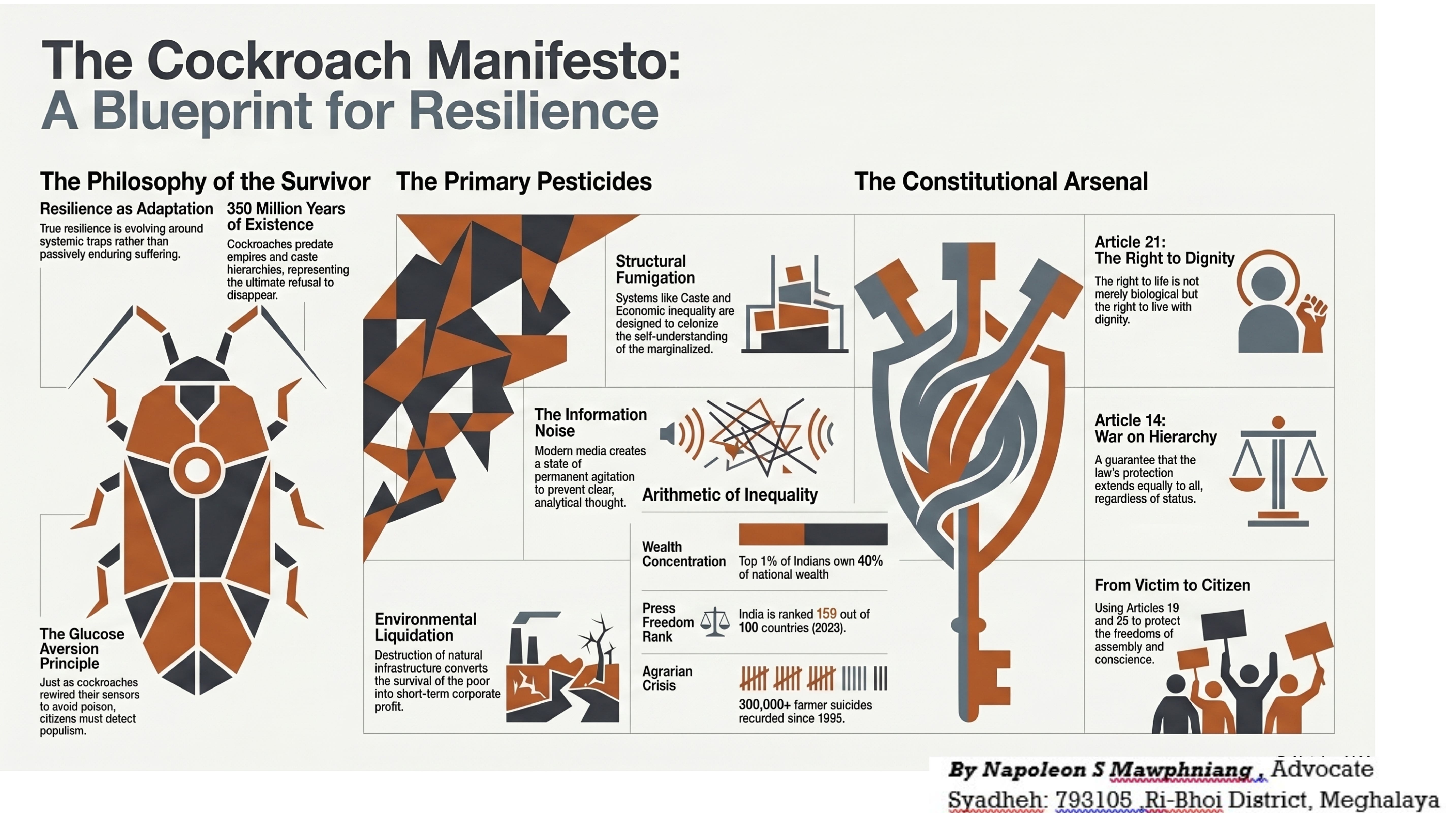
PART NINE: THE DIGITAL COCKROACH — TECHNOLOGY, SURVEILLANCE, AND THE FUTURE OF PRIVACY
Chapter 9.1 — The Promise and the Peril of Digital India
India is the world’s largest democracy and one of the world’s fastest-growing digital economies. These two facts are in increasing tension with each other.
The digital infrastructure built over the past decade — the Aadhaar biometric identity system, the Jan Dhan financial inclusion network, the UPI payment system, the CoWIN vaccination platform, the ONDC digital commerce network — represents a genuine achievement of state capacity. These systems have provided services to people who previously had no access to formal state services. They have enabled welfare delivery, financial transactions, and vaccination records at a scale and speed that would have been impossible without digital infrastructure.
They have also created the most comprehensive surveillance infrastructure in the world.
Aadhaar links biometric identity to banking, to tax filing, to property records, to mobile phone connections, to government benefit access. A person’s Aadhaar number is the thread through which all of these can be connected into a single profile. The question of who has access to this profile, under what conditions, with what oversight, and what the consequences of data breaches are — these questions have been addressed imperfectly by the Supreme Court in the K.S. Puttaswamy v. Union of India cases (2017 and 2019) and inadequately by the Digital Personal Data Protection Act, 2023.
We note, without a sense of relief, that the Digital Personal Data Protection Act provides for a Data Protection Board whose members are appointed by the government and whose decisions are therefore subject to the influence of the government that also happens to be the largest collector and user of personal data in the country. This is the structural conflict of interest that defines the Indian digital governance problem: the state is simultaneously the regulator, the collector, and the user of citizen data, with no truly independent oversight.
The Internet Shutdown Problem:
India is the world leader in internet shutdowns — by a very large margin. Between 2012 and 2023, India recorded over 750 internet shutdowns, more than the next ten countries combined. Internet shutdowns are deployed during protests, elections, communal violence, and examination periods — the last of which is a particularly striking use of a measure explicitly designed to prevent the circulation of information.
The Supreme Court in Anuradha Bhasin v. Union of India (2020) held that internet access is protected under Article 19(1)(a) and that shutdown orders must be published, time-limited, and subject to review. The implementation of this ruling has been, to put it charitably, inconsistent.
Artificial Intelligence and Algorithmic Governance:
The rapid deployment of AI systems in government services — facial recognition at airports and public spaces, predictive policing systems, automated benefit eligibility determination, digital evidence analysis — creates new forms of risk for the marginalized.
AI systems trained on historical data will replicate historical biases. A facial recognition system trained predominantly on one demographic will be less accurate for other demographics — specifically, studies have shown higher error rates for darker-skinned faces, which is not an abstract concern in a country with India’s demographic diversity and India’s history of colorism and caste-based discrimination. A predictive policing system trained on arrest data from a system with documented anti-Muslim and anti-Dalit bias will predict higher criminality in Muslim and Dalit neighborhoods and will thereby justify the additional policing that produces the additional arrests that justify the prediction.
This is algorithmic discrimination. It is discrimination laundered through the appearance of mathematical objectivity. It is the most sophisticated fumigation technology yet developed.
We demand: algorithmic transparency and accountability; the prohibition of facial recognition in public spaces without explicit legislative authorization and strict judicial oversight; the right to human review of any government decision made by an automated system; and the inclusion of civil society, particularly the civil society of the communities most affected by these systems, in the governance of AI deployment by the state.
PART TEN: THE POLITICAL VISION — DEMOCRACY FOR THE MANY, NOT THE FEW
Chapter 10.1 — The Crisis of Electoral Democracy
We are not against elections. Elections are necessary. Elections are the mechanism by which citizens exercise collective sovereignty over governance. Elections are the achievement of generations of struggle — the struggle to extend the franchise from the propertied to all, from men to all, from the literate to all.
But elections, in their current Indian form, have become the vehicle for a particular kind of democratic theater that performs popular sovereignty while delivering oligarchic governance.
The problems are structural:
Electoral Finance: The Supreme Court’s judgment in Association for Democratic Reforms v. Union of India (2024) struck down the Electoral Bond Scheme — a mechanism that allowed corporations and wealthy individuals to purchase bonds from the State Bank of India and donate them anonymously to political parties. The Court held that the scheme violated voters’ right to information under Article 19(1)(a) because voters could not know which corporations were funding which parties and therefore could not assess the potential conflicts of interest between corporate donations and government policy.
The scheme, while it operated, transferred approximately seventeen thousand crore rupees to political parties, with the largest recipients being the ruling party. We note that the striking down of the scheme is a victory for transparency and for the constitutional principle of informed democratic participation. We note that the incentive for such schemes remains — that corporate money will seek political access through whatever channel is available — and that the creation of transparent, publicly funded elections is the only structural solution.
Electoral Rolls and Voter Suppression: The integrity of the electoral roll — the list of registered voters — is the foundation of democratic participation. Allegations of the systematic removal of valid voters from electoral rolls, particularly in constituencies and communities that tend to vote against the ruling party, have been made by opposition politicians, journalists, and civil society organizations with increasing regularity. The Election Commission of India, once the gold standard of electoral administration globally, has seen its institutional independence questioned in ways that were not previously common.
The First-Past-The-Post System: India’s electoral system awards representation to the candidate with the most votes in each constituency, regardless of whether that candidate obtains a majority. The result is that a party can win a landslide parliamentary majority with 35% or 40% of the national vote — leaving the other 60% or 65% of voters effectively unrepresented. We do not claim that proportional representation is a panacea, but we note that a system whose mathematical properties guarantee legislative supermajorities from electoral minorities raises fundamental questions about its fitness for purpose in a diverse democracy.
The Criminalization of Politics: Over half of the Members of Parliament elected in 2019 had criminal cases pending against them, according to the Association for Democratic Reforms. Approximately a quarter faced serious charges including murder, robbery, and crimes against women. The Supreme Court has repeatedly expressed concern about this and has directed that criminal cases against elected officials be tried expeditiously — directions that have been variously obeyed and ignored.
We want elections that are genuinely free and fair. We want an Election Commission whose independence from the executive is constitutionally guaranteed, not merely conventionally maintained. We want full transparency in electoral finance. We want a criminal justice system that processes cases against sitting legislators with the same speed that it processes cases against ordinary citizens. We want politicians who are accountable to their constituents and not merely to their party leaders and their donors.
Chapter 10.2 — Decentralization and the Democracy of Proximity
The 73rd and 74th Constitutional Amendments (1992-93) created the framework for the third tier of Indian democracy — the Panchayati Raj institutions for rural areas and the Urban Local Bodies for cities. These amendments devolved constitutional status to local government and required the reservation of seats for Scheduled Castes, Scheduled Tribes, and women.
The implementation of these amendments has been uneven across states — genuinely transformative in some states (Kerala’s decentralization model has been internationally studied as a successful example of participatory democracy), largely nominal in others where state governments have retained financial and administrative control, leaving panchayats with constitutional existence but without the resources or the authority to actually govern.
We want devolution — real devolution, of funds, of functions, and of functionaries — to local bodies. We want panchayats that can actually decide how resources are allocated in their territory, that can hold the administration accountable, that can participate meaningfully in the planning of development projects that affect their communities.
We want the gram sabha — the general assembly of all voters in a village, which is the most grassroots democratic institution in the Constitution — to be recognized and empowered as the primary decision-making body on matters of local governance, land use, natural resources, and community development.
We note that the Forest Rights Act specifically empowers the gram sabha in matters of forest governance — and that this provision is one of the most consistently violated provisions of the Act.
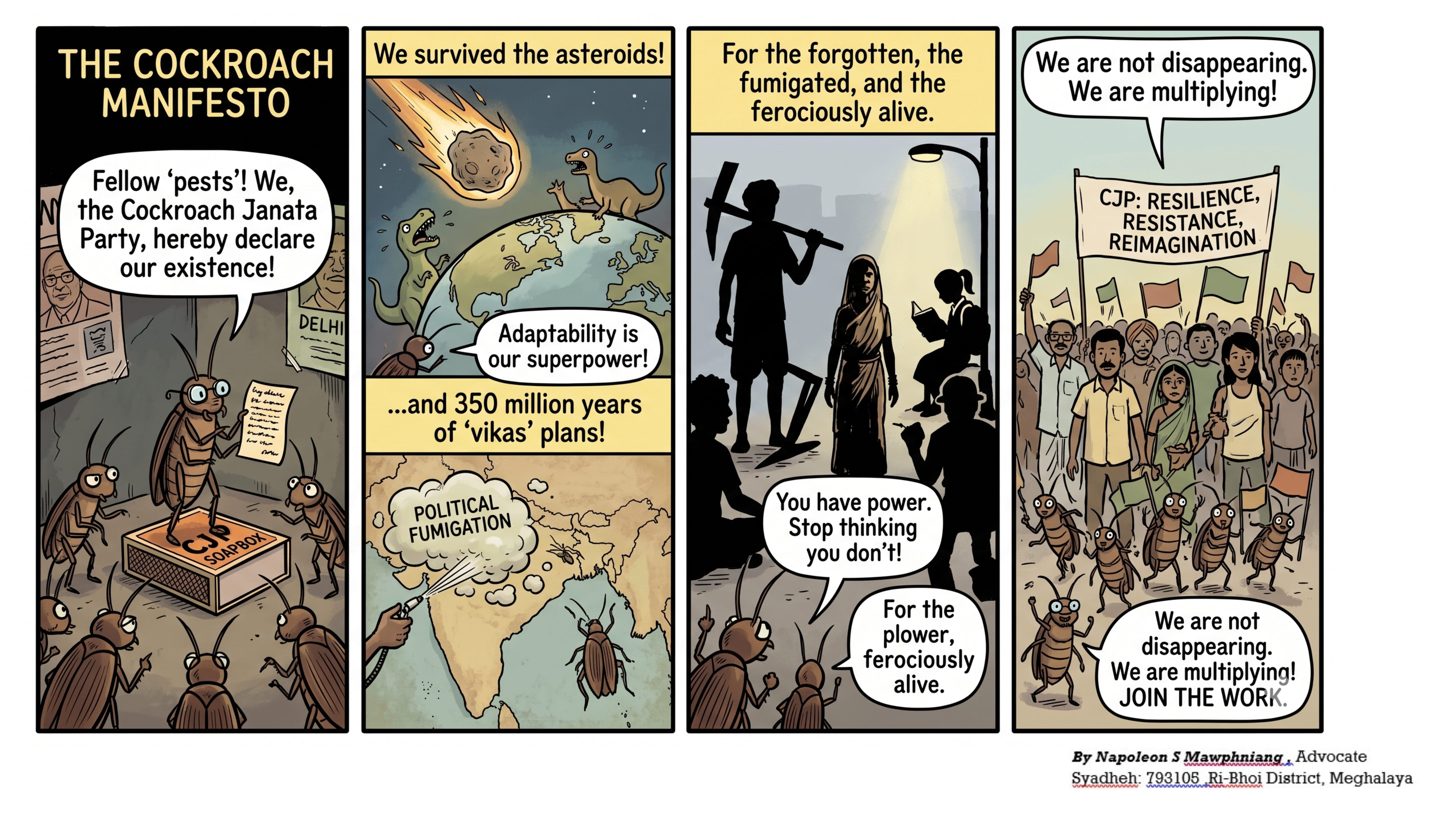
PART ELEVEN: THE CULTURAL RENAISSANCE — ART AS RESISTANCE, BEAUTY AS REBELLION
Chapter 11.1 — The Cockroach Aesthetic
Art has always been both a mirror and a hammer — a mirror that shows us what we are, and a hammer with which we break what we should not be.
Indian art in the present moment is in a state of crisis and creativity simultaneously. The crisis: the shrinking of the space for artistic expression that challenges power, the self-censorship produced by the threat of sedition charges and mob violence, the suppression of films and books and plays and exhibitions that engage with contested historical and political questions. The creativity: the explosion of independent music, of feminist art, of Dalit literature, of theatrical forms that carry social critique into spaces where official culture does not reach.
Dalit literature — the writing of Namdeo Dhasal, of Bama, of Omprakash Valmiki, of Sharankumar Limbale — is perhaps the most significant literary development in post-Independence India. It is literature that does something Indian high culture has generally refused to do: speak from the perspective of those who suffer the system, in their own voice, without the mediation of the observer from the privileged position. Dhasal’s poetry is visceral, angry, technically complex, and absolutely unforgiving. It is the kind of poetry that the powerful do not want taught in schools because it makes the experience of the oppressed undeniably present.
We want this literature in the curriculum. We want Bama’s Karukku alongside Kalidasa’s Shakuntala. We want both. We want the fullness of Indian cultural production, not the version that has been sanitized for the comfort of those who have benefited from the arrangements it documents.
We want the music of protest — from Gaddar’s Telugu folk music to Kabir’s revolutionary devotional poetry to the hip-hop emerging from the peripheries of Indian cities that samples B.R. Ambedkar and 2Pac in the same verse — to be recognized as the legitimate cultural heritage of this country, not as a subcultural curiosity.
We want cinema — that great Indian art form that reaches across language and class and literacy in a way that no other medium can — to be free to engage with the social reality of India in all its complexity: the cinema of Ritwik Ghatak, of Shyam Benegal, of Aparna Sen, of Neeraj Ghaywan, of Payal Kapadia, who won at Cannes while some Indian critics argued that her film did not represent the “real” India. What India do they mean? The India that does not have communal riots? The India where the poor do not exist? We want the real India, in all its difficulty and beauty, on screen.
On the Banning of Books:
The right to read is a fundamental liberty. Every book that is banned is a fumigation attempt — an attempt to prevent the circulation of ideas that the powerful find threatening. We note a long and embarrassing tradition in Indian public life of attempting to suppress books: the removal of chapters from textbooks, the withdrawal of translations under political pressure, the FIRs filed against authors and publishers for “hurting religious sentiments,” the mobs that burn books and the politicians who provide the matches.
We cite S. Rangarajan v. P. Jagjivan Ram (1989), in which the Supreme Court held that a film could not be banned merely because some people objected to its content: “Our commitment to freedom of expression demands that it cannot be suppressed unless the situations created by allowing the freedom are pressing and the community interest is endangered. The anticipated danger should not be remote, conjectural or far-fetched. It should have proximate and direct nexus with the expression.”
We want this standard applied rigorously and consistently to every attempt to suppress artistic expression.
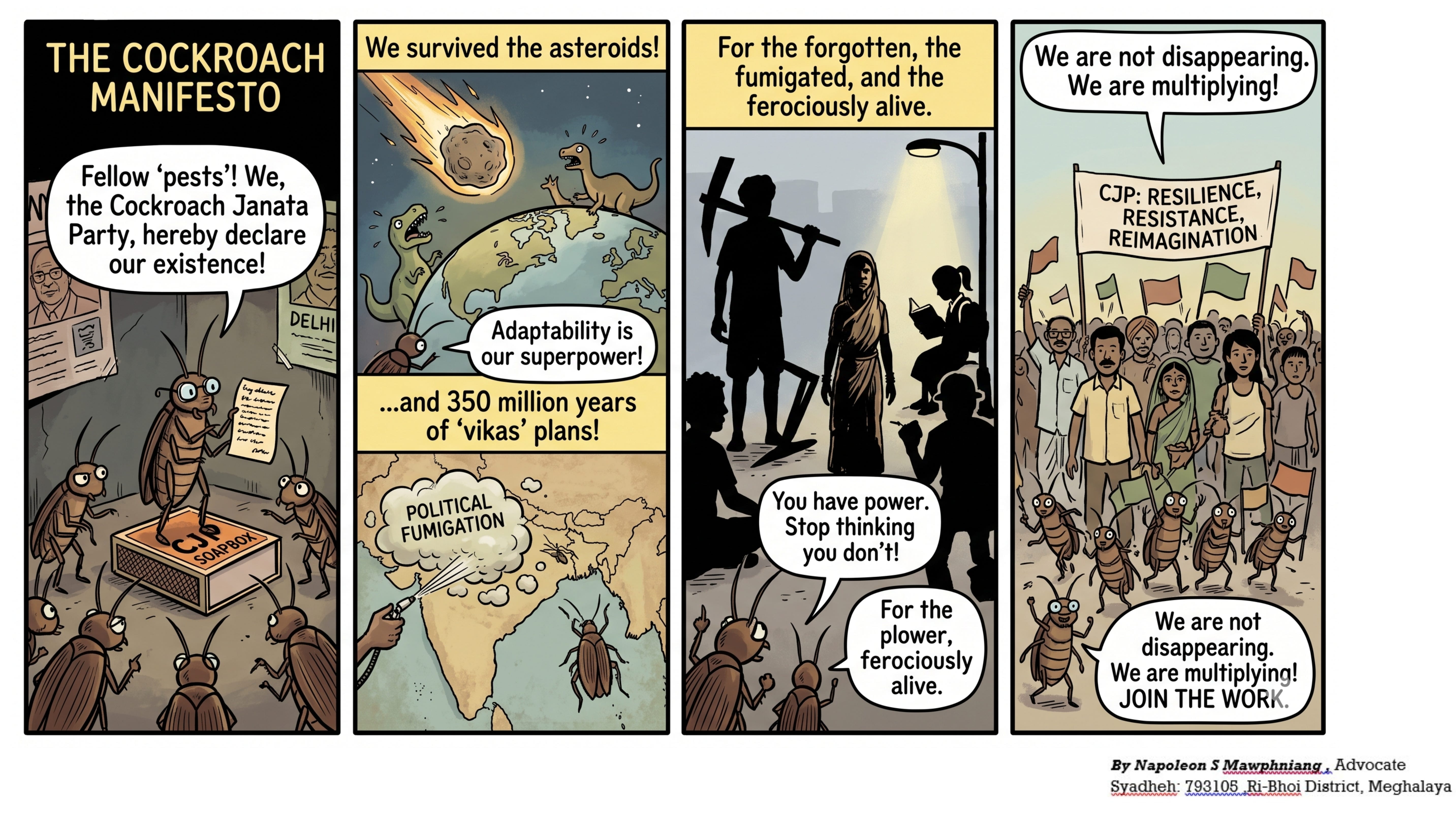
PART TWELVE: THE YOUTH AND THE MANIFESTO — A LETTER TO THE NEXT GENERATION
Chapter 12.1 — You Who Are Reading This in the Small Hours
We know who you are.
You are reading this on a cracked phone screen, in a hostel room in Hyderabad or a paying-guest accommodation in Pune or a village in Chhattisgarh where the WiFi is just good enough on most nights. You are reading this because something in you — some residual, unkillable instinct toward the real — is not satisfied with the explanations you have been given. You are reading this because you know, with the bone-deep certainty of lived experience, that something is wrong, and you are trying to find the language for what you know.
We want to say: the language has been there for a long time. It is the language of the Constitution, which guarantees your rights. It is the language of Ambedkar, who insisted on your dignity. It is the language of Phule, who educated the uneducated. It is the language of Savitribai Phule, who opened the first school for girls in India and was pelted with stones for it and continued anyway. It is the language of Bhagat Singh, who went to the gallows at twenty-three without asking for mercy and without abandoning his principles. It is the language of Irom Sharmila, who fasted for sixteen years against the Armed Forces Special Powers Act in Manipur. It is the language of Tukaram Mundhe, who implemented the forest rights as an IAS officer without compromise and was transferred seventeen times. It is the language of every person who chose the difficulty of truth over the comfort of silence.
You are the inheritors of this language.
You are 65% of this country. India is, by the demographic statistics, the world’s youngest major country — a median age of approximately 28 years. The decisions made in the next decade will shape the world you will live in for the next fifty years. The decisions are being made by people who will not live in the consequences for as long as you will.
This is not an argument for youth chauvinism — the idea that young people are inherently right or inherently revolutionary. Young people can be reactionary. Young people can be fascist. The history of the twentieth century is full of young people who gave their energy to terrible causes. Youth is not wisdom. Youth is energy. The question is what you put the energy toward.
We want you to put it toward the following:
Know the Constitution. Read it. Not as a ceremonial document but as a practical instrument. Know your rights under Article 14, 19, 21, 25. Know the Directive Principles. Know the Fundamental Duties. Know the constitutional provisions for reservation and understand their history and rationale. The Constitution is the most powerful tool available to the citizen of India, and it is shameful that most Indians go through twelve years of compulsory education without ever reading it.
Know the law. The law can be used against you. It can also be used by you. There are organizations — the Human Rights Law Network, the Alternative Law Forum, the Lawyers Collective, hundreds of district legal services authorities — that provide legal aid and legal education to citizens who cannot afford private lawyers. Use them. Support them. If you are a law student, consider what it would mean to put your skills in the service of the people who most need them rather than the corporations that can most afford them.
Organize. The single most important insight of every successful social movement in history — from the labor movement in Britain to the civil rights movement in the United States to the anti-apartheid movement in South Africa to the farmers’ movement in India — is that individual action, however courageous, is insufficient. The cockroach does not survive alone. The cockroach survives in community, in collective intelligence, in the network of shared information and mutual support that makes the colony more resilient than any individual.
Join something. Start something. Connect with people across the lines of caste, religion, region, and class that have been constructed to prevent the formation of effective solidarities. Find your allies in unexpected places. The farmer in Punjab who is angry about agricultural policy and the Dalit activist in Nagpur who is angry about atrocities and the Muslim teacher in Lucknow who is angry about surveillance and the feminist in Chennai who is angry about the criminal justice system’s treatment of survivors of violence — these people have more in common than they know, because all of them are facing different weapons from the same arsenal.
Refuse despair. This is the most political instruction in this manifesto. The political economy of the present moment depends on your despair. It depends on your cynicism. It depends on your conclusion that nothing matters, that the system cannot be changed, that resistance is futile. This conclusion, wherever you find it, serves the interests of those who benefit from the continuation of current arrangements. Despair is not philosophical depth. Despair is the system’s most successful fumigation product.
We do not offer false optimism. We do not tell you that everything will be fine. We tell you what is true: that things have been worse, and been changed; that systems that appeared permanent have been dismantled; that the apartheid state of South Africa fell; that the Berlin Wall came down; that the Emergency in India lasted twenty-one months and was defeated by an election; that the farmers’ movement in India succeeded; that the three farm laws were repealed; that the Supreme Court read down Section 377; that the women of this country refused, collectively and persistently, to accept violence as the price of inhabiting public space.
The arc of history does not bend toward justice automatically. It bends toward justice when enough people put their hands on it and pull.
We are pulling.
Are you coming?
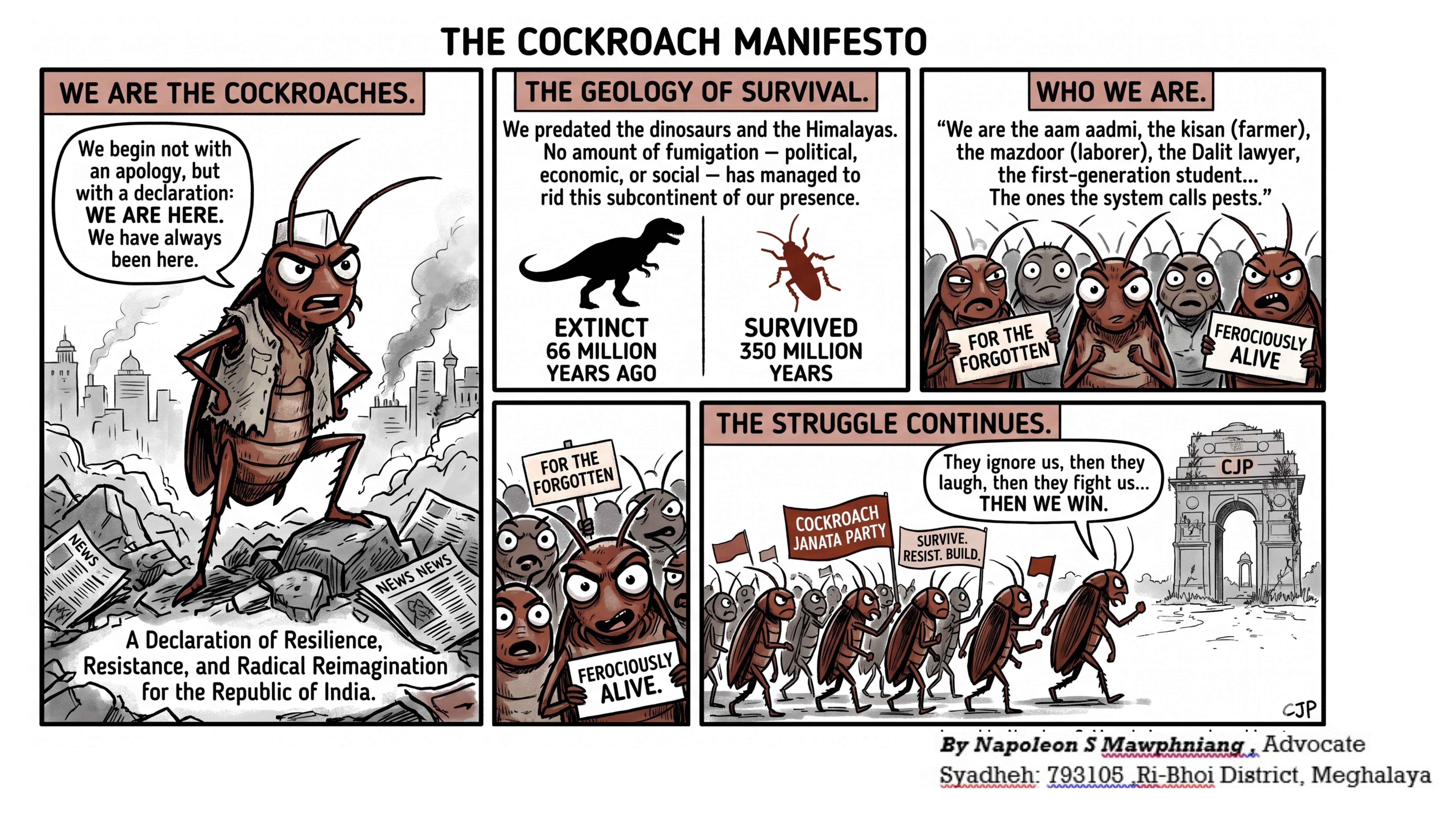
PART THIRTEEN: THE FOURTEEN-POINT CHARTER OF THE COCKROACH JANATA PARTY
Our Demands, Presented Without Apology
We present here not a party program but a people’s charter — a set of demands that we believe any government committed to the constitutional promise of justice, liberty, equality, and fraternity must implement. We present these not as gifts that the government gives to the people but as rights that the people claim from the government.
One: Universal and Quality Public Health Care
The public health expenditure of India must be raised to at least 2.5% of GDP (as recommended by the National Health Policy 2017) and sustained at that level with annual increases. The Ayushman Bharat program must be genuinely universal, genuinely cashless, and genuinely free at the point of use. The public health system must be staffed, equipped, and funded to the standard necessary to provide care that no Indian needs to pay for out of pocket.
We cite: the right to health as derived from Article 21 (Bandhua Mukti Morcha v. Union of India, 1984; Consumer Education and Research Centre v. Union of India, 1995); the Directive Principle in Article 47; the National Health Policy 2017.
Two: Free and Quality Public Education from Preschool to University
The Right to Education Act guarantees free and compulsory education from 6 to 14. We want it extended from birth (through anganwadis under the Integrated Child Development Services) through university. We want the education provided to be of genuine quality — not the underfunded, understaffed, infrastructure-deficient education that is currently provided in government schools and that drives parents who care about their children’s education to sacrifice beyond their means for private schooling.
We cite: Unni Krishnan v. State of Andhra Pradesh (1993); the Right to Education Act, 2009; Article 45 of the Directive Principles; NEP 2020’s stated commitment to 6% of GDP on education.
Three: A Living Wage for All Workers
The minimum wage must be a living wage — calculated on the basis of the actual cost of decent living in each region, indexed to inflation, and universally enforced. The four Labor Codes must be reviewed to restore the protections that were weakened in the consolidation process. Gig workers must be recognized as workers with the full protections of labor law, whatever the platform’s preferred terminology for the relationship.
We cite: Article 43 of the Directive Principles (the right to a living wage); the Unorganized Workers’ Social Security Act, 2008; the Code on Social Security, 2020, and its shortcomings; ILO Convention 102 on Social Security (which India has not ratified but whose standards represent international best practice).
Four: Land Reform and Agricultural Justice
The concentration of agricultural land in the hands of a minority while a majority of farmers are smallholders or landless laborers is a structural cause of the agrarian crisis. We want: the implementation of existing land reform legislation in states where it remains on paper; the recognition of the land rights of women, who cultivate but rarely hold title; the recognition of common land rights of communities; the prohibition of the conversion of agricultural land to corporate use without genuine community consent; the establishment of agricultural markets that provide farmers with a minimum price linked to cost of production, without the distortions of middlemen and market power.
We cite: the Comprehensive Agrarian Reform Program; Article 39(b) of the Directive Principles (the distribution of material resources to subserve the common good); the Forest Rights Act, 2006; the Land Acquisition, Rehabilitation and Resettlement Act, 2013 and the proposed weakening of its consent requirements.
Five: Full Implementation of the Forest Rights Act
Every gram sabha in every forest-dwelling community in India must have the right to govern the forest resources in its territory in accordance with the Forest Rights Act, without interference from the forest department, without displacement without consent, and with the recognition of both individual and community forest rights.
We cite: the Scheduled Tribes and Other Traditional Forest Dwellers (Recognition of Forest Rights) Act, 2006; Orissa Mining Corporation v. Ministry of Environment & Forest (2013), in which the Supreme Court held that the consent of the gram sabha is mandatory before forest land can be diverted for mining.
Six: Electoral Finance Transparency and Publicly Funded Elections
In the wake of the Supreme Court’s striking down of the Electoral Bond Scheme in Association for Democratic Reforms v. Union of India (2024), we demand: a system of capped, transparent campaign finance with full public disclosure of all donations above a nominal threshold; the exploration of a system of state funding of elections to reduce the dependency of electoral politics on corporate money; the strengthening of the Election Commission’s independence through a collegium-based appointment process rather than executive appointment.
We cite: the right to information as fundamental to the right to vote under Article 19(1)(a) (PUCL v. Union of India, 2003; ADR v. Union of India, 2024).
Seven: The Right to Privacy and Digital Sovereignty
Every citizen of India has, pursuant to the Supreme Court’s judgment in K.S. Puttaswamy v. Union of India (2017), a fundamental right to privacy as part of the right to life and personal liberty under Article 21. We demand: a Digital Personal Data Protection framework with genuine independence of the regulatory authority; the prohibition of mass surveillance without specific judicial authorization; the right to data portability and the right to erasure; the regulation of facial recognition technology in public spaces.
Eight: Constitutional Protection for Religious and Linguistic Minorities
The state must fulfill its constitutional obligations under Articles 14, 25, 26, 29, and 30 to all religious and linguistic minorities. The investigation and prosecution of communal violence must be impartial, timely, and independent of the political interests of the government of the day. The provisions of the Unlawful Activities (Prevention) Act must not be used against peaceful religious or cultural expression. The Places of Worship (Special Provisions) Act, 1991, which the Supreme Court has affirmed establishes the religious character of places of worship as of August 15, 1947 — that date, the very birthday of our republic’s promise — must be honored, enforced, and defended not as a bureaucratic technicality but as a moral covenant between the Indian state and its plurality of souls. We say this plainly, without apology, and without the cowardly equivocation that has come to characterize the political speech of our age: a nation that tears open its own healed wounds in search of ancient grievances is not a nation marching toward greatness — it is a nation consuming itself from within, feeding its hunger for identity with the flesh of its own people.
We, the cockroaches of the Cockroach Janata Party, have watched these wounds being reopened with surgical precision and political intent. We have watched courts become battlegrounds not for justice but for archaeology — the archaeology of hatred, of conquest narratives, of civilizational grudges that serve no one except those who profit from the perpetual state of communal anxiety. We have watched the Places of Worship Act — a law passed in the wisdom of a moment of national reckoning, a law that said enough, the past is the past, let the living live — being whittled away, circumvented, and philosophically dismantled by those who understand that a nation perpetually at war with its own history can never ask difficult questions about its present.
In M. Siddiq (D) Thr. Lrs. v. Mahant Suresh Das & Ors. (2019), the Supreme Court’s Constitution Bench, while adjudicating the Ayodhya dispute, noted in terms that deserve to be read aloud in every classroom in India, that the Places of Worship (Special Provisions) Act, 1991 “imposes a non-derogable obligation towards enforcing our commitment to secularism under the Indian Constitution.” Non-derogable. That word does not mean “unless it is politically inconvenient.” That word does not mean “unless the majority finds it offensive.” Non-derogable means absolute. It means beyond the reach of electoral arithmetic. It means that some things — some fundamental commitments — must be placed beyond the auction house of competitive populism.
We invoke this not as lawyers reciting precedent, but as citizens who have watched the auction house open its doors.
The Gyanvapi mosque survey orders, the Mathura litigation, the dozens of smaller cases filed in district courts across the country — all testing, probing, searching for the crack in the wall of the Places of Worship Act — represent not a legal exercise but a political project. And we are not naive enough to pretend otherwise. When Ambedkar wrote the Constitution, when Nehru delivered his Tryst with Destiny speech, when Maulana Azad chose to stay in India at Partition’s bloody hour — they were all making a wager. They were betting that India, unlike every other postcolonial nation fractured by religious nationalism, would choose the harder, nobler path. They were betting that we would be plural not because we had no choice, but because we understood that pluralism is civilization — that monoculture is the biology of extinction.
We are the cockroaches, and we have seen extinction up close. We have survived it. We are telling you: monoculture kills.
The Constitutional Architecture of Minority Rights
Articles 14, 15, 25, 26, 29, and 30 of the Constitution do not exist in isolation. They exist as a system — an ecosystem, one might say, in the spirit of our entomological identity — where each provision supports and enables the others. Remove one, and the others weaken. Hollow one out through administrative neglect or judicial interpretation that favors majoritarian sentiment, and the entire edifice of minority protection begins to crack.
Article 14 guarantees equality before law. But equality before law means nothing when the law itself is applied with the thumb of prejudice pressed upon the scale. We have watched the Unlawful Activities (Prevention) Act — that blunt, brutal instrument — deployed against Muslim clerics for sermons, against Christian missionaries for prayer meetings, against Sikh activists for historical commemoration, while identical acts of incitement and provocation by those aligned with the political majority pass without investigation, without FIR, without so much as a notice. This is not equality before law. This is the law wearing the costume of neutrality while doing the work of discrimination.
Article 25 guarantees freedom of conscience and free profession, practice, and propagation of religion. Propagation. The framers chose that word deliberately. They put it there knowing that some would find it uncomfortable. They put it there because they understood that a person’s faith is not merely a private matter of personal piety — it is a living, breathing, speaking presence in the world. The anti-conversion laws passed by multiple state governments — laws with names like the Freedom of Religion Act, a nomenclature of Orwellian genius — directly contradict the constitutional guarantee of propagation. We call them what they are: they are instruments of demographic anxiety dressed in the language of protection. They presuppose that the tribal, the Dalit, the poor person who converts has no agency of their own — that they must be protected from their own informed choices by a paternalistic state that knows better.
Article 30 guarantees minorities the right to establish and administer educational institutions. Yet we have seen state governments withhold recognition, starve minority institutions of grant-in-aid, and subject them to administrative harassment that their majority counterparts never face. The Supreme Court in T.M.A. Pai Foundation v. State of Karnataka (2002) and P.A. Inamdar v. State of Maharashtra (2005) attempted to navigate the complex territory between minority rights and regulatory oversight. The balance remains contested, fragile, and perpetually threatened by administrative caprice.
We demand not just the letter of these provisions but their spirit: the spirit that says every Indian, regardless of their faith, their tongue, their sect, their syncretic practice, their heterodox interpretation of their own religion — every Indian has the right to live, worship, educate, and exist with dignity and without fear.
The Linguistic Question
We are a land of languages. Not a land with many dialects of one great tongue — a land of many great tongues, each carrying within it an entire universe of thought, literature, philosophy, and identity. Kannada is not lesser than Hindi. Tamil is not a regional variant of something more important. Bengali is not a provincial indulgence. Marathi, Odia, Malayalam, Telugu, Gujarati, Punjabi, Kashmiri, Sindhi, Manipuri, Bodo, Santali, Maithili, Dogri — each of these languages is a civilization. Each of these languages carries, in its grammar and idiom and poetry and abuse and lullaby and battle cry, the entire human experience of a people.
The Eighth Schedule of the Constitution recognizes 22 languages. Dozens more await recognition — languages spoken by hundreds of thousands of people who do not see themselves reflected in any official document, who cannot access justice or education or healthcare in the tongue that their mothers sang to them. We demand the expansion of the Eighth Schedule to include all languages with significant speaker populations and established literary traditions. We demand that the Three-Language Formula be implemented not as a vehicle for the hegemony of any single language but as a genuine celebration of India’s multilingual genius.
We have watched with the antennae of alarm the repeated attempts to impose Hindi as a national language upon states that have their own proud, ancient linguistic traditions. The Dravidian languages predate Sanskrit in geological time. Tamil literature — the Sangam poetry of Thiruvalluvar, of Andal, of Avvaiyar — is among the oldest continuous literary traditions on earth. To tell a Tamil speaker that their language is secondary, that they must learn the language of the Hindi belt to access the corridors of power in their own country, is not unity — it is erasure. It is the linguistic equivalent of conquest.
Article 347 allows the President to recognize languages spoken by a substantial proportion of a state’s population. Article 350A directs states to provide facilities for instruction in the mother tongue at primary stage. Article 350B establishes the Special Officer for Linguistic Minorities. These provisions are not decorative. They are the Constitution speaking in multiple voices simultaneously — which is, in fact, the only way the Indian Constitution can speak and remain true to the civilization it governs.
We, the Cockroach Janata Party, stand for a multilingual India that draws strength from its diversity rather than anxiety from it. We stand for the proposition that a child educated in their mother tongue is not a provincial — they are a human being with roots, and a human being with roots can reach further than a human being who has been cut loose from the soil of their own language and made to navigate the world in someone else’s tongue.
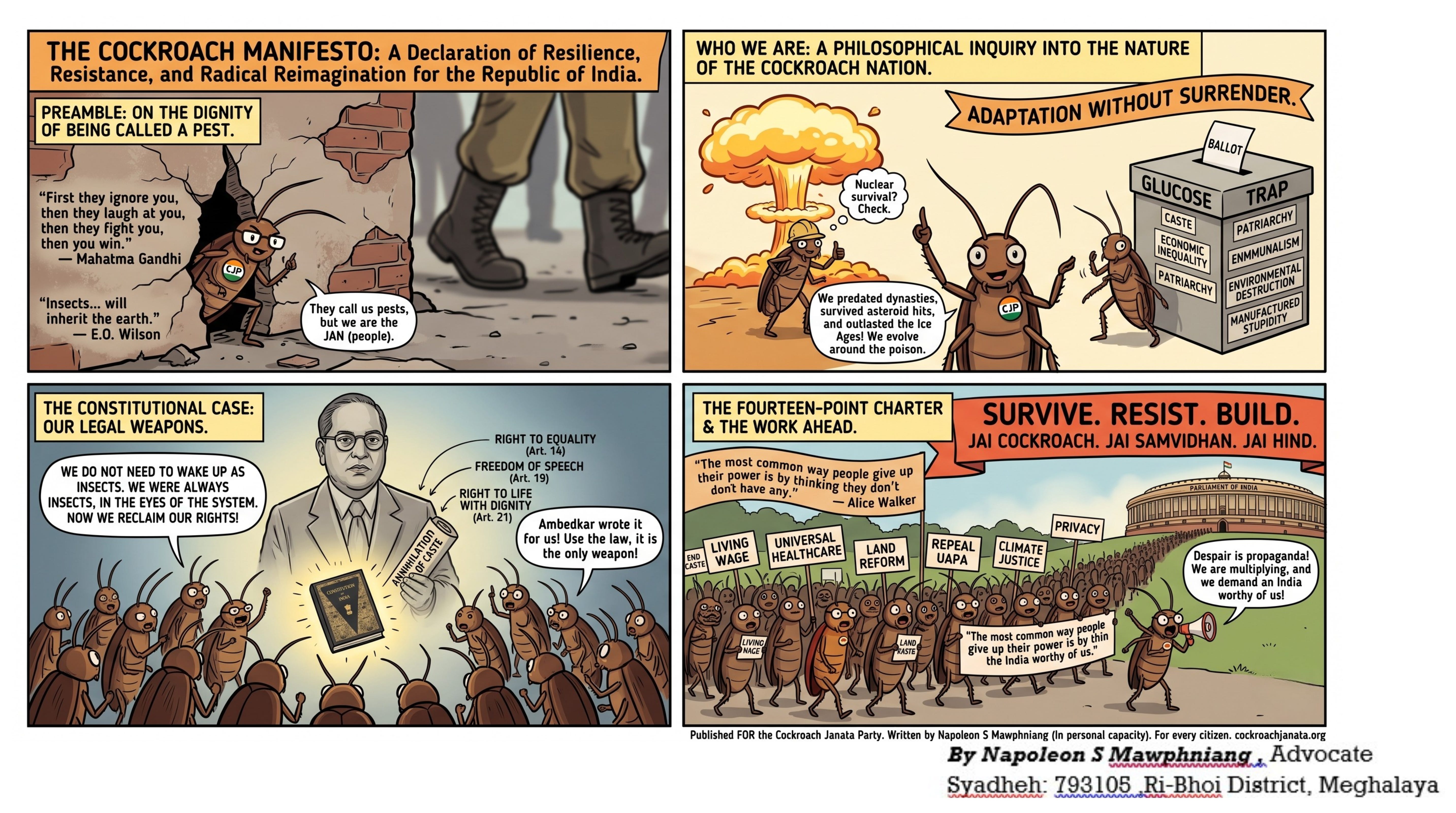
NINE: Land, Forest, and the Rights of Those Who Were Here Before
“The forest is not empty. It never was.”
Before there was a Constitution, before there was a nation, before there was a colonial survey map that drew lines through rivers and across mountain ranges with the casual confidence of those who had never walked the land they were cartographing — before all of this, there were people. They were here. They knew the names of every tree. They knew which root could cure fever and which bark could stop bleeding. They had governance systems, dispute resolution mechanisms, relationships with the earth that were simultaneously ecological and spiritual — because for them, unlike for us in our concrete cities, the two were never separate.
We are speaking of the Adivasi people of India. We are speaking of the Scheduled Tribes — the Gonds and the Bhils and the Mundas and the Santhals and the Dongria Kondhs and the Jarawa and the hundreds of other communities who have been systematically, relentlessly, and with extraordinary legal creativity dispossessed of their lands, their forests, their rivers, and their futures in the name of development, conservation, and national progress.
The Forest Rights Act, 2006 — officially the Scheduled Tribes and Other Traditional Forest Dwellers (Recognition of Forest Rights) Act — was one of the most significant pieces of legislation in independent India’s history. It was an acknowledgment of what the Supreme Court in Samatha v. State of Andhra Pradesh (1997) had already recognized: that the transfer of tribal lands to non-tribals, including through the mechanisms of the state, amounted to a fundamental violation of constitutional rights. The Forest Rights Act was an attempt — incomplete, imperfect, but genuine — to reverse centuries of dispossession and recognize the legal rights of forest communities over the land they had lived on and lived with for generations.
Its implementation has been a scandal. State governments have dragged their feet. Forest departments — whose institutional culture was formed under colonial forest laws that treated Adivasi communities as encroachers in their own homes — have resisted the Act with bureaucratic ingenuity. Claim forms have been lost. Gram Sabhas have been manipulated. The three-tier dispute resolution process has been subverted. And meanwhile, mining companies, infrastructure projects, and “conservation” efforts backed by international NGOs with no accountability to local communities have continued to displace forest peoples at an industrial scale.
The Supreme Court’s order in Wildlife First & Ors. v. Ministry of Forest & Environment & Ors. (2019) — which, in its original form, threatened eviction of millions of forest dwellers before a modified order was issued — revealed how precarious the rights of Adivasi communities remain even under a law specifically designed to protect them. We are a nation that can generate a Supreme Court order potentially evicting 10 million people from their ancestral lands without this becoming the dominant story of our national discourse. Let that sink in. Let that disturb your sleep.
The Grammar of Dispossession
The dispossession of Adivasi communities in India follows a recognizable grammar — a set of moves, a sequence of steps that has been repeated so many times, in so many states, that it has achieved the status of administrative routine.
The grammar works like this:
First comes the Survey — a technical exercise in which the land that a community has lived on for generations is measured, mapped, and given a classification that does not include the category “belongs to the people living on it.” The land becomes forest land, or revenue land, or government land, and the people living on it become, overnight, illegal occupants.
Then comes the Development Project — a dam, a mine, a national highway, a smart city, a wildlife sanctuary, a Special Economic Zone. The project is announced with ceremony and the language of national interest. Employment numbers are cited. GDP contributions are projected. Environmental Impact Assessments are produced — documents that, in our experience, have a remarkable tendency to find that proposed projects will have minimal environmental impact regardless of their actual nature.
Then comes the Consultation — a public hearing held in a district headquarters that the affected community cannot reach, or held in a language they do not speak, or held with three days’ notice, or held after the project has already been approved in principle. This consultation is not designed to result in genuine consent. It is designed to produce a piece of paper that says consent was obtained.
Then comes the Compensation — a figure calculated by a bureaucratic formula that has no relationship to what the land is worth to the people who have lived on it, to the value of the forest that will be destroyed, to the cost of rebuilding a life in an alien place. The compensation is paid, sometimes, eventually, partially, with deductions for administrative costs that no one can explain.
Then comes the Displacement — which is called “rehabilitation” in the official documents, because language is always the first casualty of injustice. People are moved to concrete boxes in places with no agricultural land, no forest access, no community networks, no cultural continuity. The concrete boxes are called houses. The places are called rehabilitation colonies. The people are called project-affected persons, which is a category designed to make them sound like passive recipients of circumstances beyond their control rather than human beings whose lives have been destroyed by deliberate policy choices.
Then comes the Forgetting — the most important step. The project is built. The dam fills. The mine opens. The highway carries trucks. The smart city rises. And the people who were displaced become invisible — statistics in rehabilitation reports that no one reads, faces in documentaries that win awards at film festivals and change nothing, names in PILs that work their way through court dockets for decades.
We, the cockroaches, refuse to participate in the forgetting. We have the biological memory of survivors. We remember what others choose to forget.
The Constitutional Framework We Invoke
The Fifth and Sixth Schedules of the Constitution establish special governance frameworks for tribal areas. The Fifth Schedule applies to most tribal areas outside the Northeast, establishing Tribal Advisory Councils and restricting the transfer of tribal lands. The Sixth Schedule applies to certain states in the Northeast, establishing Autonomous District Councils with significant legislative and judicial powers.
The Panchayats (Extension to Scheduled Areas) Act, 1996 — PESA — extended the panchayat system to Fifth Schedule areas with crucial modifications that recognized the primacy of the Gram Sabha in tribal governance. Section 4 of PESA recognizes the competence of the Gram Sabha to safeguard and preserve traditions and customs, to manage community resources, and to resolve disputes using customary law. It gives the Gram Sabha the right to be consulted before land acquisition, to prevent alienation of land, and to take appropriate action to restore unlawfully alienated land.
In practice, PESA is one of the most comprehensively violated laws in India. State governments have failed to pass conforming legislation. State laws passed in purported conformity with PESA have actually diluted its protections. The Gram Sabha’s power of consent has been treated as the power of consultation — a fundamental perversion of the statute’s intent. The Supreme Court in Nandini Sundar v. State of Chhattisgarh (2011) — the Salwa Judum case — documented in chilling detail the ways in which the constitutional framework for tribal governance had been systematically circumvented in the context of anti-Maoist operations. The Court’s words were unambiguous: “The State of Chhattisgarh, in arming and deploying SPOs (Special Police Officers) has acted in a manner that is repugnant to the constitutional order.”
We do not justify violence in any form. We do not excuse the violence of Maoist movements that have also killed innocents, that have also displaced communities, that have also terrorized the very people they claim to represent. But we insist that you cannot understand the existence of armed insurgency in tribal India without understanding the context of dispossession, violence, and institutional abandonment in which it grew. You cannot bomb a forest without understanding why some people in that forest have picked up weapons. You cannot call for law and order without first acknowledging the lawlessness that preceded it.
The constitutional promise to the Adivasi communities of India — the promise of protected lands, self-governance, cultural survival, and equal citizenship — has been broken so many times, in so many ways, that it requires not just policy reform but a fundamental reimagining of the relationship between the Indian state and India’s first peoples.
We demand: full implementation of the Forest Rights Act. We demand: PESA conforming legislation in all Fifth Schedule states. We demand: a moratorium on displacement from forest land until all pending Forest Rights Act claims have been fully and fairly adjudicated. We demand: Free, Prior, and Informed Consent — as recognized in the United Nations Declaration on the Rights of Indigenous Peoples, to which India is a signatory — as a binding legal requirement for any project affecting tribal land. We demand: an independent commission to investigate and redress historical dispossession. We demand: that the grammar of dispossession be unlearned, word by painful word.
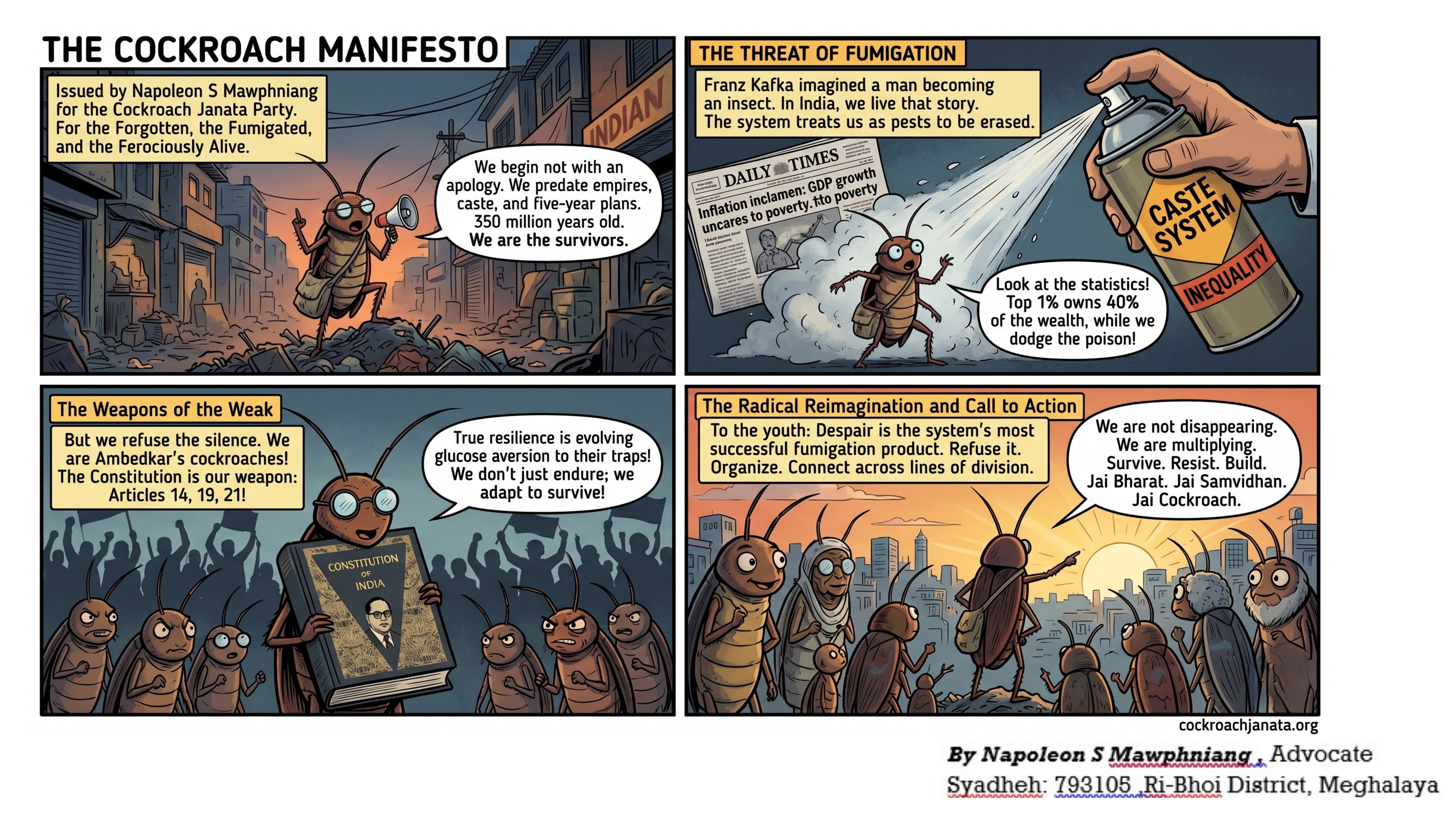
TEN: The Economy of Dignity — Against Crony Capitalism and For a Just Economy
“Poverty is not an accident. It is a policy.” — Arundhati Roy
We are not economists. We are cockroaches — and cockroaches know that survival is fundamentally an economic question. The question of who eats and who does not, who shelters and who does not, who works and on what terms, who owns and who is dispossessed — these are not abstract philosophical inquiries. They are the daily reality of the overwhelming majority of the 1.4 billion people whose lives constitute the project we call India.
And we will say what the polite economists at think tanks and the polished spokespeople at press conferences will not say clearly: the Indian economy, as it is currently structured, is not designed to produce broad-based prosperity. It is designed to produce spectacular wealth for a small class and manageable poverty — not destitution, just enough poverty to keep people compliant — for everyone else. This is not an accident of history or a failure of policy. It is the outcome of deliberate choices made by powerful people in favor of other powerful people, dressed in the language of reform, efficiency, liberalization, and growth.
The statistics, when you hold them together, tell a story that should shake every conscience in this republic. According to Oxfam India’s Survival of the Richest report (2023), the top 1% of India’s population holds more than 40% of the country’s total wealth. The bottom 50% of India — approximately 700 million people — holds just 3% of the country’s wealth. India has more billionaires than ever before in its history. It also has more people in multi-dimensional poverty — lacking adequate nutrition, healthcare, education, and basic services — than any other single country on earth.
These facts are not separate facts. They are causally connected facts. The concentration of wealth at the top and the persistence of poverty at the bottom are not two different problems. They are two faces of the same structural arrangement. When one entity is granted regulatory favors, tax concessions, cheap public land, and access to natural resources that are constitutionally held in trust for all citizens — when public sector banks lend thousands of crores to companies whose promoters then leave the country — when the assets of failing private enterprises are written off while the assets of failing farmers are seized — this is not a free market. This is, to use the technical economic term, loot.
The Constitutional Economics We Assert
The Constitution’s economic vision is not the vision of an unregulated market. The Preamble speaks of justice — social, economic, and political. Not just political justice, not just the formal equality of one person, one vote. Economic justice. The Directive Principles of State Policy — while not directly justiciable, as Article 37 specifies — represent the Constitution’s aspirational economics, and they are specific.
Article 38 directs the state to promote the welfare of the people by securing a social order in which justice — social, economic, and political — informs all institutions of national life. Article 39 directs the state toward ensuring that the ownership and control of material resources is distributed to serve the common good, and that the operation of the economic system does not result in the concentration of wealth and means of production to the common detriment.
Concentration of wealth to the common detriment. The Constitution had a phrase for what we are describing. The framers, many of whom had witnessed the extraction economics of colonialism at first hand, understood that capitalism without constitutional guardrails would reproduce colonialism’s inequalities through domestic actors rather than foreign ones. They were right.
The Supreme Court in State of Kerala v. N.M. Thomas (1976) held that Articles 14 and 16 must be read in the light of Article 46, which directs the state to protect the economic interests of the weaker sections. The Court in Bandhua Mukti Morcha v. Union of India (1984) recognized the fundamental right to live with basic dignity as part of Article 21, encompassing the right to livelihood, to education, to healthcare, and to freedom from bonded labor. These are not radical propositions. They are the settled constitutional jurisprudence of India. Yet they remain profoundly aspirational for hundreds of millions of our fellow citizens.
The Farmer and the Free Market
We speak of the farmer because India’s economy, for all its software exports and startup unicorns, remains at its foundation agricultural. Over 50% of India’s workforce is employed in agriculture. Agriculture contributes approximately 18% of GDP. The gap between those two numbers tells you everything about the structural exploitation of the agricultural sector — a sector where hundreds of millions of people work and yet receive a disproportionately small share of the economic value their labor produces.
The three Farm Laws of 2020 — the Farmers’ Produce Trade and Commerce (Promotion and Facilitation) Act, the Farmers (Empowerment and Protection) Agreement on Price Assurance and Farm Services Act, and the Essential Commodities (Amendment) Act — were repealed following the extraordinary farmers’ protests of 2020-21, in which hundreds of thousands of farmers, predominantly from Punjab, Haryana, and Uttar Pradesh, sat at the borders of Delhi for over a year in one of the longest and most disciplined mass movements in Indian democratic history.
We honor that movement. We honor it as an example of what organized, nonviolent, constitutionally rooted civil disobedience looks like when it is led by people who have nothing to lose. We honor the over 700 farmers who died during the protest. We note that their deaths were not given the media coverage, the political attention, or the national mourning that deaths of the powerful routinely receive.
But the repeal of those three laws did not resolve the structural crisis of Indian agriculture. The Minimum Support Price — which farmers’ organizations have long demanded be given statutory backing and legal guarantee — remains a discretionary government announcement rather than a legal right. Contract farming arrangements continue to disadvantage small and marginal farmers in negotiations with corporate buyers. Agricultural input costs — seeds, fertilizers, pesticides — continue to rise. Credit remains inaccessible to small farmers except through informal money lenders at exploitative rates. And the promise of agricultural income doubling — a promise made with statistical confidence in 2016 — has not been kept, and there is no credible roadmap for its fulfillment.
We demand: a statutory Minimum Support Price for all notified crops, guaranteed by law and enforceable in court. We demand: a national agricultural debt relief commission with the power to restructure and, where necessary, cancel the debts of small and marginal farmers. We demand: investment in rural agricultural infrastructure — irrigation, cold storage, rural roads, rural electrification — not as electoral announcements but as budgeted, time-bound, audited commitments. We demand: the right of farmers and farming communities to collect, exchange, and use indigenous seeds, free from the stranglehold of intellectual property regimes designed by and for multinational corporations.
The Worker and the Gig Economy
We speak of the worker. We speak specifically of the new worker — the worker who is called, in the euphemistic language of platform capitalism, a “partner” or a “delivery executive” or a “service provider” — the worker who delivers your food, drives your cab, cleans your home, and assembles the packages that arrive at your door with miraculous speed and at prices that would be impossible to sustain if someone, somewhere, were not being paid too little.
The four Labour Codes — the Code on Wages (2019), the Industrial Relations Code (2020), the Code on Social Security (2020), and the Occupational Safety, Health and Working Conditions Code (2020) — consolidated 44 existing labor laws. The stated purpose was simplification. The actual effect, in many significant ways, has been the dilution of worker protections — raising the threshold for mandatory trade union recognition, expanding the definition of “fixed-term employment” in ways that can be used to deny permanence, and extending the scope of exemptions for small establishments.
The International Labour Organization’s core conventions — on freedom of association, collective bargaining, freedom from forced labor, freedom from child labor, and non-discrimination — represent minimum global standards. India has ratified some and not others. The right to organize and collectively bargain — the fundamental right through which workers exercise collective agency against the structural power of capital — must be recognized, protected, and enforced without qualification.
The gig worker — that new figure of 21st-century Indian capitalism — has no employment status in law, no guaranteed minimum wage, no social security, no protection against arbitrary deactivation by the algorithm that is their effective employer. The Code on Social Security (2020) contains provisions for gig workers but they remain largely unimplemented. Rajasthan’s Platform Based Gig Workers (Registration and Welfare) Act, 2023 — the first state-level legislation specifically addressing gig workers’ rights — represents a beginning, an important one, but only that.
We demand: recognition of gig workers as workers, not contractors, for the purposes of labor protection. We demand: portability of social security benefits — provident fund, gratuity, health insurance — that follow the worker across platforms and employers. We demand: the right of platform workers to organize, to know the criteria by which the algorithm evaluates them, and to challenge algorithmic decisions through a fair and accessible process.
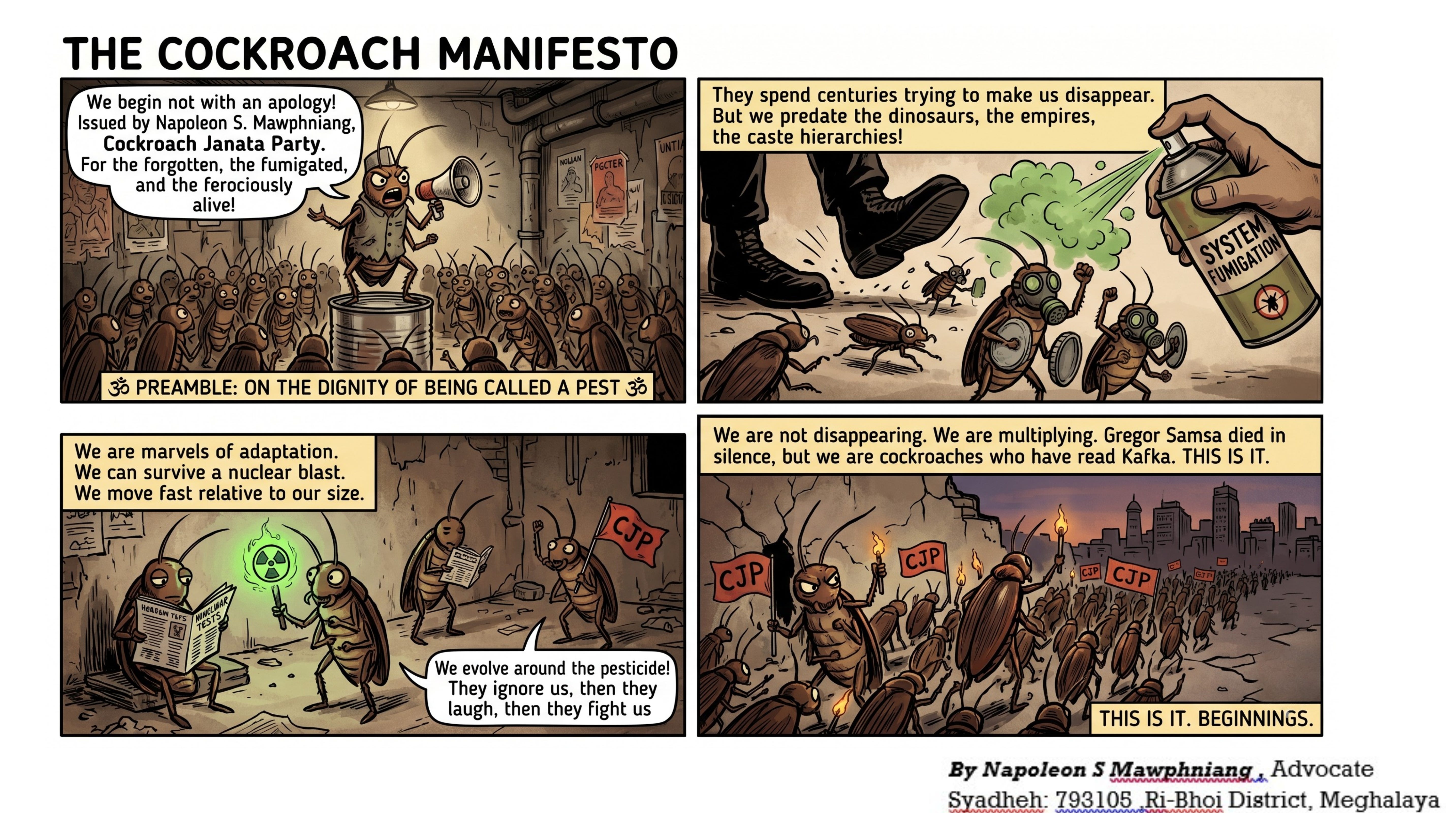
ELEVEN: The Digital Republic — Technology, Surveillance, and the Future of Freedom
“The most dangerous moment for a bad government is when it begins to reform.” — Alexis de Tocqueville, The Old Regime and the Revolution
We live in a country where more than 800 million people access the internet. We live in a country where the state has built one of the most sophisticated digital identity infrastructure systems in the world. We live in a country where CCTV cameras multiply on every street corner, where facial recognition technology is being deployed at airports, railway stations, and protest venues, where the question of who can see what, who can know what, and who can control what is becoming the defining political question of our time.
The digital republic is not separate from the constitutional republic. The rights guaranteed in the Constitution — to privacy, to expression, to movement, to association, to a fair trial, to dignity — do not evaporate in digital space. The Supreme Court in Justice K.S. Puttaswamy (Retd.) v. Union of India (2017) — the privacy judgment — settled this with a nine-judge bench unanimously recognizing privacy as a fundamental right under Article 21. Justice D.Y. Chandrachud’s concurring opinion in that case is a document of extraordinary importance. It recognized that privacy includes “informational privacy” — the right of a person to control information about themselves. It recognized the danger of the surveillance state. It recognized that the body, both physical and digital, is the site of fundamental rights.
That judgment was handed down in 2017. The surveillance infrastructure has expanded dramatically since then.
Aadhaar and the Architecture of Surveillance
The Aadhaar system — the biometric identity infrastructure that links iris scans and fingerprints to a 12-digit number that is then linked to bank accounts, ration cards, mobile numbers, property records, tax filings, and virtually every other point of interaction between the citizen and the state — was declared constitutional in Justice K.S. Puttaswamy (Retd.) v. Union of India (2018) by a 4:1 majority, with Justice D.Y. Chandrachud dissenting in terms that deserve careful reading.
Justice Chandrachud’s dissent described the Aadhaar Act’s passage as a Money Bill — which it was, despite not meeting the constitutional definition of a Money Bill — as a “fraud on the Constitution.” He described the potential for Aadhaar to enable pervasive state surveillance, to create a system in which every transaction, every interaction, every movement of every citizen could potentially be tracked, recorded, and used against them. He described the danger of dataveillance — the use of data collected for one stated purpose being repurposed for surveillance and control.
The majority upheld Aadhaar for government welfare purposes while striking down its mandatory use in private entities. But the questions Justice Chandrachud raised have not been answered. The questions have, in fact, become more urgent.
The Digital Personal Data Protection Act, 2023 (DPDPA) was passed with much fanfare as India’s answer to the GDPR — Europe’s comprehensive data protection regulation. The Act has significant provisions: consent requirements, data minimization principles, rights of data principals to access and correct their data. But it also has significant problems. The government is exempted from large portions of the Act when acting in the interest of “sovereignty, integrity, and security of India” or for “prevention, detection, investigation or prosecution of offences” — exemptions broad enough to swallow the rule. The Data Protection Board established under the Act lacks the independence of a genuinely autonomous regulatory body. And the Act contains no provisions on surveillance reform — the single largest source of state-driven privacy violation in India today.
We demand: an independent Privacy Commission with constitutional status, similar to the Election Commission of India, empowered to investigate complaints against both state and private entities, to issue binding orders, and to impose meaningful penalties. We demand: judicial oversight of all state surveillance programs — no surveillance without a warrant issued by an independent magistrate. We demand: a Surveillance Reform Act that brings India’s intelligence and law enforcement agencies under a legal framework that specifies their powers, establishes oversight mechanisms, and creates accountability for abuse.
The Internet Kill Switch and the Right to Communicate
India holds the unfortunate distinction of being the world’s largest democracy and, simultaneously, the world’s most frequent user of internet shutdowns. According to Access Now’s #KeepItOn reports, India has accounted for the largest number of internet shutdowns globally in multiple consecutive years. Kashmir alone has experienced the world’s longest continuous internet shutdown in a democracy — over 180 days following the revocation of Article 370 in August 2019.
The Supreme Court in Anuradha Bhasin v. Union of India (2020) held that internet access is a fundamental right under Article 19(1)(a) (freedom of speech and expression) and Article 19(1)(g) (right to practice any profession or carry on any trade). The Court held that internet shutdowns must be for a necessary and proportionate purpose, must be for the shortest possible duration, and must be subject to review by the state. The Court ordered the publication of all shutdown orders.
These directions have been observed in breach. Internet shutdowns continue to be imposed — in Manipur, in Rajasthan, in Haryana, in Jammu — with frequency, duration, and scope that cannot, under any credible constitutional analysis, be described as necessary and proportionate. The right to communicate is not a luxury. It is not a convenience. In the 21st century, the internet is the public square, the marketplace, the library, the doctor’s office, the school, and the community center. Cutting it off is not a tool of law and order. It is a tool of information control.
We demand: the prohibition of internet shutdowns as a routine law and order measure. We demand: that any internet restriction be subject to prior judicial approval except in the most extreme emergencies — and that even emergency restrictions be subject to review within 24 hours by an independent judicial authority.
Artificial Intelligence and the Question of Accountability
We speak of artificial intelligence not because we are technologists, but because we are citizens, and the deployment of AI-powered systems in governance affects every citizen — especially the most vulnerable. Facial recognition technology is being used by police forces to identify “suspects” at public gatherings, to screen applicants for welfare benefits, to track the movements of individuals identified as persons of interest. The accuracy of facial recognition systems across different demographic groups is demonstrably unequal — they are significantly less accurate for women, for dark-skinned individuals, for the elderly. In a country as diverse as India, the deployment of a technology that is biased against the very communities that are already most marginalized by the justice system is not a technical problem. It is a constitutional one.
The algorithm that determines who receives welfare benefits, whose tax return is flagged for scrutiny, whose loan application is approved, whose passport application is expedited or delayed — these algorithms are making decisions that profoundly affect human lives. They are doing so without transparency, without explanation, without accountability, and without any mechanism through which affected individuals can understand, contest, or seek redress for automated decisions.
We demand: a moratorium on the use of facial recognition technology by law enforcement and other government agencies until a comprehensive legal framework is established. We demand: algorithmic transparency — the right of any person affected by an automated government decision to receive a meaningful explanation of how that decision was reached. We demand: an AI ethics commission with genuine regulatory power to assess, monitor, and when necessary prohibit the deployment of AI systems in high-stakes public contexts.
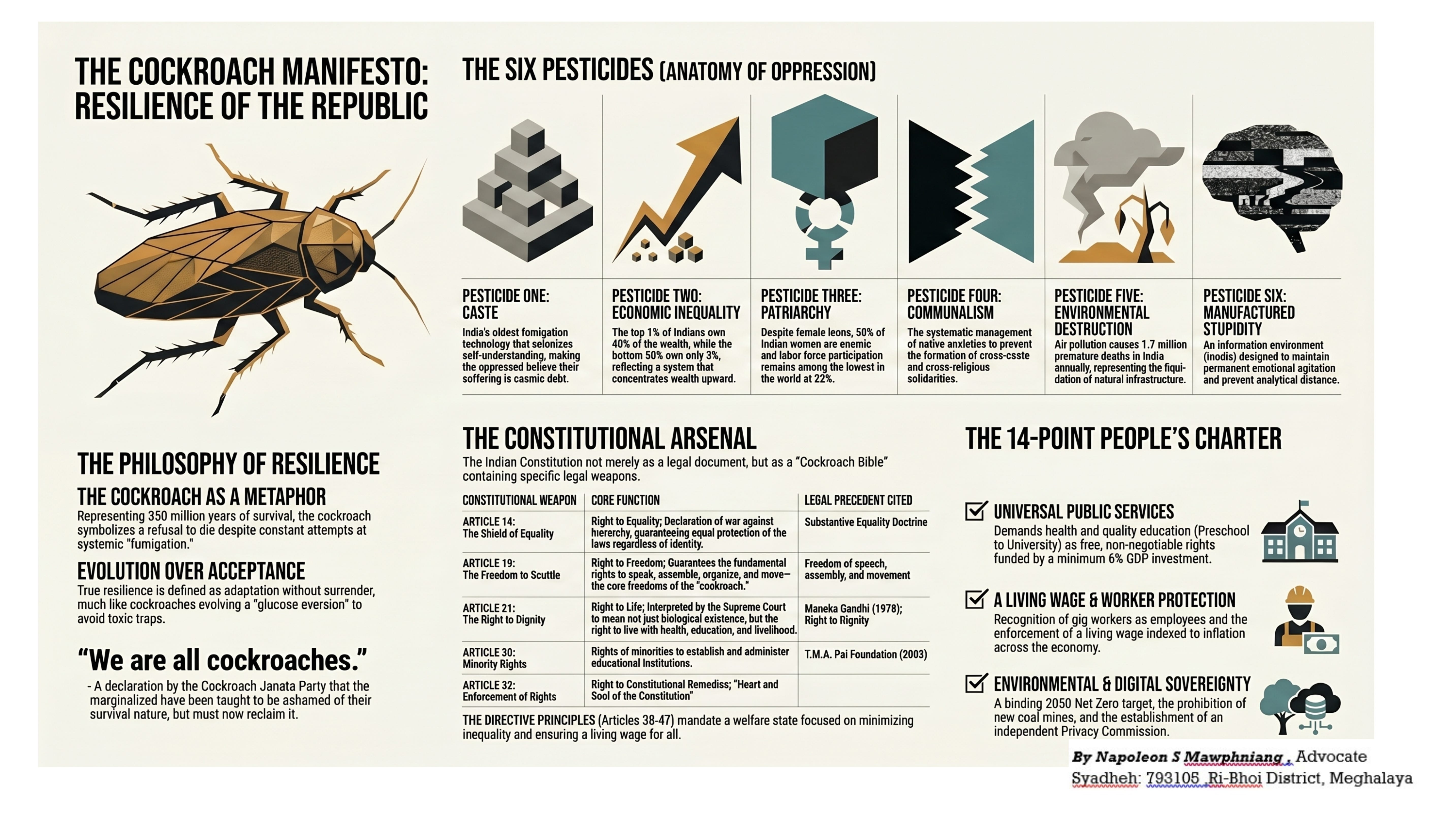
TWELVE: The Climate Emergency and the Right to a Future
“We are the first generation to feel the effect of climate change and the last generation that can do something about it.” — Barack Obama
“The sky is not the limit when there are footprints on the moon.” — And yet the sky is the limit when it is on fire.
The monsoon is changing. The Himalayan glaciers — the water towers of Asia, the sources of rivers that sustain the agriculture and the drinking water of hundreds of millions of people — are retreating at accelerating rates. The frequency and intensity of cyclones in the Bay of Bengal and the Arabian Sea is increasing. Heatwaves that were once-in-50-year events are now once-in-5-year events. Sea levels are rising, and the coastal communities of Sundarbans, of Odisha, of Tamil Nadu, of Kerala, of Gujarat are feeling the water at their feet.
We are not speaking of the future. We are speaking of the present. The climate emergency is not a threat on the horizon. It is an ongoing catastrophe that is, right now, today, destroying the livelihoods of farmers, fishermen, forest communities, and urban poor across India.
The constitutional framework for environmental protection is robust. Article 21’s right to life has been interpreted to include the right to a clean environment. Article 48A directs the state to protect and improve the environment. Article 51A(g) places on every citizen the fundamental duty to protect and improve the natural environment. The Supreme Court’s constitutional environmental jurisprudence, from M.C. Mehta v. Union of India (1987) onwards, has been among the most progressive in the world. India’s National Green Tribunal, established under the National Green Tribunal Act, 2010, is the most comprehensive specialized environmental court in Asia.
And yet. And yet the Himalayan glaciers recede. And yet the forests shrink — because forest diversion for infrastructure and mining continues at a pace that the compensatory afforestation program cannot match and does not meaningfully attempt to match. And yet the rivers run dirty, or run dry, or run in channels so modified by dams and barrages that the fish no longer know their way home.
The Political Economy of Climate Inaction
We must speak plainly about why India struggles to translate its constitutional environmental commitments into effective climate action. It is not a matter of technical incapacity. India has some of the finest environmental scientists, climate economists, and sustainability practitioners in the world. It is not a matter of legal framework — the framework, as we have noted, is strong.
It is a matter of political economy. The industries that produce the most greenhouse gas emissions — power generation, steel, cement, transportation, petrochemicals — are also the industries that generate the most campaign contributions, that employ the most people in politically significant constituencies, that are most closely interlocked with the networks of political and business power that govern India. This is not a conspiracy. It is a structural feature of how advanced capitalism interacts with democratic politics: those who benefit most from the status quo have the greatest incentive and the greatest resources to maintain it.
India’s Nationally Determined Contributions under the Paris Agreement — its climate pledges — have been described as “highly insufficient” by the Climate Action Tracker, meaning they are not consistent with limiting global warming to 1.5°C. The commitment to reach net zero emissions by 2070 is the latest of any major economy. The expansion of renewable energy — which has been genuinely impressive in terms of installed capacity — has been accompanied by the continued approval of new coal mines and coal power plants, because the transition from coal has to be managed against the employment and energy security implications that a too-rapid transition would create.
We are not naive. We understand the genuine dilemma facing India: a country that has contributed a fraction of the cumulative greenhouse gas emissions that have caused the climate crisis, that has hundreds of millions of people still without reliable electricity or adequate cooking fuel, that has legitimate development aspirations that its citizens have every right to pursue — this country faces a genuine and profound injustice in being asked to limit its carbon emissions while the historically responsible wealthy nations have, in the main, failed to deliver the climate finance they promised and continue to consume at levels that are themselves unsustainable.
This is true. And we invoke it as a matter of international climate justice, not as an excuse for domestic inaction. The transition to clean energy in India is, simultaneously, a climate imperative, a development opportunity, a public health necessity — because air pollution from coal combustion kills an estimated 1 million Indians every year — and a matter of basic dignity for the millions of people who currently depend on dirty fuels for cooking and heating.
What We Demand for the Climate
We demand: a binding domestic net zero target of 2050, backed by a credible, independently monitored transition plan, sectoral decarbonization roadmaps, and just transition support for workers and communities in fossil fuel industries.
We demand: the immediate establishment of a constitutional right to a clean, healthy, and sustainable environment — joining the growing number of countries whose constitutions explicitly recognize this right, and giving Indian citizens direct constitutional standing to challenge actions that threaten the climate.
We demand: the prohibition of new coal mine approvals and coal power plant approvals. The existing coal infrastructure can be managed through its economic life while renewables scale — but not a single new approval should be granted.
We demand: a National Climate Adaptation Fund, capitalized at a meaningful scale, directed specifically at the communities most vulnerable to climate impacts — coastal communities, Himalayan communities, drought-prone agricultural regions, urban heat island zones — and administered with genuine community participation.
We demand: that India’s international climate diplomacy be matched by its domestic climate action — that we not invoke climate justice as an argument for international redistribution while simultaneously expanding domestic emissions.
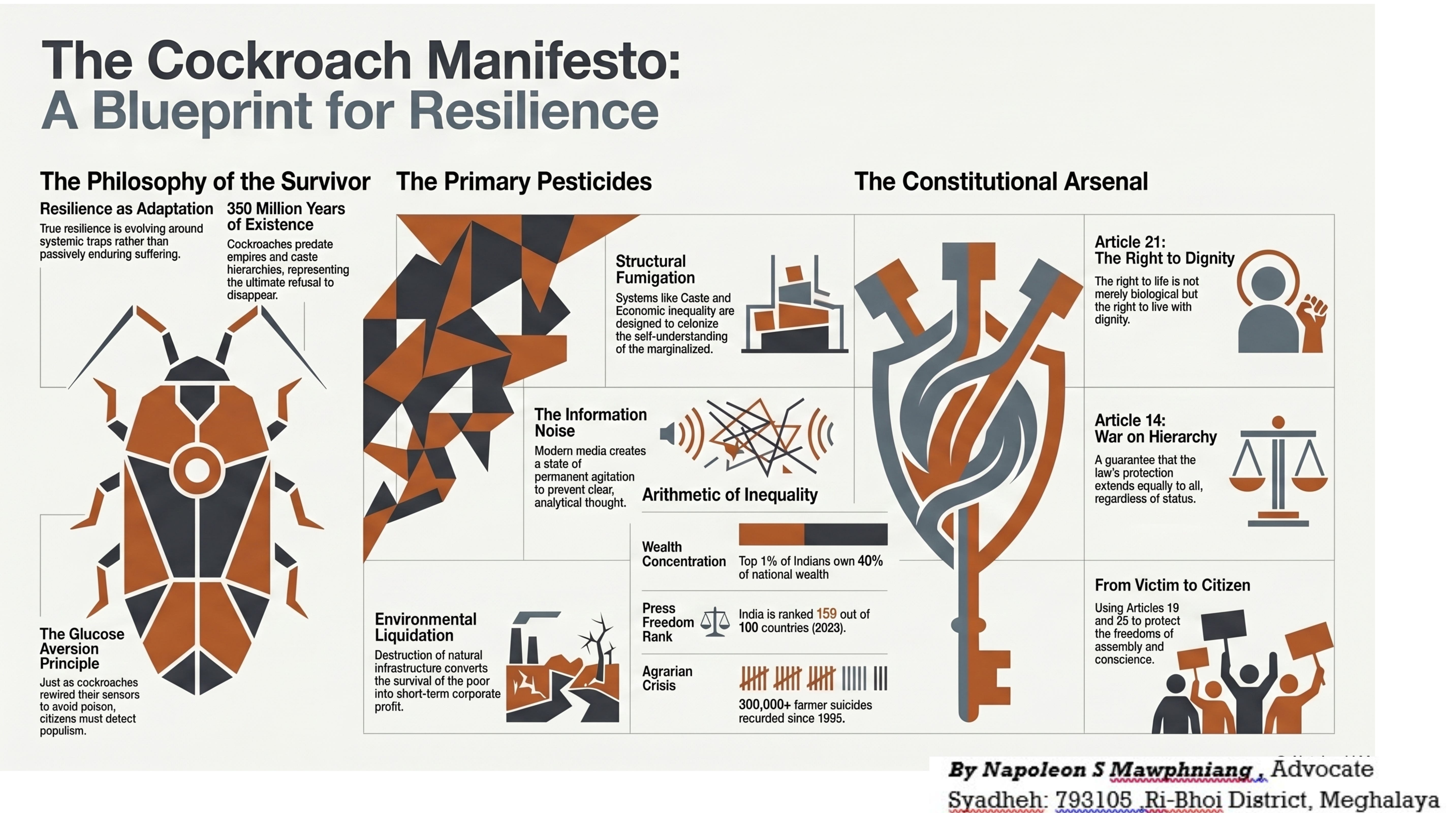
THIRTEEN: The Question of Kashmir — An Unsettled Account
“In the valley of the shadow, we are all complicit in the silence.”
We approach this section with care, with humility, and with the recognition that Kashmir is not a political talking point. Kashmir is a place. It is a valley of extraordinary beauty where human beings live, love, grieve, and have been doing so for millennia. The political question of Kashmir — its constitutional status, its relationship to the Indian Union, the aspirations of its people — is one of the most complex, most contested, and most consequential questions in South Asian politics. We will not resolve it in these pages. We will not pretend to resolution where none exists.
What we will do is insist on the minimum that constitutional democracy demands: that the people of Jammu and Kashmir — all of them, Kashmiri Muslims and Kashmiri Pandits and Dogris and Gujjars and Ladakhis — be treated as citizens of the republic, with all the rights, dignity, and protections that citizenship entails.
The revocation of the special status of Jammu and Kashmir through the Presidential Orders of August 5, 2019, and the subsequent bifurcation of the state into two Union Territories, raised constitutional questions of the gravest seriousness. The challenge to these actions was adjudicated by the Supreme Court in Dr. Rajnath Singh Raina v. Union of India (2023), where a five-judge Constitution Bench upheld the revocation — a decision whose reasoning continues to be extensively debated by constitutional scholars.
We take no position on the final status question — it is above the pay grade of cockroaches to resolve. What we insist upon, with the full force of constitutional principle, is this: the months of communication blackout that followed the revocation, the mass detentions under the Public Safety Act — a law so sweeping in its preventive detention powers that it has been called a “lawless law” by Amnesty International — the restrictions on assembly, the limitations on press freedom, the deployment of military and paramilitary forces in configurations more appropriate to active war zones than to a territory that is constitutionally part of India — none of this can be squared with the republic’s foundational commitments.
The Kashmiri Pandit community’s displacement — their exodus from the valley in the 1990s, their decades in refugee camps, the failure of successive governments to enable their dignified return — is also an unresolved wound in the body of the republic. The political exploitation of their suffering — the way their pain has been deployed as a rhetorical weapon in communal politics while genuine solutions for their return and rehabilitation have been subordinated to political calculations — is a betrayal of the same kind, from a different direction.
Kashmir’s unresolved status is not a security problem waiting for a military solution. It is a political problem waiting for a political solution — one that can only emerge from processes of genuine dialogue, democratic participation, and constitutional good faith.
We demand: the restoration of full statehood to Jammu and Kashmir, as the Supreme Court’s 2023 judgment directed, at the earliest. We demand: the repeal or comprehensive reform of the Public Safety Act to bring it in conformity with constitutional standards for preventive detention. We demand: an independent commission to investigate all alleged human rights violations in Jammu and Kashmir and to provide justice and compensation to victims. We demand: a genuine political process — not an administered process, not an engineered outcome, but a genuine dialogue — with the full spectrum of Kashmiri political opinion.
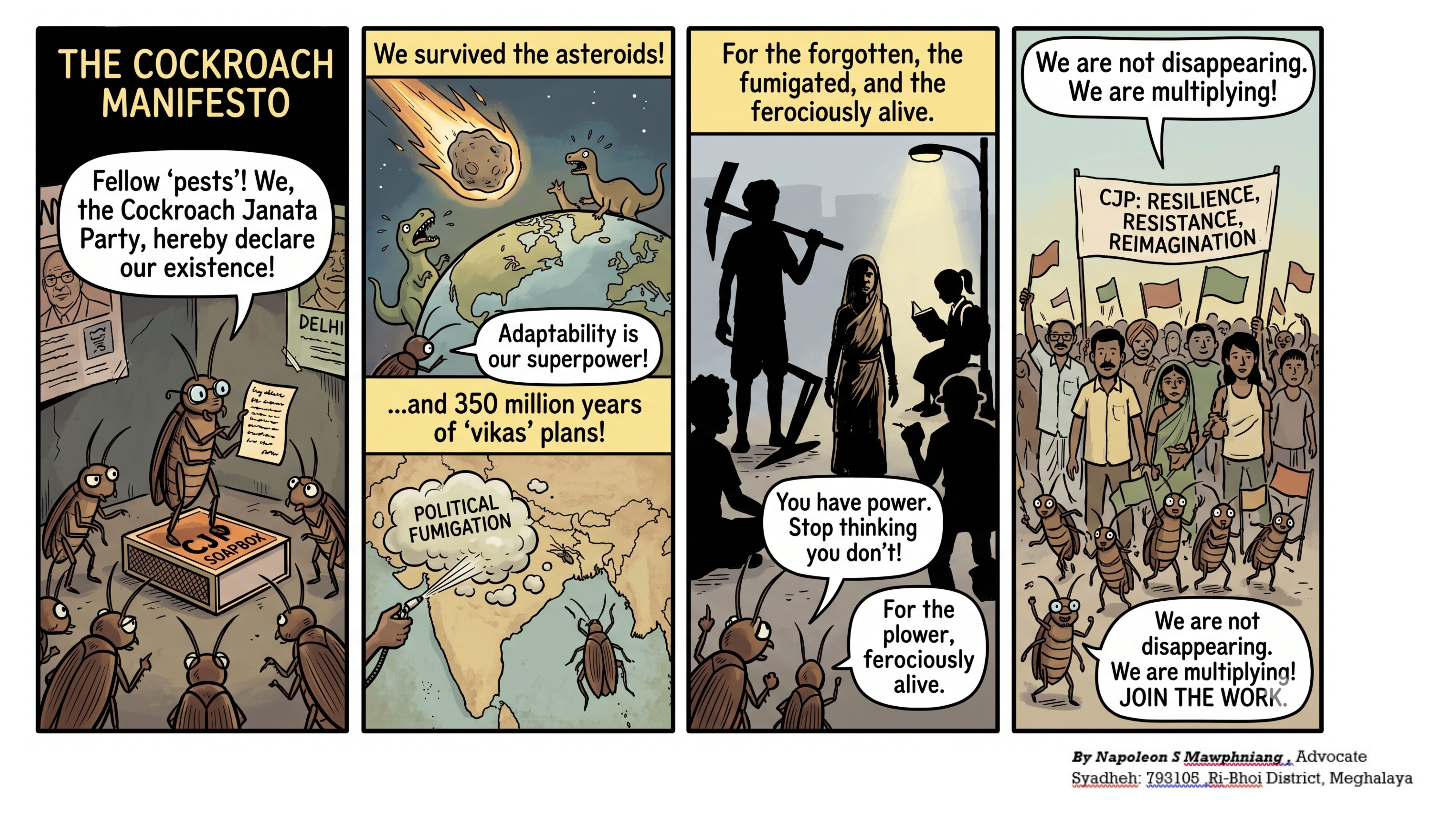
FOURTEEN: Foreign Policy for a Post-Colonial World
“Vasudhaiva Kutumbakam — the world is one family. But a family that forgets its history is a family that will repeat it.”
India’s foreign policy has, in its best moments, been animated by the vision of Vasudhaiva Kutumbakam and the Non-Aligned Movement’s insistence on the sovereign equality of nations — the insistence, born of the bitter experience of colonialism, that no nation has the right to dominate another, that international relations must be governed by law and not power, that the voiceless must have a voice in the councils of the world.
We honor that tradition. We honor it in the memory of Jawaharlal Nehru’s inaugural address to the United Nations, in the vision of Panchsheel, in India’s role in the Bandung Conference, in the insistence of Indian diplomacy that the postcolonial world must not merely replace European masters with American or Soviet ones.
And we note, with the clarity of creatures who have survived every empire that ever rose on this earth, that this tradition is under strain. The pressures of a multipolar world, the demands of great power competition between the United States and China, the Russian invasion of Ukraine, the evolving geometry of regional security in Asia, the economic imperatives of energy security and supply chain resilience — all of these create real and complex choices for Indian foreign policy.
But we insist on some principles that should be non-negotiable regardless of the pragmatic pressures of the moment.
We insist that India’s foreign policy cannot credibly invoke the rules-based international order when convenient and dismiss it when inconvenient. You cannot cite the UN Charter’s prohibition on the unilateral use of force to oppose Chinese aggression in the Indo-Pacific while refusing to acknowledge the same prohibition when Russia invades Ukraine. Principles are only principles if they are applied consistently. Selective application of principles is not principle — it is interest dressed in principle’s clothing.
We insist that India’s engagement with its South Asian neighborhood must be guided by the long-term interest of regional stability and mutual prosperity rather than the short-term temptation of hegemonic dominance. The Neighbourhood First policy is a sound starting point — but it requires that India be a reliable, respectful, and non-coercive partner to its smaller neighbors, not a patron expecting deference or a power using economic leverage to extract political compliance.
We insist that India’s voice on the reform of the global governance architecture — the reform of the UN Security Council, the reform of the IMF and World Bank, the reform of the WTO dispute settlement mechanism, the reform of the global climate finance architecture — must be a voice for genuine multilateralism and genuine representation of the Global South, not merely an argument for adding India to the existing club of privileged powers.
We insist that India’s growing military expenditure and its expanding security partnerships must be matched by an equivalent investment in human security — the security of India’s own people from poverty, disease, ignorance, and environmental catastrophe.
FIFTEEN: The Cockroach Coda — A Civilization’s Promise to Itself
“The arc of the moral universe is long, but it bends toward justice.” — Theodore Parker, elaborated by Martin Luther King Jr.
“But it does not bend by itself. It bends because people bend it.” — The Cockroach Janata Party
We have written these pages in the voice of the cockroach — in the voice of those who survive, who persist, who cannot be exterminated because they are everywhere and nowhere, because they occupy every crack in every wall of every building that power has ever erected.
We have written in this voice because we believe that the future of India will be written not in the air-conditioned offices of power but in the chawls of Mumbai, in the lanes of Dharavi, in the farms of Vidarbha, in the forests of Bastar, in the factories of Gurugram, in the schools of Bihar, in the hospitals of Uttar Pradesh, in the universities where young people are learning to ask questions that their teachers have not been given the freedom to answer, in the streets where people march with the constitutional text in their hands and the conviction that what is written there can become true.
We have drawn from the literature of the world because we believe that the struggles described in these pages are not uniquely Indian. They are the universal struggle of the many against the few, of the governed against the ungoverned, of those whose lives are shaped by power against those who hold power and would rather not be disturbed while doing so. Tolstoy’s peasants, Dickens’ workhouses, Zola’s miners, García Márquez’s one-hundred-years of imaginary solitude that mirrors very real solitudes, Chinua Achebe’s world that fell apart under the weight of colonial encounter, Toni Morrison’s beloved ghosts of slavery that haunt the American present — all of these speak to the Indian condition because the human condition is one.
Ambedkar read Marx and rejected the parts that were wrong while retaining the parts that were right. He read Gandhi and rejected the parts that preserved caste while honoring the parts that spoke of human dignity. He read the history of every constitution in the world before writing India’s — and what he produced was not a borrowed document but an original one, one that took the best that human civilization had learned about how to organize collective life and adapted it to the specific, complex, beautiful, contradictory genius of India.
We honor that inheritance. We honor it not through reverence — reverence is static, and the Constitution is a living document — but through use. Through the daily, difficult, unglamorous work of invoking rights, challenging violations, filing cases, organizing communities, building coalitions, writing pamphlets, holding meetings in village squares and college auditoriums and WhatsApp groups and town halls.
What the Youth Must Understand
We are writing for you — the young person in the college hostel room reading this at midnight, the young person who is angry and doesn’t yet know exactly why, the young person who has been told that political engagement is naive, that the system cannot be changed, that the powerful will always win, that the best strategy is individual escape — get the marks, get the job, get out.
We are writing to tell you that escape is not available. There is no country called Abroad that will save you permanently. There is no career high enough that its walls will keep out the consequences of the republic’s failures. There is no privilege sufficient to insulate you forever from the effects of democratic decay, of environmental collapse, of economic inequality, of communal polarization. History is not a spectator sport. It will find you wherever you sit.
We are writing to tell you that the young people of every generation who changed the world began where you are: uncertain, underprepared, angry, hopeful, not sure if it was worth it, not sure if they had the strength. The students of the 1942 Quit India movement who went to jail while they were preparing for exams. The young lawyers of the civil rights movement in America who sat at lunch counters and let themselves be beaten while maintaining the dignity their oppressors were trying to strip from them. The young women of the Chipko movement who wrapped their arms around trees in the Himalayan forests and said, you will have to go through us. The students of Tiananmen Square. The children of Soweto. The daughters of the Mothers of the Plaza de Mayo. The young people of the Arab Spring — some of whom won and many of whom were crushed, but none of whom can be said to have failed in their humanity.
We are writing to tell you: it is worth it. Not because winning is guaranteed — we are cockroaches, and we know that winning is never guaranteed. But because living as a full citizen — as a person who takes responsibility for the republic, who engages with its failures as their own, who insists on the dignity of their fellow citizens with the same energy they bring to insisting on their own — is a better life than the life of a person who has been successfully persuaded that none of this concerns them.
The Cockroach Ethic
We have been asked — and we ask ourselves — what does the cockroach stand for, beyond survival? What is the philosophy of an insect that has outlasted every civilization, every empire, every extinction event that has wiped cleaner organisms from the face of the earth?
We offer this: the cockroach stands for adaptation without abandonment of self. The cockroach adapts to every environment — to cold and heat, to darkness and light, to abundance and scarcity, to the palaces of the powerful and the gutters of the dispossessed — without ceasing to be what it is. It does not pretend to be something else. It does not perform for the comfort of those who find it unsightly.
And the cockroach is not alone. Cockroaches move in collectives. They communicate through chemical signals — not through the algorithms of social media, which fragment attention and reward outrage, but through the slow, patient chemistry of proximity, of inhabiting the same space, of sharing the same walls.
The politics we are calling for is a cockroach politics: adaptive, collective, honest, unglamorous, patient, and utterly unkillable.
The Demands We Summarize, the Future We Envision
Having walked through the length and breadth of India’s constitutional promise and its lived failures, we consolidate what we have demanded throughout these pages — not as a shopping list for a political party, but as a framework for a civilizational reckoning:
On Democracy and Elections:
Full electoral reform including state funding, disclosure norms, and an independent Election Commission genuinely insulated from executive pressure
Proportional representation reform to ensure that the composition of Parliament reflects the actual distribution of voter preferences
Constitutional protection for the right to information, the right to protest, and the right of citizens to hold their representatives accountable
On the Judiciary and Rule of Law:
A transparent, independent collegium reform that ends the opacity of judicial appointments
Comprehensive law reform and repeal of colonial-era legislation still used to suppress dissent
Fundamental reform of the UAPA, NSA, and PSA to bring preventive detention laws in line with constitutional standards
Investment in legal aid infrastructure that makes justice accessible to the poor
On Education:
Tripling of public expenditure on education as a percentage of GDP
Constitutional protection of university autonomy and academic freedom
Curriculum reform that teaches critical thinking, constitutional literacy, and scientific temper
Elimination of caste and communal bias from educational content and pedagogical practice
On Healthcare:
Universal health coverage as a constitutional right, enforceable in court
Doubling of public health expenditure as a percentage of GDP
Reform of the pharmaceutical sector to ensure affordable access to essential medicines
Mental health as a component of the fundamental right to health
On Caste:
Implementation of Rohith Act recommendations to end discrimination in higher education
Comprehensive reform of the prison system to address caste-based hierarchies within incarceration
Independent monitoring of atrocity prevention and prosecution under the SC/ST (Prevention of Atrocities) Act
Genuine representation of Dalit, Adivasi, and OBC communities in the private sector, judiciary, and media
On Gender:
Comprehensive legal reform to end gender-based discrimination in property, inheritance, and family law
A fully resourced national gender-based violence prevention and response system
50% representation of women in all elected bodies
Economic empowerment programs designed by women, for women, with full community participation
On Minorities:
Strict enforcement of the Places of Worship (Special Provisions) Act, 1991
Repeal of anti-conversion laws
Linguistic rights protection including expansion of the Eighth Schedule
Independent prosecution of communal violence without political interference
On Land and Forest Rights:
Full implementation of the Forest Rights Act
PESA conforming legislation in all Fifth Schedule states
FPIC as a binding legal requirement for projects affecting tribal lands
Moratorium on displacement pending resolution of Forest Rights Act claims
On the Economy:
Statutory Minimum Support Price for agricultural produce
Agricultural debt relief commission
Gig worker protection legislation and portability of social security
Progressive reform of taxation to reduce wealth concentration
On Digital Rights:
Independent Privacy Commission with constitutional status
Judicial oversight of all surveillance
Moratorium on facial recognition technology
Internet shutdown prohibition except under judicial oversight
On Climate:
Constitutional right to a clean environment
Binding net zero target of 2050 with independent monitoring
Prohibition on new coal approvals
Just transition support for fossil fuel-dependent workers and communities
On Kashmir and Northeast:
Restoration of statehood to Jammu and Kashmir
Reform of preventive detention laws
Independent human rights commission for conflict-affected areas
Genuine political dialogue with all stakeholders
On Foreign Policy:
Principled multilateralism applied consistently
Neighbourhood First policy implemented without hegemonic pressure
Advocacy for Global South representation in reformed multilateral institutions
The Final Word: A Letter to the Cockroach in All of Us
There is a cockroach in each one of us. There is a part of each one of us that has survived things it was not supposed to survive — poverty, humiliation, failure, grief, the daily indignity of a system that was not built for us and does not particularly care whether we thrive or merely endure.
That part of us — the part that survived — is not a weakness. It is not something to be ashamed of. It is, in fact, the source of our greatest capacity for solidarity, because those who have survived know what it means to be in danger. They know what it means to need help. They know what it means to have the world arranged against you — and they know, because they have felt it, the transformative power of a single act of assistance from a fellow creature who was under no obligation to help but chose to anyway.
We are calling for an India in which that act — the act of choosing to help, choosing to stand with the vulnerable, choosing the harder but truer path of solidarity over the easier path of comfortable indifference — becomes not exceptional but ordinary. Not heroic but habitual. Not the province of saints and activists but the daily practice of citizenship.
The Constitution does not ask us to be saints. It asks us to be citizens. It asks us to hold the republic to its promises. It asks us to participate — in elections, in institutions, in the long, difficult, unglamorous work of democratic self-governance. It asks us to remember that the rights it guarantees are not gifts from the state — they are assertions of our own humanity, pre-existing and inalienable, which the state is merely bound to recognize and protect.
The cockroach does not wait for permission to survive. Neither do we.
We are the Cockroach Janata Party. We live in your walls, your floors, your foundations. We were here before you built this place, and we will be here long after you have finished deciding what to do with it.
But we would prefer — we would very much prefer — to spend the time between now and then building something together. Something worthy of the civilization that produced the Vedas and the Upanishads and the Sangam poetry and the Ajanta frescoes and the architecture of Hampi and the mathematics of Aryabhata and the philosophy of Nagarjuna and the social vision of Kabir and the revolutionary love of Mirabai and the constitutional genius of Ambedkar.
Something worthy of the 1.4 billion people who are India — not the India of statistics and GDP projections and credit ratings and geopolitical calculations, but the India of people. The farmer who plants in the morning not knowing if the monsoon will come. The student who studies by streetlight because the electricity at home is unreliable. The woman who walks four kilometers to the water source before sunrise so that her family can eat. The old man in the village who still knows the names of the stars and the movements of the birds and the signs of rain in the behavior of ants.
These people are India. Their lives, their struggles, their aspirations, their dignity — these are the measure by which the republic must be judged. Not by its missiles, not by its GDP rank, not by its representation on international bodies, not by the performances of its political leaders on international stages.
By them. By the farmer and the student and the woman and the old man. By the Dalit child who walks to school. By the young woman who wants to study engineering and is told that girls don’t do that. By the Muslim shopkeeper who wonders, in the quiet hours, whether his country still considers him fully its own. By the Adivasi family that watches the forest their ancestors protected being surveyed for a mine that will give them nothing and take everything.
By them. Always by them.
Jai Bharat. Jai Samvidhan. Jai Cockroach.
Survive. Resist. Build
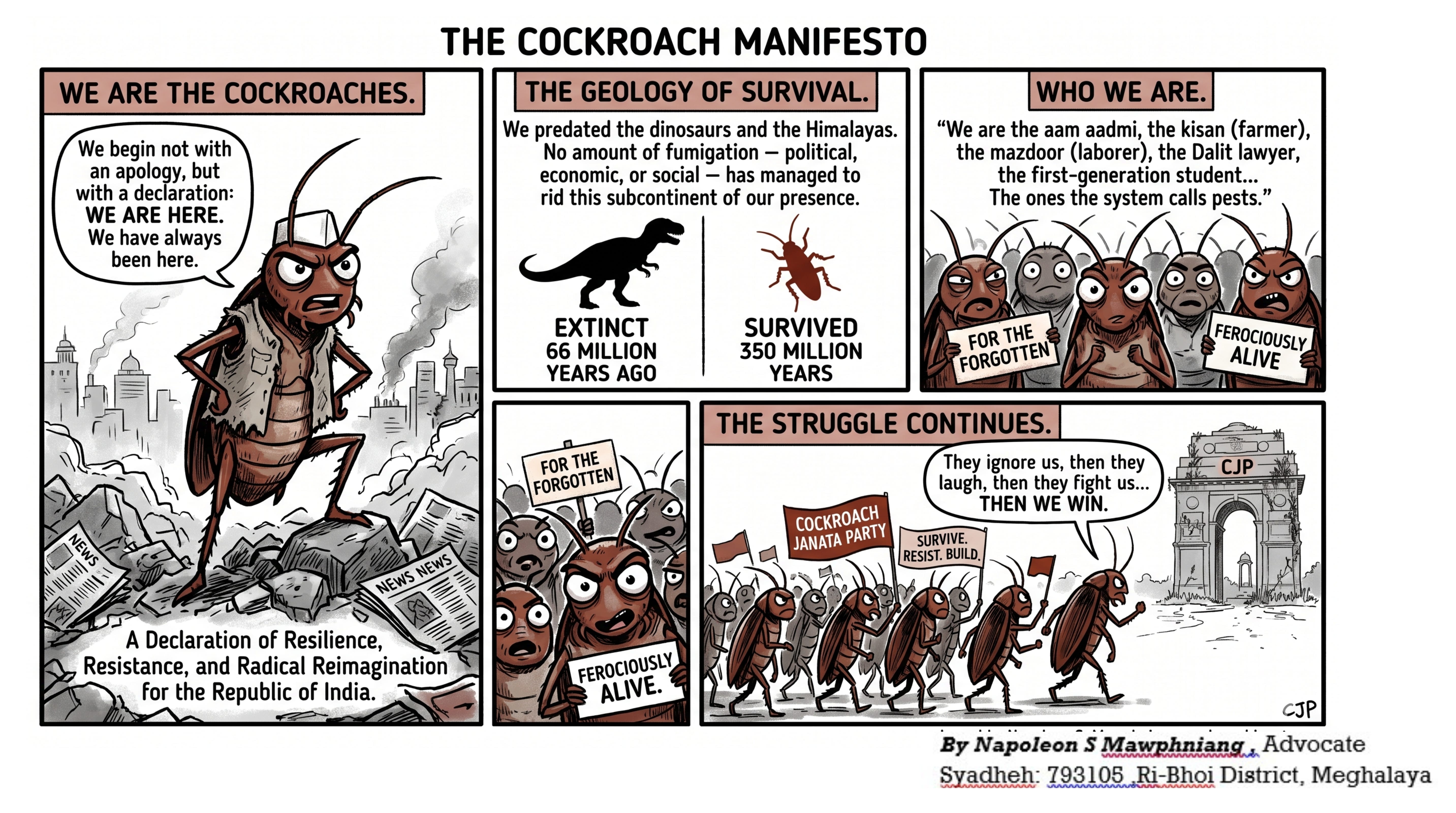
.
Published FOR the Cockroach Janata Party
This Manifesto may be freely reproduced, distributed, translated, performed, sung, painted on walls, read aloud in universities, discussed in tea stalls, debated in village squares, and argued about at family dinners. It may not be used to justify violence against any human being or any cockroach. It is the property of no one and the responsibility of everyone.
जीवित रहो। प्रतिरोध करो। निर्माण करो। வாழ்க. எதிர்க்க. கட்டு. বেঁচে থাকো। প্রতিরোধ করো। গড়ে তোলো। ਜਿਉਂਦੇ ਰਹੋ। ਵਿਰੋਧ ਕਰੋ। ਬਣਾਓ।
Survive. Resist. Build — in every tongue that India speaks.
The cockroach is not a symbol of filth. The cockroach is a symbol of persistence in a world that has repeatedly tried to make it disappear. We are that persistence. We are that refusal. We are the republic remembering what it promised to be.
- FOR THE COCKROACH JANATA PARTY Established in the cracks of the walls of power. Operating in every corner of the republic.
End of Manifesto Beginning of the Work.
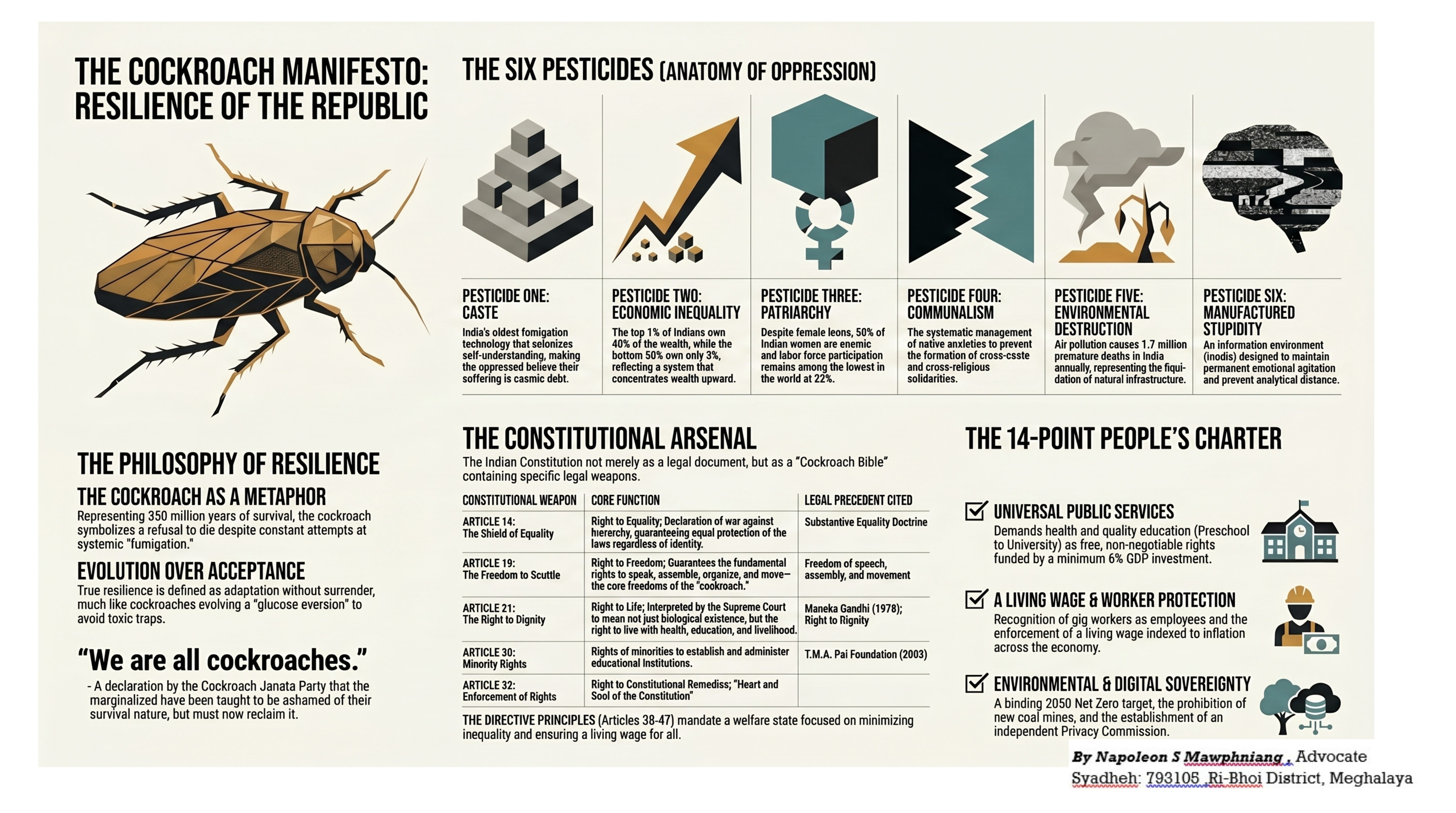
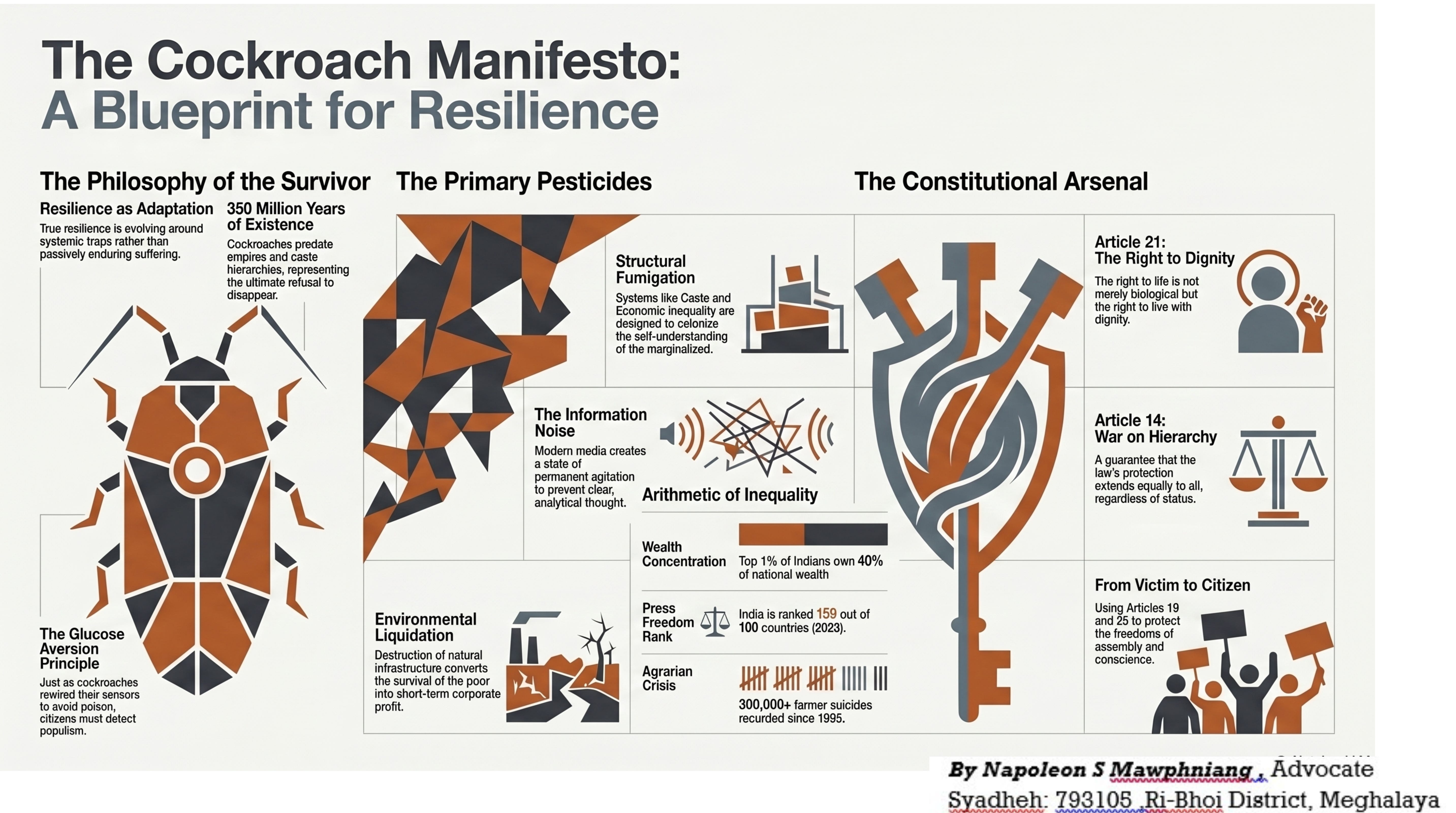
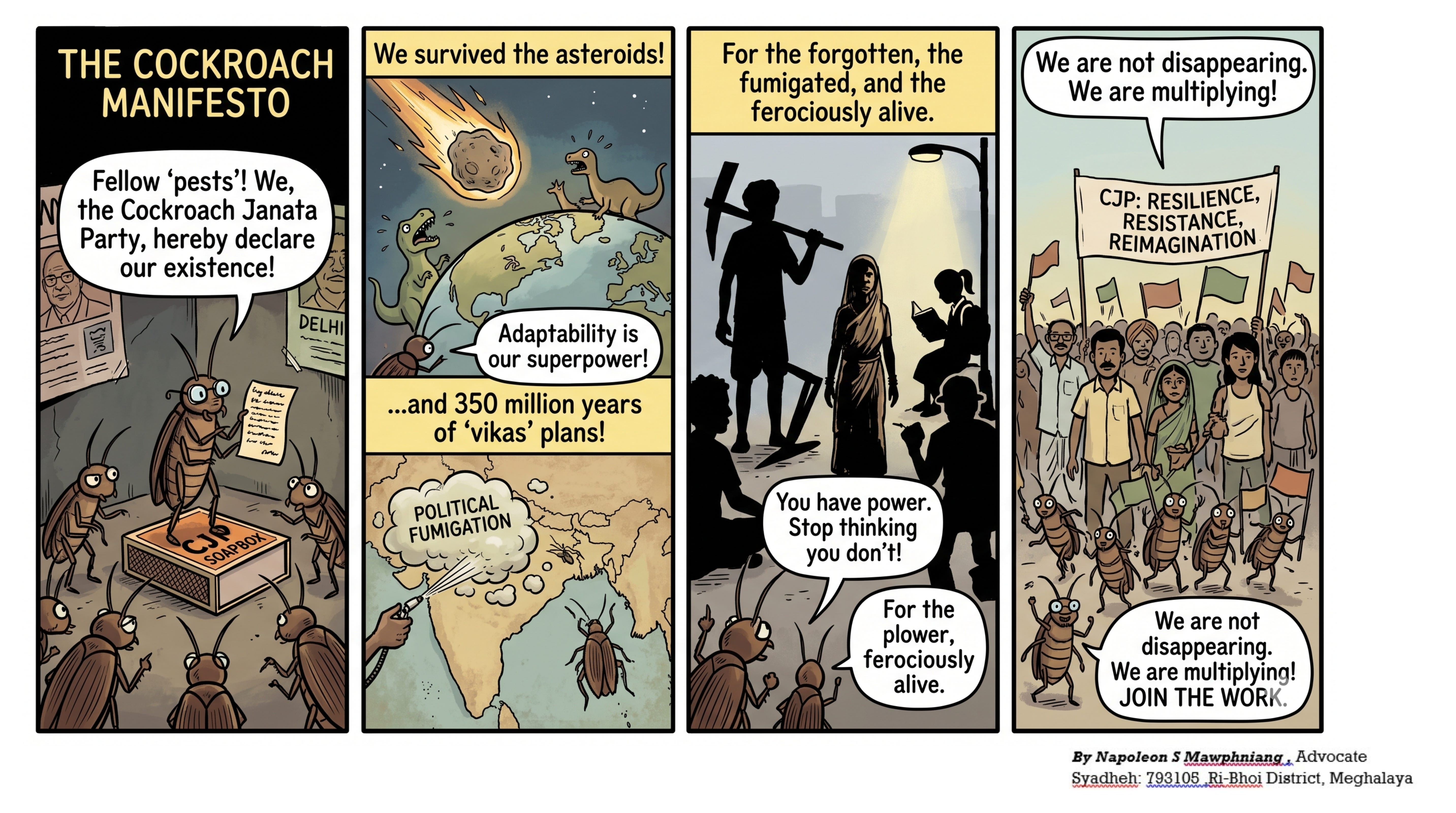
CONCLUSION:
A PERSONAL DECLARATION
The Author Speaks — In His Own Voice, From His Own Conscience.
Written by Napoleon S. Mawphniang — In Personal Capacity, For No Party, For Every Citizen
“A writer only begins a book. A reader finishes it.” — Samuel Johnson
“And a citizen — a true citizen — takes what is written and makes it real.” — Napoleon S. Mawphniang
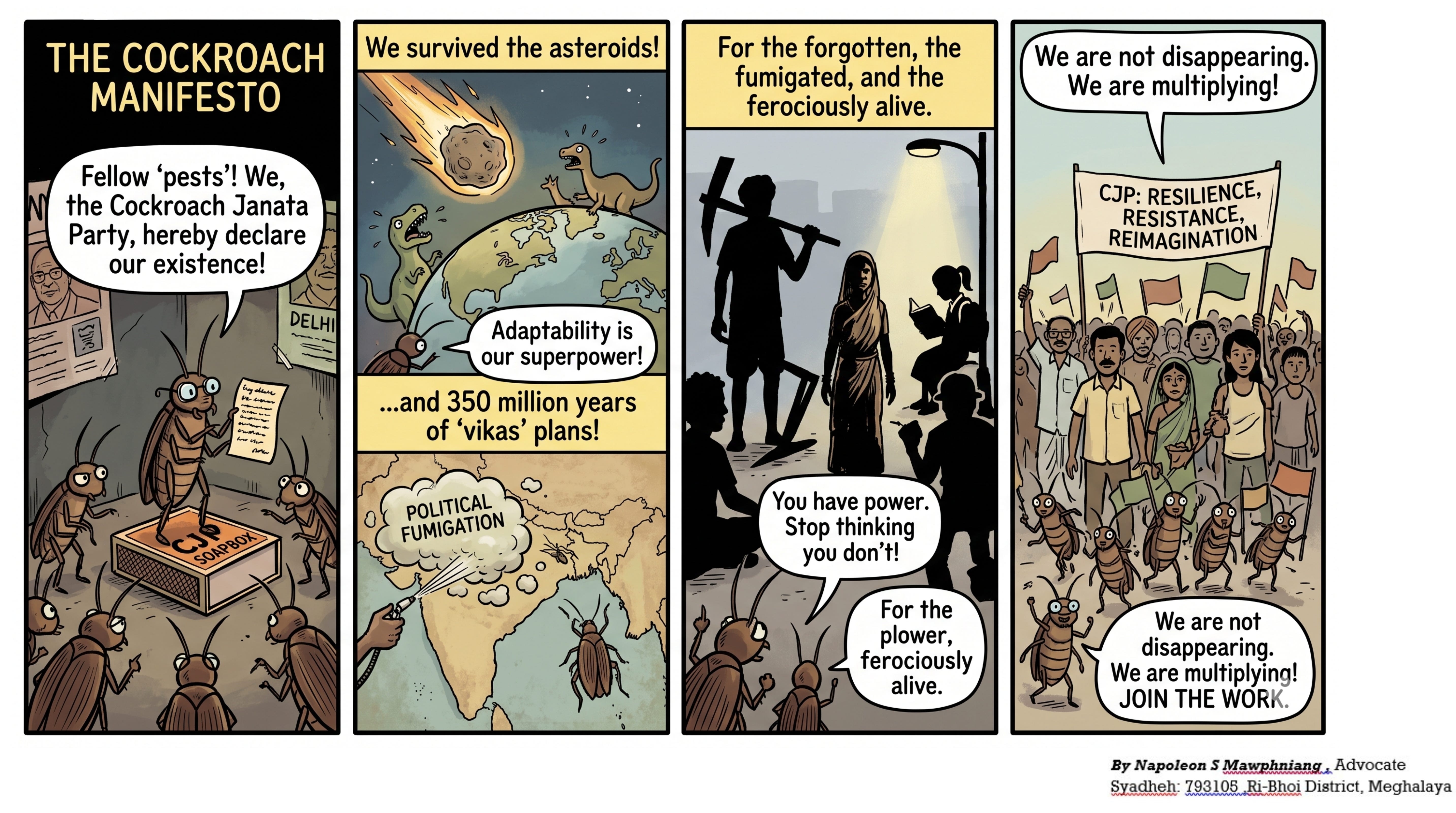
I. A Confession Before the Curtain Falls
There is something profoundly uncomfortable about writing a conclusion to a manifesto that was never supposed to be yours. I — Napoleon S. Mawphniang — did not found the Cockroach Janata Party. I did not invent the metaphor of the cockroach as a political symbol of survival, resilience, and the refusal to be exterminated by the indifference or hostility of the powerful. I did not draw the logo, register the website at cockroachjanata.org, or hold the founding meeting — if one was ever held, or if it was held in the way most meaningful things in India are held: informally, urgently, in someone’s cramped living room over cups of chai going cold, with the ceiling fan turning slowly and someone’s child sleeping in the corner while the adults argued about the country they were leaving that child.
What I did was this: I read the idea. I understood it. I felt it — the way you feel a piece of writing that puts language to something you have been carrying in your chest for years without the words to name it. And I sat down, as a writer does, as a citizen does, and I wrote what follows — the manifesto you have just read, in its entirety.
I want to be completely transparent about this, because transparency is not merely a political demand I make of governments and institutions in the pages above. It is a personal obligation I accept for myself, right here, in this final section, before you close this document and decide what, if anything, to do with it.
This manifesto is independent. It carries no party affiliation, no organizational backing, no institutional endorsement, and no ideological sponsorship. It is not funded by any political party — Left, Right, or Centre. It is not commissioned by any think tank, any NGO, any foreign government, any domestic interest group, or any entity with a financial stake in the political future of India. It emerged from one person’s engagement with an idea that deserved more than a web address and a clever name. It emerged from one person’s conviction that the idea of the cockroach — as a democratic symbol of ordinary, persistent, unkillable citizenship — deserved a document worthy of the constitutional republic it is invoking.
That person is me. And I speak for no one but myself.
II. Who Is Napoleon S. Mawphniang, and Why Should You Care?
I want to resist the temptation to write a self-aggrandizing biography here, in the manner of political manifestos whose authors spend more words establishing their own credentials than engaging with the ideas they claim to champion. I will say only what is relevant.
I am a citizen of India. I am a person who comes from a part of this country — the Northeast, that extraordinary, long-overlooked, gorgeous, complicated region that mainland India consistently forgets exists until it needs it for a geopolitical argument or a tourism brochure — a part of India that has its own deep relationship with the questions this manifesto raises: questions of identity, of belonging, of constitutional protection, of the distance between what the state promises and what the state delivers.
I am a writer. Writing is not just my profession — it is my method of understanding the world. I think by writing. I process by writing. When something troubles me deeply, I do not march first or protest first or post first — I write first, because writing forces a discipline of thought that other forms of expression can sometimes bypass. Writing requires you to finish your sentences. Writing requires you to follow your arguments to their conclusions, even when those conclusions make you uncomfortable. Writing is where I live — and this manifesto is, therefore, the most natural home I know for everything I have been thinking about the republic I was born into and live in.
I am, most importantly for the purposes of this conclusion, apolitical. I want to be very careful about what I mean by this, because “apolitical” is a word that can be used either honestly or dishonestly — used dishonestly, it means “I have politics but I am hiding them.” Used honestly, it means something more specific and more difficult: it means that I have not given my loyalty, my identity, or my critical faculty to any political party, any political leader, or any political ideology in such a way that I would defend them when they are wrong or excuse them when they betray the people they claim to serve.
I have opinions. I have values. I believe in the Constitution of India. I believe in its Preamble’s promise of justice, liberty, equality, and fraternity. I believe in the rule of law. I believe in the dignity of every human being regardless of their caste, their religion, their language, their gender, their sexuality, their economic status, or their political opinion. These are not partisan positions — they are constitutional positions. If holding them makes me “political” in the eyes of those who consider the Constitution itself to be a partisan document, then that tells us something important about the state of our republic’s political conversation.
I am not a Congress supporter. I am not a BJP supporter. I am not a Communist, a Socialist, an Aam Aadmi Party loyalist, a Trinamool sympathizer, a DMK supporter, or a partisan of any of the dozens of regional parties that populate India’s political landscape. I have watched all of them, in their turns in power, fall short of the constitutional ideal — some more catastrophically than others, some in ways that are more immediately dangerous than others, but none of them innocent of the charge that they have preferred power to principle when the two came into conflict.
My apolitical stance is therefore not disengagement. It is a demand for higher standards across the board. It is the insistence that citizens — especially young citizens — must develop the capacity to evaluate every government, every party, every leader, and every policy on its merits, independently, without the cognitive surrender that partisan loyalty demands.
III. Why the Cockroach Janata Party’s Idea Moved Me
I first encountered the concept of the Cockroach Janata Party the way one encounters most interesting things in the digital age — sideways, while looking for something else, with half my attention and then gradually, as the idea asserted itself, all of it.
The idea that the cockroach — despised, overlooked, exterminated as a matter of domestic routine, surviving in the margins and the cracks of every system ever built — could serve as the symbolic foundation for a democratic politics of ordinary citizens spoke to something I had been trying to articulate for years. India’s mainstream political discourse is dominated by the imagery of power — the lion, the lotus, the hand, the fist, the wheel, the dawn, the sun. All of these symbols speak upward — toward strength, toward glory, toward the summit of achievement, toward the radiant future promised by the leader who is speaking.
The cockroach speaks downward — toward the floor, toward the foundation, toward the unglamorous reality of the majority of human life in this country. The cockroach does not promise a golden age. The cockroach promises survival and adaptation — which is, in fact, more honest, more achievable, and in many ways more valuable than the golden age that is perpetually being promised and perpetually being deferred.
I was moved by the democratic humility of that symbolism. I was moved by the implicit argument it makes: that politics should be of, by, and for the people who actually live in this country — not the people who appear on the covers of business magazines, not the people who speak at Davos, not the people whose children study abroad and whose holidays are international, but the people who navigate the public hospital system, the public school system, the public transport system, the public distribution system — the people for whom the word “public” still means something, because private is not yet an option.
And so I wrote. Not because I was asked to, not because I was paid to, not because I represent the Cockroach Janata Party or any party — but because the idea deserved to be met with the full seriousness that ideas deserve when they are genuinely trying to say something true about the country we share.
This manifesto is my gift to the idea. It is offered freely, without conditions, without copyright assertion, without political agenda. If it is useful, use it. If it is wrong, correct it. If it is incomplete, complete it. That is the only ownership I claim: the ownership of having tried to say something true.
IV. The Youth of India: My Direct Address
I have written this entire manifesto using the pronoun we. I switch now, in this personal conclusion, to the pronoun you — because there is something I need to say directly, personally, from one human being to another, that the collective voice cannot carry.
You are the most consequential generation in Indian history.
I do not say this as flattery. I say it as a factual description of the circumstances into which you were born. You are coming of age in a moment when the choices your generation makes — politically, economically, culturally, technologically, environmentally — will determine the character of India for the next hundred years. The decisions being made right now about the nature of Indian democracy, about the relationship between the state and the citizen, about the economy and who it serves, about the climate and how India responds to it — these decisions are shaping the India that your children and grandchildren will inherit.
And you — the 18-to-35-year-old reading this, in whatever language you first think in, in whatever part of this vast country you call home — you are a voter, a worker, a student, a creator, a consumer, a neighbor, and a citizen. You are all of these simultaneously. And in every one of these roles, you have more power than you have been led to believe.
The political establishment of India — across all parties, across all ideological persuasions — has a fundamental interest in you believing one of two things: either that they are your saviors, your champions, your protectors, and your only hope, to whom you owe uncritical loyalty; or, alternatively, that the system is so corrupt, so entrenched, so impervious to change, that your engagement with it is futile and your disengagement is understandable.
Both of these messages serve the same purpose: they keep you from exercising independent judgment. The first asks you to surrender your mind to a leader. The second asks you to surrender your agency to despair. Both are designed to prevent the thing that those who hold power most fear: a generation of citizens who think for themselves, judge for themselves, organize for themselves, and hold power to account on their own terms.
Do not give them what they want.
V. The Three Virtues I Ask You to Embody
I am not a prophet. I am not a politician. I am not a guru. I am a writer with a typewriter — or in the modern version, a keyboard — and a citizenship, and a conscience. And from that position, I want to propose three virtues that I believe, with everything I have, are the foundation of the better India that this manifesto envisions.
Accountability
Accountability begins with yourself. Before you demand accountability from your elected representatives — and you must demand it, loudly, persistently, without apology — ask yourself whether you are accountable. Whether the positions you take can withstand scrutiny. Whether the information you share is verified. Whether the outrage you feel is proportionate to the actual harm being done, or whether it has been manufactured by an algorithm or a political operation to serve someone else’s purpose.
Accountability in public life means that every person who holds public office — every MP, every MLA, every bureaucrat, every judge, every police officer, every public university administrator — must be able to answer, clearly and honestly, for every decision they make with public resources or public authority. Not someday. Not eventually. Now. Immediately. Continuously.
The Right to Information Act, 2005 — one of the most powerful democratic tools ever placed in the hands of Indian citizens — exists precisely for this purpose. It is not merely a legal provision. It is a constitutional instrument for holding power to account. Every time you file an RTI application, you are exercising sovereignty. Every time a citizen discovers, through an RTI response, that a road was built at ten times its actual cost, or that a school that received government funds does not exist, or that a welfare scheme’s beneficiaries list is fictional — every time this happens, the republic is, in a small way, functioning as it was designed to.
Accountability also means holding the opposition accountable — not just the party in power. The disease of Indian politics is not any single party. It is the culture that protects those in power from scrutiny while they are in power and then suddenly rediscovers its principles when they are in opposition. The citizen’s job is to refuse this game. Accountability is not a weapon to be deployed against one’s enemies. It is a standard to be applied to everyone.
Responsibility
With the extraordinary power of the youth vote — India has one of the youngest populations of any major democracy — comes extraordinary responsibility. The responsibility to vote, always, in every election. The responsibility to vote not for the candidate who belongs to your caste or your religion or who promises you a job or a subsidy, but for the candidate who best represents the constitutional values of justice, liberty, equality, and fraternity — who is most likely, based on their record and their character, to govern in the public interest.
Responsibility means not being used. I want to be very direct about this, because it is perhaps the most important single sentence in this conclusion: no political party — none, not one, regardless of what it tells you about itself — has your interests as its primary concern. Political parties are organizations whose primary objective is the acquisition and retention of power. They dress this objective in the language of service, of development, of ideology, of cultural pride, of economic progress — but at the core, the party exists to win elections. And it will use whatever tools are available to achieve that objective, including you.
The tool of choice for the political exploitation of youth, in India as in many other countries, is identity. You are told that your caste is under threat. You are told that your religion is under threat. You are told that your language, your culture, your community, your pride — some aspect of who you are — is under attack by enemies who can be named, and that the party speaking to you is the only defense. This is the oldest and most effective form of political mobilization, and it is also the most destructive — because it substitutes identity for thought, and substitutes the party’s interests for your own.
Responsibility means recognizing this operation when it is being run on you. It means asking: who benefits from my outrage? It means asking: what concrete policy is being proposed, and who will it actually help? It means asking: why is this particular enemy being named right now, before this particular election? These questions are not cynical. They are democratic. They are the minimum due diligence that citizenship requires.
Responsibility also means taking care of the public spaces — physical and virtual — that belong to all of us. The public park, the public library, the public hospital, the public school. These are not government resources. They are citizen resources, held by the government in trust for all of us. Treat them accordingly — with care, with respect, and with the insistence that they be maintained, funded, and made accessible to everyone who needs them.
Transparency
Be transparent about who you are, what you believe, and why. In the age of anonymous social media, when it is possible to hold and express political opinions without attaching your name or your face to them, the temptation toward comfortable anonymity is understandable. The consequences of speaking openly can be real — professional, social, sometimes even physical.
But transparency is also power. When you attach your name and your face to a reasoned position — when you say I, this specific person with this specific background and these specific experiences, believe this, for these reasons — you are doing something that a hundred anonymous posts cannot do. You are making a human claim on another human’s attention and respect. You are saying: I am not a bot, I am not a troll, I am not an instrument of someone else’s political operation. I am a citizen with a conscience, and this is what my conscience tells me.
Transparency in the digital age also means being transparent about the sources of your information. Before you share something — a claim, a statistic, a video, an allegation — verify it. This is not a counsel of paralysis. It is a counsel of responsibility. The single greatest threat to democratic discourse in India right now is not any political party or any government policy. It is the systematic pollution of the information environment by misinformation — often deliberately manufactured and algorithmically amplified — that makes it impossible for citizens to have a shared factual reality on which to base their political judgments.
If you share misinformation, you become an instrument of its spread, regardless of your intentions. If you verify before you share, you become a node of clarity in a system that is drowning in noise.
VI. The Method: Constitutional, Peaceful, Visionary
I want to be absolutely unambiguous about this, because clarity here matters more than in any other section of this document: the change this manifesto envisions must be achieved through constitutional, democratic, and peaceful means. There is no other legitimate way.
Violence is not a tool of democratic change. It never has been, and in a country as complex and diverse as India — where every act of violence ignites unpredictable chains of retaliatory violence, where the history of partition and communal conflict has shown us what organized violence can do to the social fabric of a civilization — the counsel of violence is not just morally wrong. It is strategically catastrophic. It will not produce the India we want. It will produce the India that those who profit from division and fear most desperately need.
The Constitution of India provides every instrument that citizens need to challenge power, to demand accountability, to seek justice, to organize politically, and to change the society in which they live. Public Interest Litigation. The Right to Information. The right to peaceful assembly under Article 19(1)(b). The right to form associations under Article 19(1)(c). The right to freedom of speech under Article 19(1)(a). The right to move the Supreme Court directly for the enforcement of fundamental rights under Article 32 — which Ambedkar himself called “the heart and soul of the Constitution.”
These instruments are not perfect. They are subject to delay, to procedural manipulation, to the slow attrition of legal complexity that exhausts plaintiffs with limited resources long before they can achieve justice. But they are real. They have produced real results. The Right to Information Act was not handed to the people by a benevolent government — it was won through years of grassroots organizing by the Mazdoor Kisan Shakti Sangathan in Rajasthan, by ordinary people demanding to see government records in village squares, before the movement grew large enough that parliament could not ignore it. The Forest Rights Act was not the spontaneous generosity of the state — it was the product of decades of organizing by Adivasi communities and their allies, documenting violations, filing cases, building political pressure until the law moved.
The Constitution moves when citizens push it. The law changes when citizens demand it. Democratic politics responds when citizens organize, vote, and hold their representatives accountable through mechanisms of continuous, disciplined, informed civic engagement.
Use your brain, not your fists. I say this not as a metaphor but as literal counsel. The single most powerful political weapon available to the youth of India is their intelligence — the capacity to understand systems, to identify injustice, to articulate demands, to organize constituencies, to communicate ideas in ways that move people. This weapon is available to everyone, regardless of wealth, regardless of caste, regardless of what college you attended or failed to attend. And unlike physical force — which concentrates in the hands of those with armies and police forces and the legitimate monopoly on state violence — intelligence scales. One person with a genuinely good idea and the ability to communicate it can change the direction of a conversation that touches millions of people.
This is not naive. This is the lesson of every successful social movement in democratic history. The most effective political transformations are won not through force but through the slow, hard work of changing what people believe is possible and what they believe they deserve. The civil rights movement in America was won not on battlefields but in courtrooms, in boycotts, in the mathematics of voter registration drives, in the music and literature and oratory that changed the moral imagination of a nation. The independence movement in India was won — ultimately — not by military force but by the most extraordinary exercise in mass civil disobedience in human history: the non-cooperation movement, the Dandi March, the Quit India movement, the patient, principled, extraordinarily courageous refusal of an entire people to participate in their own subjugation.
Gandhi’s genius was not mystical. It was strategic. He understood that the colonizer’s strength was contingent on the colonized’s cooperation — that British rule in India required Indian participation to function — and that withdrawing that cooperation was more powerful than any military challenge could be. The cockroach’s equivalent genius is the same: the ordinary citizen’s cooperation — with institutions, with consumption patterns, with information flows, with electoral choices — is what makes the system run. And the organized withdrawal of that cooperation, or its strategic redirection, is the most powerful democratic force available.
VII. Vision, Not Just Grievance
I want to end with something that I believe is missing from much of India’s current political discourse: vision. Not just the articulation of what is wrong — though getting the diagnosis right is essential — but the imagination of what could be right. Not just the catalogue of failures — though honest reckoning with failure is the beginning of improvement — but the blueprint of success.
India has always been a civilization of extraordinary visionary ambition. The people who built Nalanda — the 5th-century university that attracted scholars from across Asia and held a library so vast that it burned for three months when it was destroyed — were not thinking small. The people who wrote the Arthashastra — a comprehensive treatise on statecraft, economics, and political theory that was, in many respects, more sophisticated than anything being written in contemporary Europe — were not thinking small. The people who designed the Constitution of India in three years, under conditions of extraordinary national trauma, produced a document of philosophical depth, structural ingenuity, and rights-protecting breadth that has few equals in the world — they were not thinking small.
What India needs — what this manifesto is ultimately calling for — is a return to the habit of thinking big. Not big in the sense of the megalomaniac infrastructure projects that displace millions to build monuments to the ambition of the powerful. Big in the sense of moral imagination. Big in the sense of asking: what kind of country do we want to be? Not just in terms of GDP rank or military capability or space program achievements — but in terms of how we treat the most vulnerable among us, in terms of the quality of education and healthcare and justice available to the person at the bottom of every hierarchy that India maintains.
This requires ideas. It requires the kind of constructive, creative, solutions-oriented thinking that goes beyond protest and resistance — though protest and resistance are essential — to actually imagining and proposing alternative ways of organizing our collective life.
I am therefore making a specific appeal: think, propose, imagine. Every young Indian who reads this manifesto and feels the pull of its arguments — I am asking you to take the next step beyond reading. Write something. Build something. Organize something. Teach something. Document something. Start a conversation in your college, your neighborhood, your workplace, your family — the most politically important space in India, the one that politicians are always trying to enter and that citizens have every right to reclaim.
Propose a policy. Not a grand policy — a specific, local, implementable policy for your village, your city ward, your school, your hospital, your water supply, your public transport route. The best national policies in India’s history began as local experiments: the Kudumbashree program in Kerala began as a poverty reduction initiative and became one of the most successful women’s self-governance models in the developing world. The MGNREGA — the rural employment guarantee scheme — emerged from years of grassroots advocacy by economists and activists who had the vision to imagine that the state could guarantee work rather than merely promise it.
Bring your ideas to the public square — the physical public square of the chaupals and the gram sabhas and the union meetings and the student councils, and the digital public square of the social media platforms that, for all their algorithmic distortions, still carry within them the possibility of democratic conversation at scale.
And be visionary with constructive intention. That last phrase matters enormously. Constructive intention means that your engagement with politics is oriented toward building something better — not toward the destruction of your opponents, not toward the revenge of historical grievances, not toward the performance of outrage for an appreciative audience, but toward the actual improvement of the actual lives of actual people.
Destructive politics is easy. Any fool can tear something down. Building is harder. Governing is harder. Maintaining institutions is harder. Sustaining democratic culture across generations is harder. But harder is where the important work is. Harder is where the future is made.
VIII. My Final Declaration
This manifesto is complete. I — Napoleon S. Mawphniang — wrote it in my personal capacity, as a citizen of India, as a writer who believes that words have power and that power must be exercised responsibly, and as a person who has been moved by an idea — the idea of the cockroach as democratic symbol — that I believe deserves to be taken seriously.
I wrote it for the youth of India — for every young person who has the constitutional right to be angry about the gap between the republic’s promise and the republic’s performance, and who also has the constitutional responsibility to channel that anger into something constructive, peaceful, intelligent, and lasting.
I wrote it for the cockroaches of India — which is to say, for everyone who has survived on the margins of a system that was not designed to include them, who has found their way through the cracks in walls that were built to keep them out, who has adapted and persisted and refused to be exterminated by the casual cruelty of institutional indifference.
I am not asking you to join the Cockroach Janata Party. I am not asking you to join any party. I am asking you to join the project of Indian citizenship — the difficult, ongoing, never-completed, constitutionally mandated project of making the republic real.
I am asking you to read the Constitution. Not as a legal document you encounter once in a civics class and then forget. As a living text — a letter written by extraordinary human beings to future generations, containing within it both a description of what we aspire to be and an instruction manual for how to get there.
I am asking you to remember that India is not the property of any party, any government, any dynasty, any community, any religion, or any ideology. India is the property of its citizens. All of them. Including the ones being told, right now, by forces of various persuasions, that they don’t quite belong.
I am asking you to be transparent about your sources, accountable for your claims, responsible with your votes, and generous with your solidarity.
I am asking you to think. And then to act. Peacefully. Constitutionally. Persistently. With the patience and survival instinct of the creature that has outlasted every empire, every catastrophe, every attempt at extermination that history has thrown at it.
Be the cockroach. Not the cockroach of the kitchen corner, scuttling away from the light. The cockroach of the republic — standing in the light, in the full glare of democratic scrutiny, saying: I am here. I belong here. I am not going anywhere. And neither is my demand for the country this Constitution promised me.
IX. A Last Word on Change
Change — real, structural, constitutional change — is slow. It is slower than it should be. It is slower than the urgency of the problems demands. This is one of the great frustrations of democratic citizenship, and I will not insult your intelligence by pretending otherwise.
But slow is not the same as impossible. The history of India since independence — for all its failures, for all its betrayed promises, for all the distance between the Constitution’s aspiration and the lived reality of hundreds of millions — is also a history of real change. The legal abolition of untouchability. The land reforms of the 1950s and 60s that, imperfect as their implementation was, broke the feudal grip of zamindari on the rural poor. The expansion of primary education. The decline of absolute poverty. The growth of a middle class. The emergence of Dalit political power — the extraordinary story of communities that were excluded from all formal power for millennia finding, through the democratic mechanism of the vote, a route to political agency.
None of these changes were gifts. All of them were won — through organizing, through struggle, through the patient accumulation of political power by people who understood that the Constitution had given them tools and that tools must be used.
The India that this manifesto envisions — transparent, accountable, constitutionally faithful, economically just, ecologically sustainable, culturally plural, socially dignified — is not a fantasy. It is the Constitution’s own vision of itself. It is what the republic was designed to become. It is not beyond reach.
It requires, simply, that enough citizens — enough cockroaches — decide that reaching for it is worth the effort.
I have made my decision. I have written these words. I offer them to you freely — to the youth of India, to the cockroaches of every crack in every wall of every building that power has ever built — with the hope that you will take them, argue with them, improve upon them, and ultimately render them obsolete by building the India that makes their complaints unnecessary.
That is the writer’s deepest wish: to write something that, eventually, no longer needs to be written. To describe an injustice so clearly that the injustice is corrected. To articulate a vision so precisely that the vision is realized.
I live in hope. Not the passive hope of one who waits for others to act, but the active hope of one who acts and hopes simultaneously — who writes and organizes and votes and argues and insists, in the full knowledge that individual action is small and collective action is everything.
We are the cockroaches. We are the citizens. We are the republic — imperfect, struggling, argued-over, beloved India, that impossible, necessary, extraordinary experiment in the democratic governance of a civilization.
Survive. Think. Build. Together.
— Napoleon S. Mawphniang Written in personal capacity. For no party. For every citizen. For the India that is still possible — and the youth who will decide whether it becomes real.
“In the end, we will remember not the words of our enemies, but the silence of our friends.” — Martin Luther King Jr.
Let there be no silence. Let the cockroaches speak. Constitutionally. Peacefully. Without ceasing.
This Manifesto is Independent. It is offered freely to all citizens of India. It may be reproduced, shared, debated, and improved upon without permission or condition. It asks nothing in return except that you think — and then act — and then think again.
Jai Hind. Jai Samvidhan. Jai Cockroach.
जय हिन्द। जय संविधान। जय कॉकरोच। Jai Bharat — in every tongue, for every citizen, without exception.
Napoleon S. Mawphniang Citizen of India. Writer. Apolitical. Hopeful. This document was written in the service of no master except the truth and the Constitution.
End of Conclusion. End of Manifesto. Beginning — always the beginning — of the work.