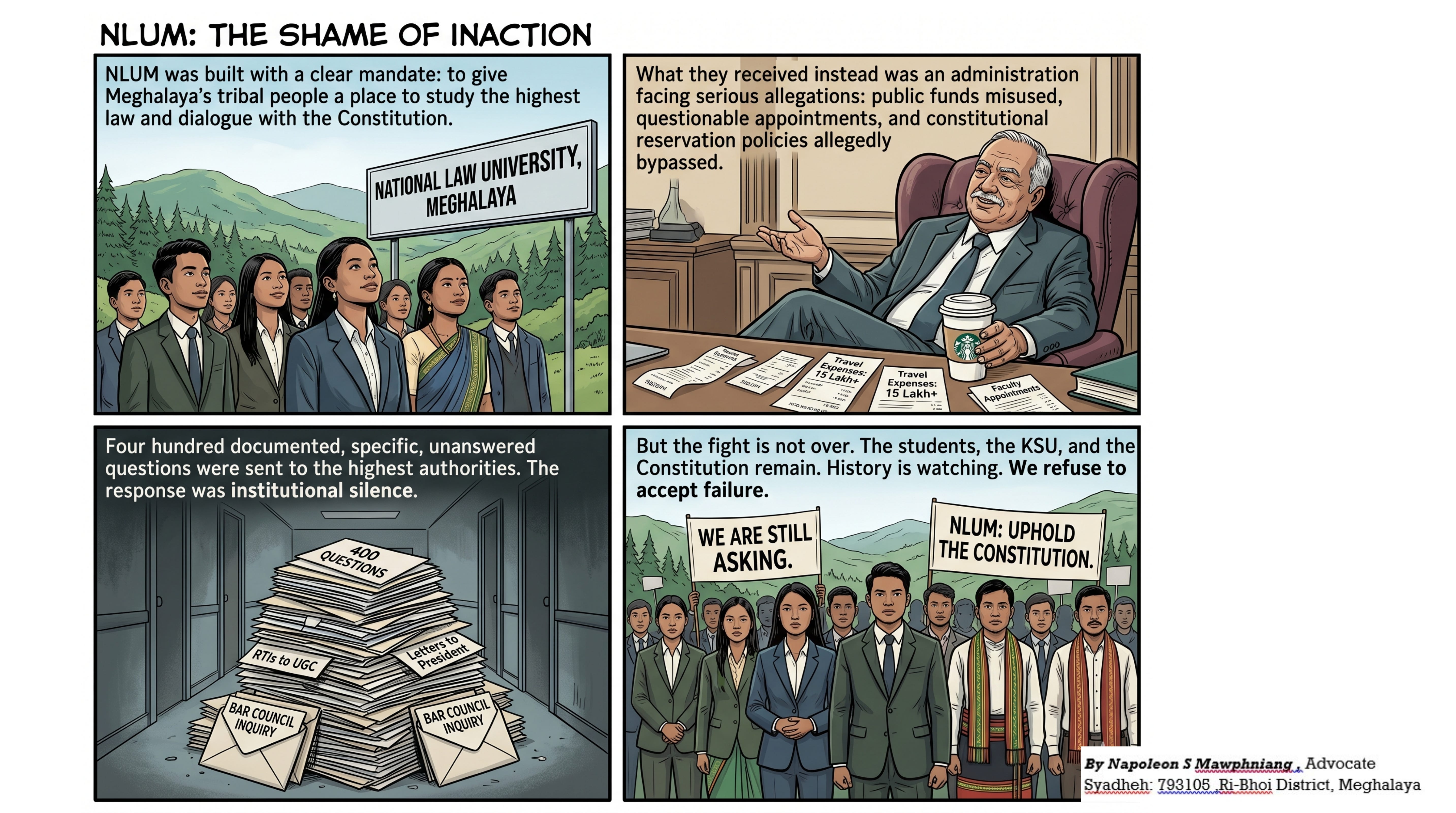
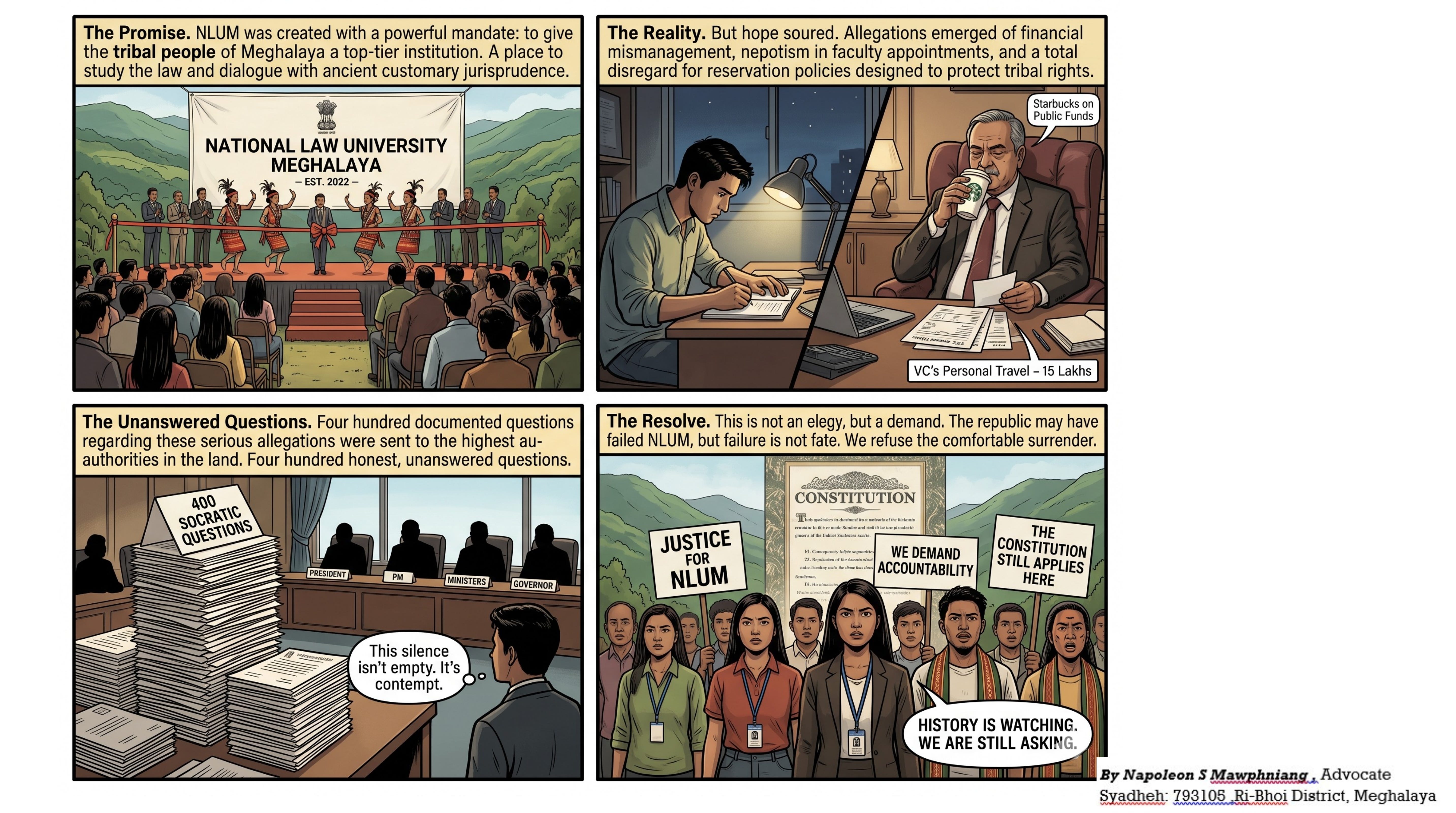
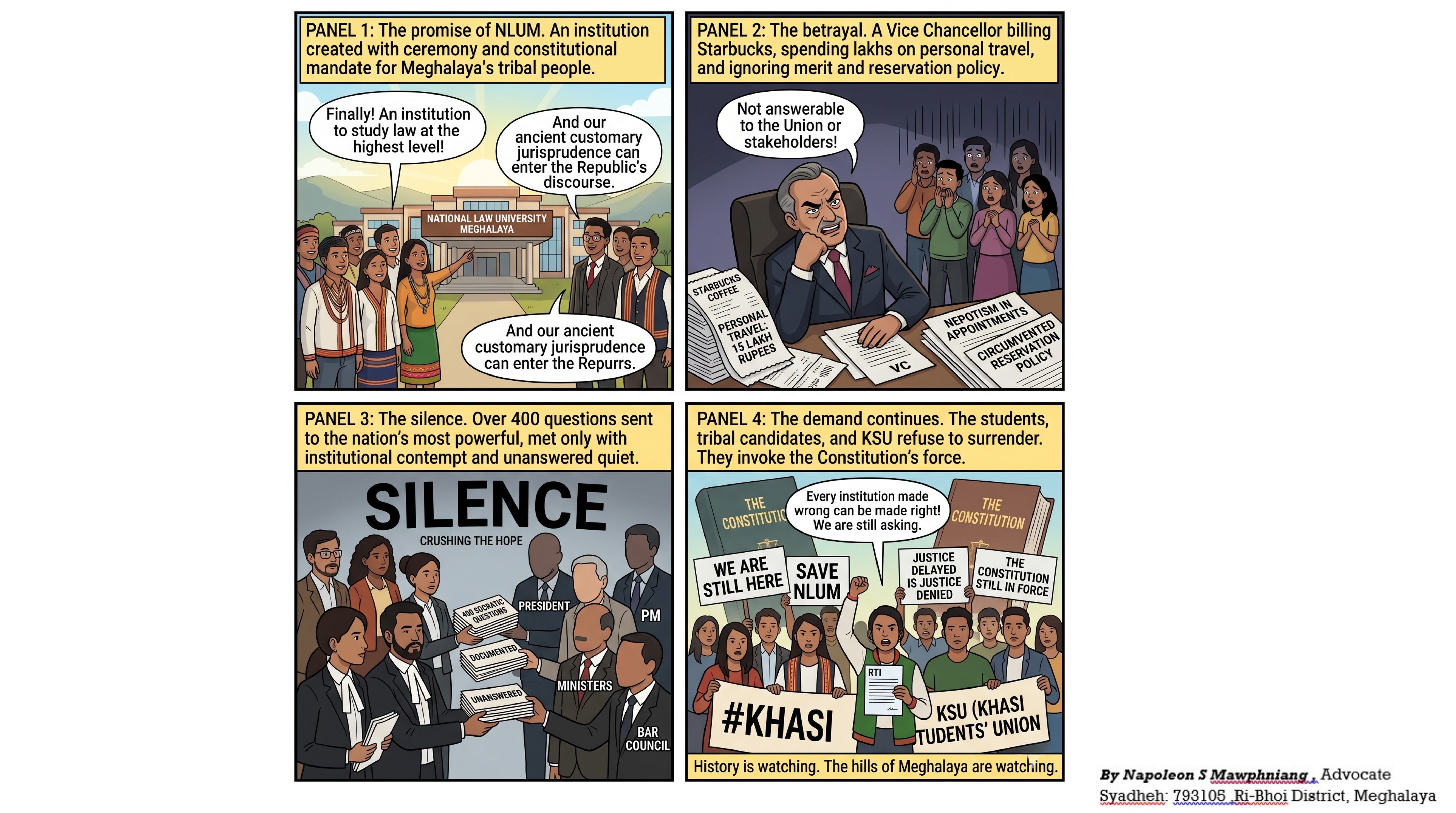
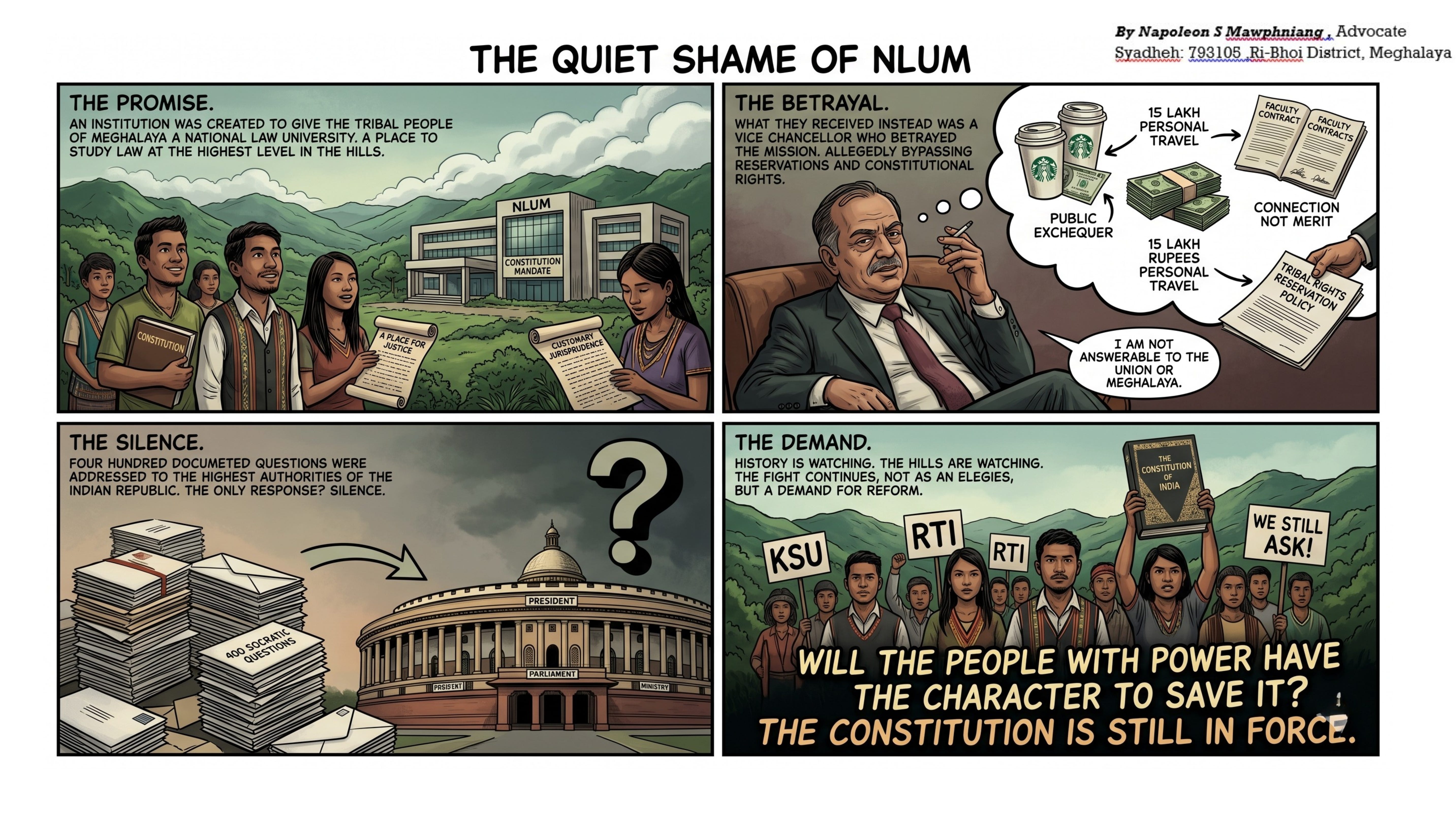
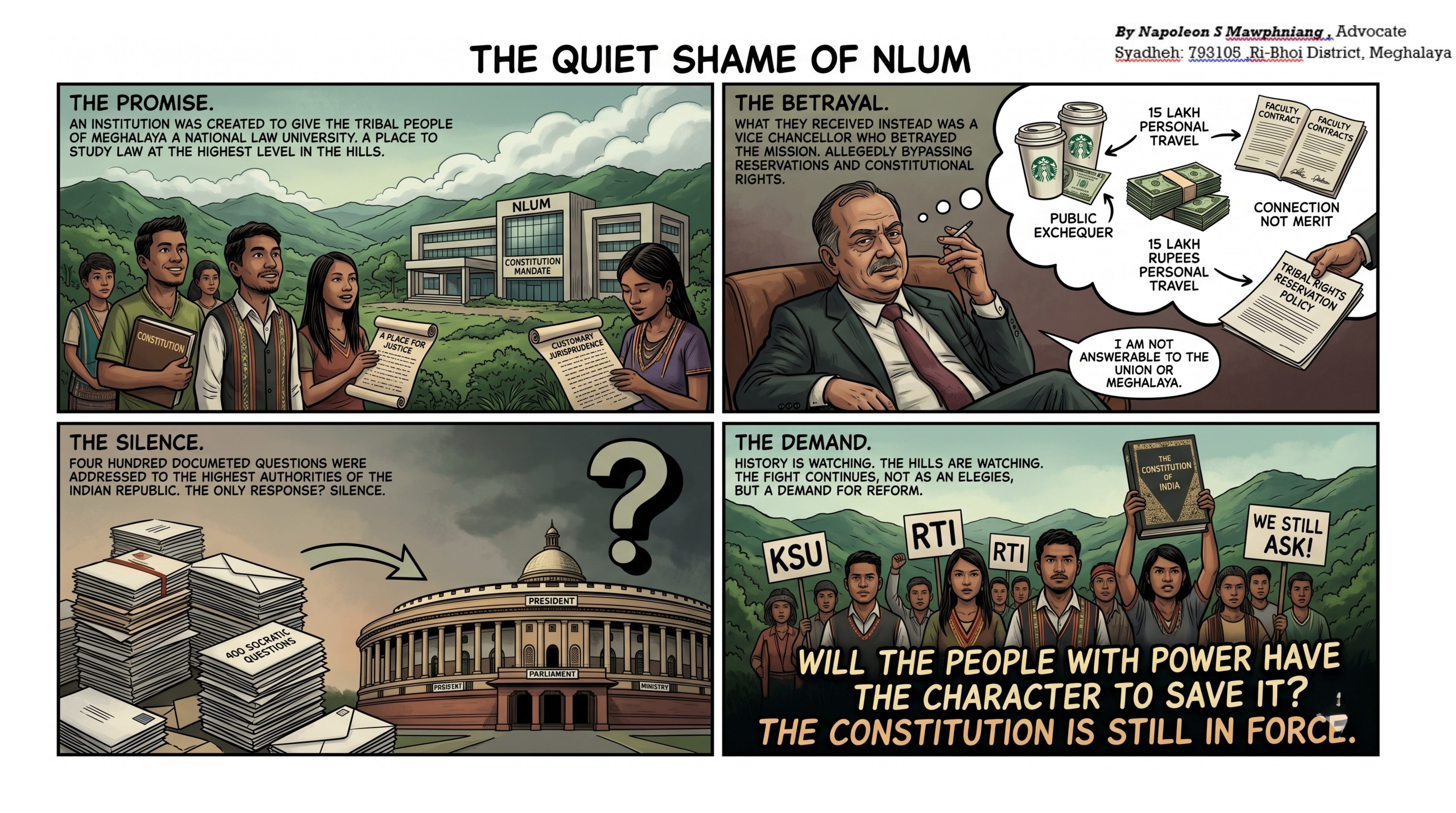
On the Deliberate Ruin of the National Law University Meghalaya: A Cry from the Periphery to the Centre of Power
“All animals are equal, but some animals are more equal than others.” — George Orwell, Animal Farm
“The oppressors do not favor promoting the community as a whole, but rather selected leaders.” — Paulo Freire, Pedagogy of the Oppressed
“It is not enough to do good; one must do it the right way.” — John Morley
To:
Her Excellency Smt. Draupadi Murmu, President of India, Rashtrapati Bhavan, New Delhi — 110004
Honourable Shri Narendra Modi, Prime Minister of India, South Block, New Delhi — 110011
Honourable Shri Amit Shah, Union Home Minister, North Block, New Delhi — 110001
Honourable Shri Dharmendra Pradhan, Union Minister of Education, Shastri Bhavan, New Delhi — 110001
From: Napoleon S. Mawphniang, Advocate, Shillong, Meghalaya
Subject: The Organised Desolation of the National Law University Meghalaya — A Betrayal of Constitutional Promise, Tribal Dignity, and the Rule of Law Itself.
Your Excellency and Honourable Ministers,
I write to you not merely as an advocate versed in the grammar of statutes and the arithmetic of precedents, but as a citizen of Meghalaya who has watched — with the combination of despair and fury that only helplessness can produce — the slow, systematic, and almost theatrical dismantling of what ought to have been one of the proudest institutions of our small and largely forgotten state. I write as a man who was born in these hills, raised in the shadow of the Law, and who has come to understand that law, when it is administered by those who have contempt for it, becomes the most efficient instrument of oppression.
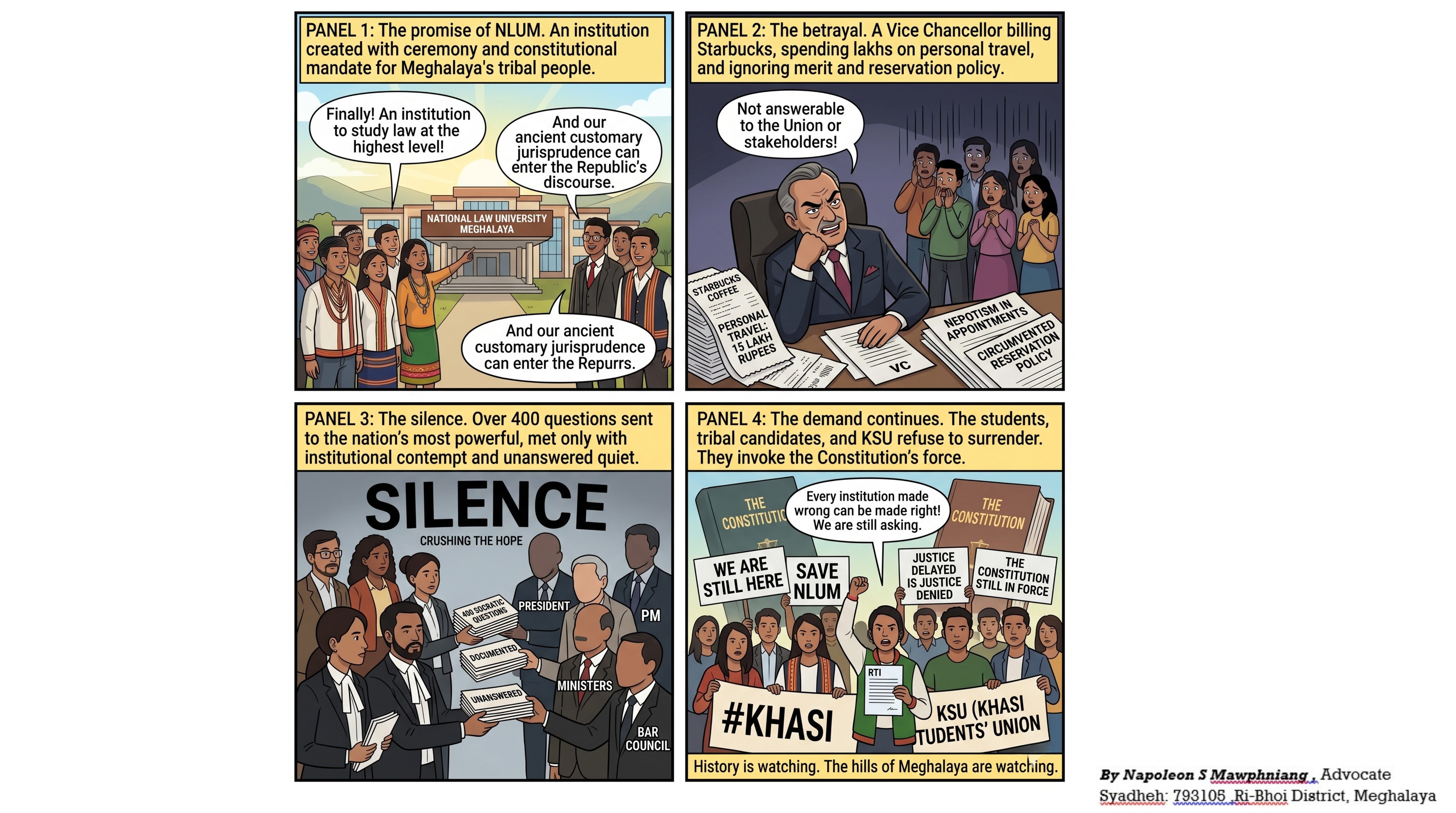
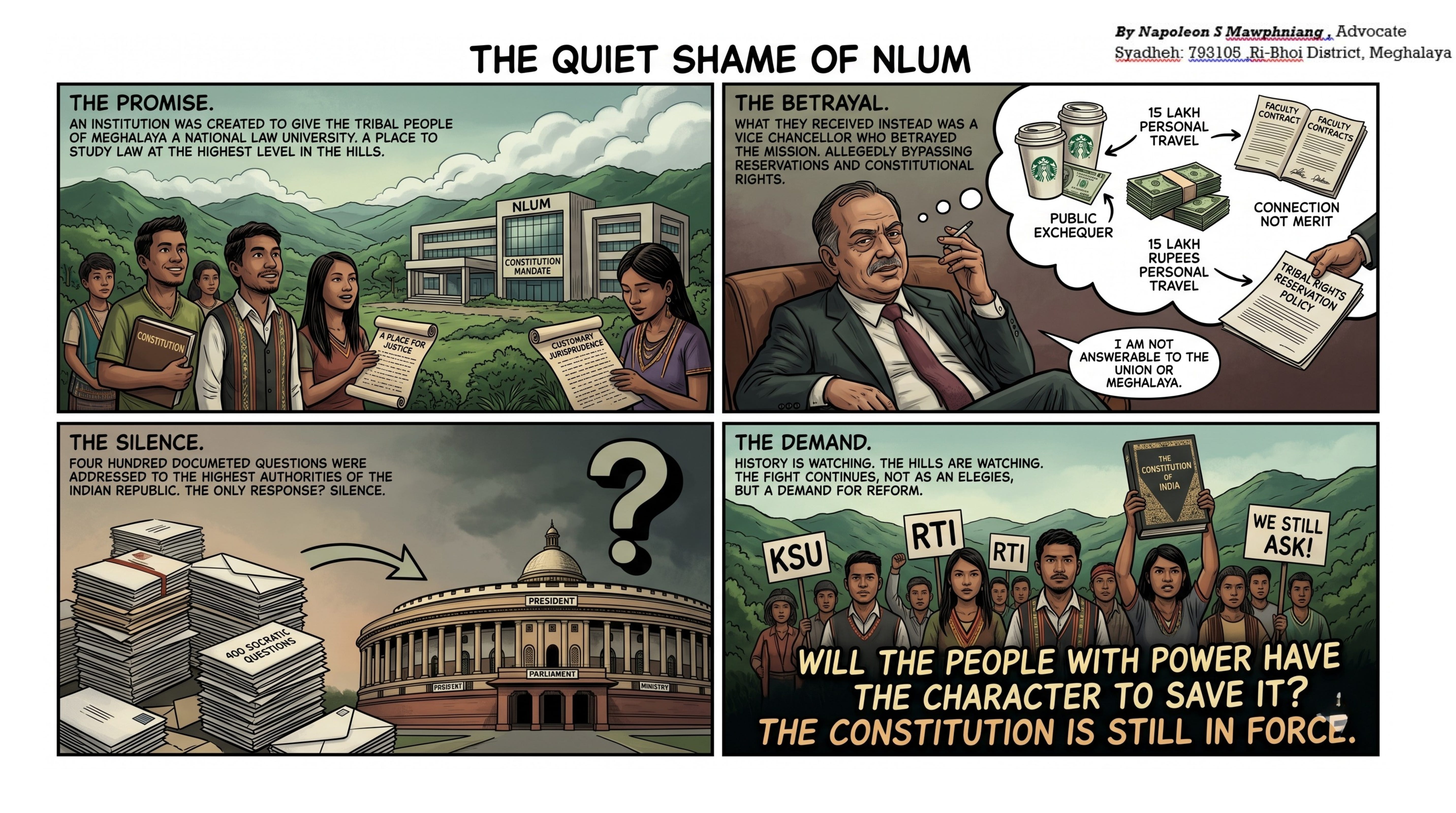
I write to you about the National Law University Meghalaya — an institution established with great ceremony and greater promises under the National Law University of Meghalaya Act, 2022, an Act of the Meghalaya State Legislature, enacted in the forty-third year of India’s pursuit of justice — and how it has been reduced, through a combination of negligence, nepotism, arrogance, and the most vulgar misuse of public funds, to something between a farce and a tragedy. I use both words deliberately. Oscar Wilde once quipped that “life is far too important a thing ever to talk seriously about,” but I suspect even that supreme ironist would find little material for comedy in what has become of this institution. There is nothing witty about a law university that does not know the law. There is nothing amusing about an institution of legal education that is itself the subject of legal complaint.[1]
Let me be blunt, in the tradition of one who has studied Orwell long enough to understand that political language is designed to make lies sound truthful, and murder respectable, and to give an appearance of solidity to pure wind. The National Law University Meghalaya — hereafter NLUM — has failed. Not partially. Not provisionally. Not in some correctable, procedural, bureaucratic fashion that can be remedied with a committee report and a strongly-worded circular. It has failed structurally, morally, institutionally, and — most damning of all — deliberately. And the Central Government, which holds this institution in a web of financial and legislative accountability, has been complicit in its failure through the most monstrous of political sins: silence.
I. The Weight of History and the Promise That Was Made
Permit me, Your Excellency and Honourable Ministers, to contextualise what this institution was supposed to mean. Context is everything. Without it, we are merely shouting into a void.
The story of the National Law Schools of India is itself a story of institutional ambition colliding with institutional reality. It begins, most meaningfully, in 1987, when the National Law School of India University (NLSIU) was established in Bengaluru under the stewardship of Professor N. R. Madhava Menon — a man of such formidable intellectual conviction that he managed to transform the landscape of Indian legal education in one generation. Before NLSIU, Indian law education was, to put it charitably, a graveyard for ambition — a place where students went not to learn the law but to acquire a parchment that would permit them to practice it. Menon envisioned something different: an institution that would produce not merely lawyers, but jurists; not merely advocates, but statesmen of the law.[2]
The model worked. It worked so spectacularly that it was replicated across the country. By the early 2000s, National Law Schools had proliferated — in Hyderabad, Kolkata, Bhopal, Jodhpur, Raipur, Lucknow, Patiala, and elsewhere. Each was established by a state act, each was autonomous yet affiliated to the Bar Council of India and recognised by the University Grants Commission, and each was supposed to carry forward the promise of the original NLSIU vision. The establishment of NLUM in 2022, through Act No. 10 of 2022 of the Meghalaya Legislature, was the latest chapter in this story. It was also supposed to be among the most significant.[1][2]
Why significant? Because Meghalaya is not Bengaluru. Meghalaya is not Delhi. Meghalaya is not Pune or Hyderabad or any of the great metropolises of the Indian legal imagination. Meghalaya is a small, hilly, landlocked state in the northeastern extremity of the republic — a state with a largely tribal population, with indigenous legal traditions that predate the Indian Constitution by centuries, with communities — the Khasi, the Jaintia, the Garo — whose relationship with formal law has been, at best, transactional and, at worst, colonial. For such a state to have its own National Law University was not merely an academic achievement. It was a constitutional statement. It was the republic saying, in the clearest possible language: you belong. Your children deserve the best legal education the country can offer. Justice is not only for those who live in the plains.
That was the promise. Let us now examine what became of it.
II. What Machiavelli Knew and What Our Administrators Forgot
Niccolò Machiavelli, in The Prince, wrote with the cold clarity of a surgeon: “It is better to be feared than loved, if you cannot be both.” But he also wrote something that our university administrators would do well to engrave above their office doors: “The first method for estimating the intelligence of a ruler is to look at the men around him.” By this Machiavellian criterion, the intelligence of those who appointed and supervised the first Vice Chancellor of NLUM may be estimated with alarming ease.[3]
The Vice Chancellor in question, Professor Indrajit Dube, was appointed to lead an institution that was, by definition, in its infancy — tender, malleable, dependent on good leadership the way a seedling depends on the direction of the sun. What the seedling got instead was shade, poor soil, and a gardener who was more interested in the comforts of his own office than in the growth of what he had been entrusted to cultivate.
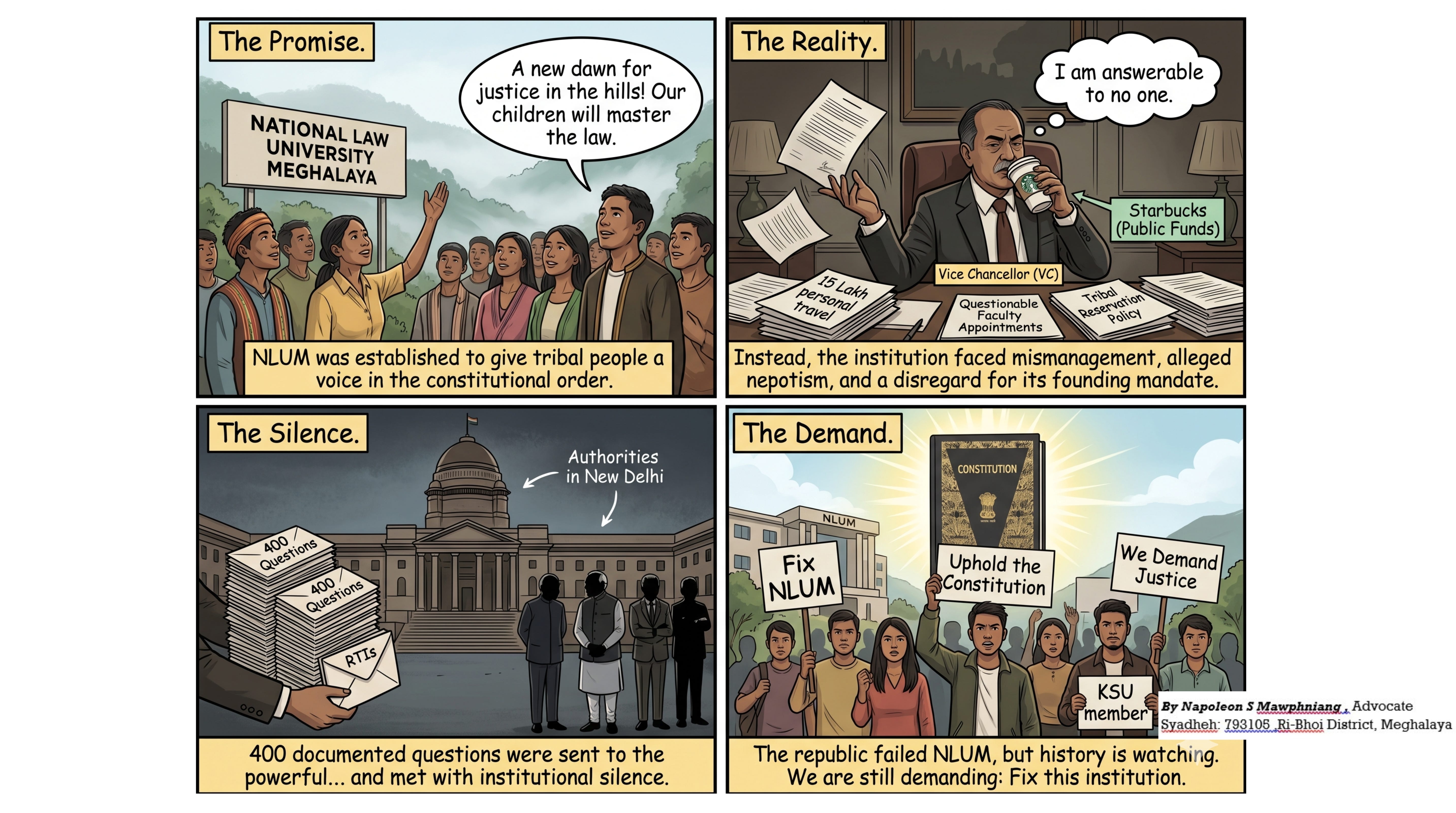
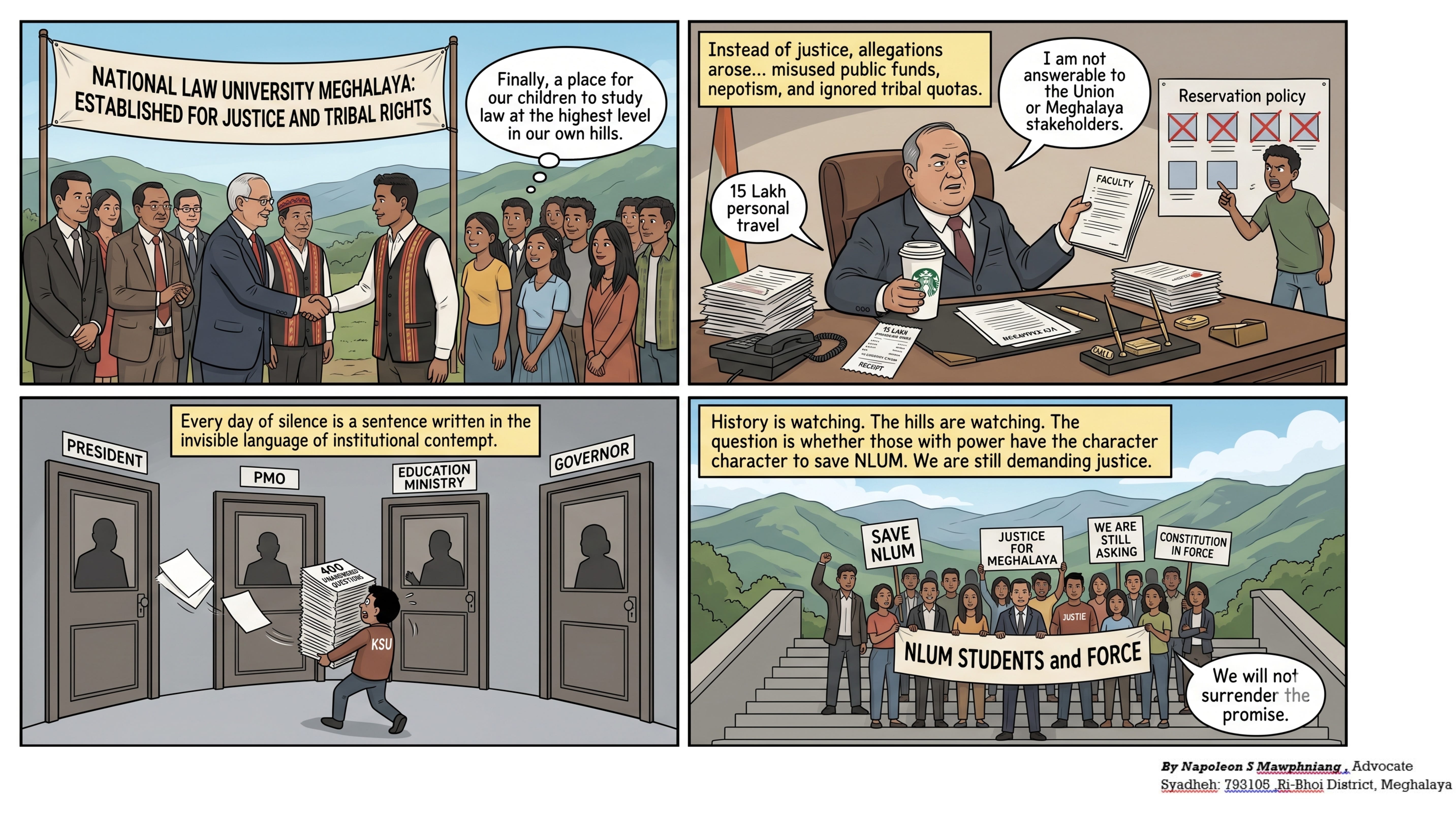
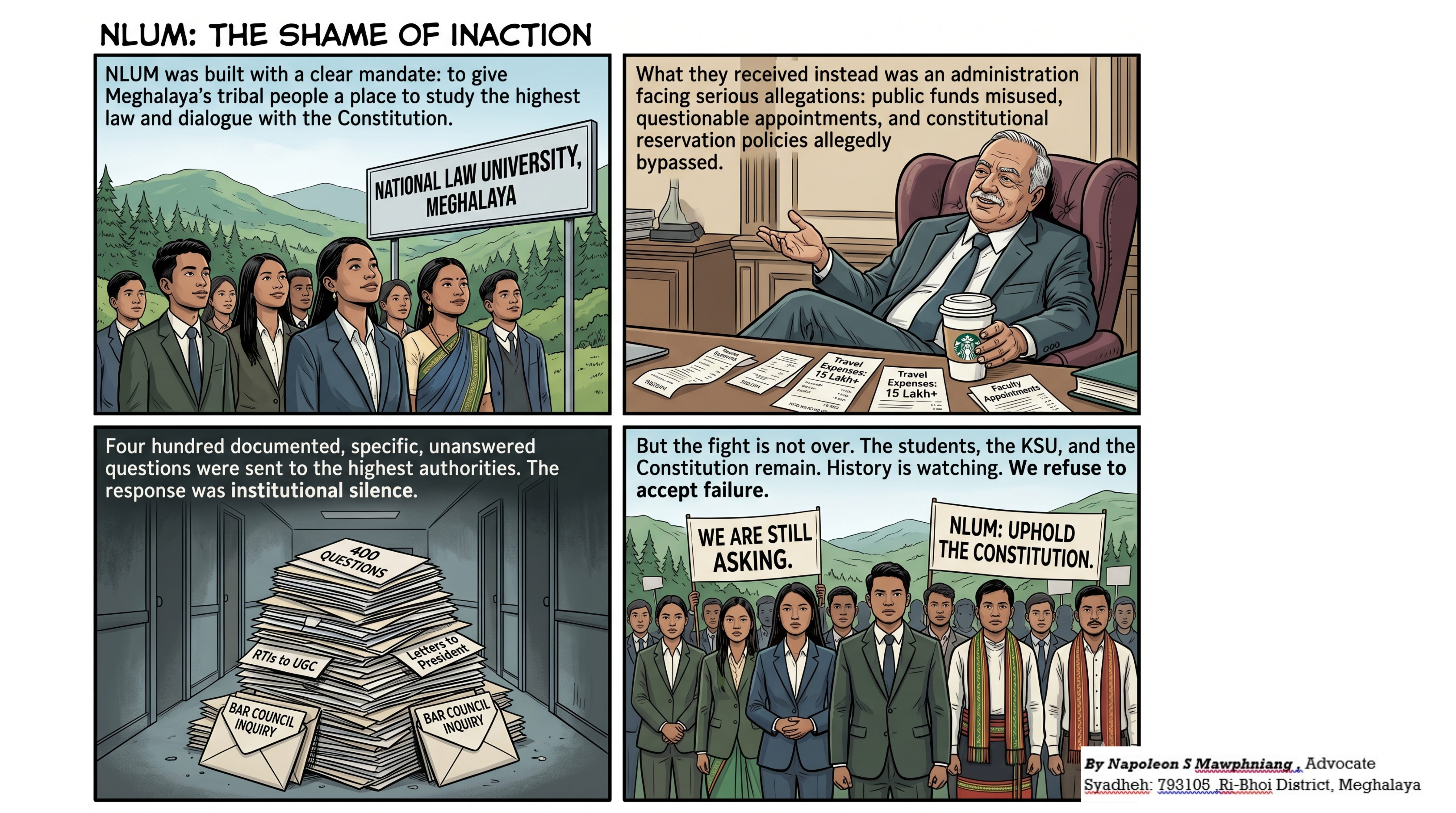
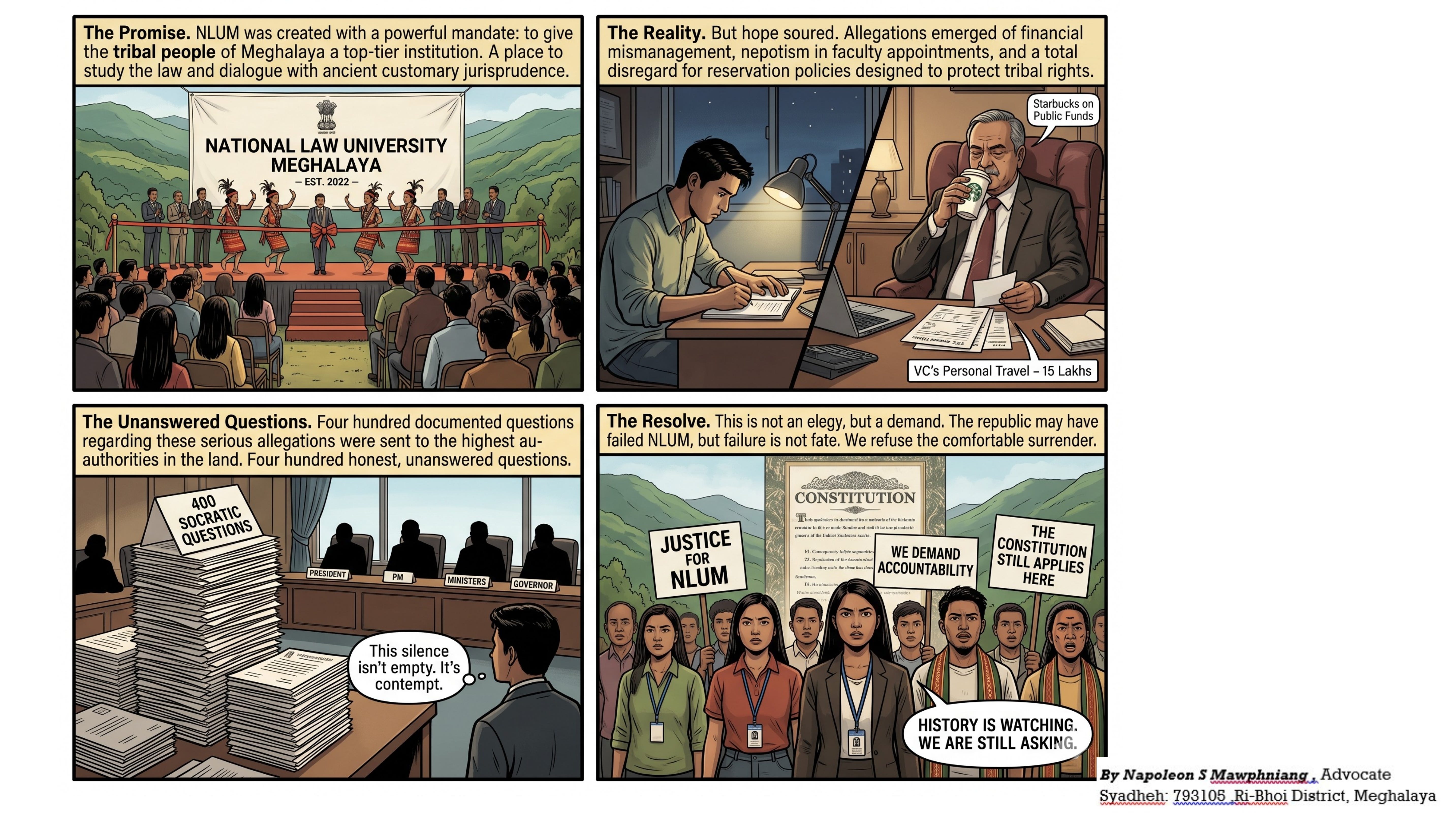
The Khasi Students’ Union, that venerable body of indigenous student advocacy without whose vigilance much of what I write here would remain buried under official silence, filed a Right to Information application that pierced through the institutional fog with the precision of a lancet. What the RTI revealed was not merely troubling; it was grotesque. According to reports published in Bar and Bench on June 5, 2025, Professor Dube had spent ₹15,10,347 on flight tickets, accommodation, food, and what the KSU described as “personal visits” between 2023 and 2025 — all at the expense of the state government. The KSU specifically pointed to receipts showing expenditure on fancy restaurants and — and let us pause here to let this detail register fully — coffee from Starbucks, billed to the public exchequer.[3]
I am not, I confess, a man who begrudges anyone their caffeine. But when a Vice Chancellor of a public university — an institution funded by the state and the Central Government and established to serve the educational needs of one of India’s most underserved populations — is billing Starbucks coffee to the government, something has gone irreversibly wrong. It is not merely a financial irregularity. It is a statement of philosophy. It says: I am above accountability. This institution exists for my convenience.
And then came the detail that ought to have produced immediate action from every level of government: ₹3,56,750 spent on alcoholic beverages for a ‘Climate Investment Coalition for the Global South’ event conducted by NLUM in Delhi on February 20, 2025. A law university. A public institution. Spending three and a half lakh rupees of public money on alcohol. At a conference. In Delhi. When students in Meghalaya lacked adequate teaching faculty for their basic subjects.[4][3]
Robert Greene, in The 48 Laws of Power, writes: “Never outshine the master.” But here we have a darker inversion: a man who mistakes his mastery of the institution for ownership of it. The Vice Chancellor had, according to the KSU, unilaterally drafted the university’s First Statutes in 2023 — a document that, remarkably, granted himself unchecked powers to appoint faculty and staff without formal selection procedures. This is not administration. This is autocracy. And autocracy, as any student of history knows, is the first cousin of institutional ruin.[5]
III. The Appointments: A Textbook in Nepotism
The philosopher Ludwig Wittgenstein wrote, in Philosophical Investigations, that “the limits of my language mean the limits of my world.” When I attempt to find language adequate to describe the appointments scandal at NLUM, I find myself approaching the limits of what polite discourse can accommodate. Let me try nonetheless.
According to the KSU’s letter to Chief Secretary D.P. Wahlang, submitted on February 25, 2025, and subsequently reported extensively in The Shillong Times, EastMojo, India Today NE, and Northeast Now, the following irregularities in appointments were documented:[6][7][8]
Six individuals — three Professors of Practice, one Associate Professor in Residence, and two Professors in Residence — were appointed without merit-based evaluation. Their posts were never advertised. No selection committee appears to have deliberated their cases. They were, in the most literal sense of the word, simply placed.[5]
The post of Associate Professor and Assistant Professor was advertised in 2022-23. The results of interviews were never published. Appointments were made — both permanent and tenure — without following due procedure and in flagrant disregard of the Meghalaya State Reservation Policy. The KSU alleged, with admirable specificity, that Dr. Ankita Chakraborty was hired without meeting UGC eligibility requirements and is connected to the Vice Chancellor through his wife, who served as Chakraborty’s Ph.D. supervisor at IIT Kharagpur.[8][6]
The appointment of Gurpreet Singh as Deputy Registrar carries its own particular weight. The position was initially advertised as permanent, subject to Meghalaya’s reservation policy — which exists precisely to protect the employment rights of tribal communities in a state where tribal people are a majority but have been historically excluded from many formal institutions of power. After concerns were raised about the selection of a non-domiciled candidate for a permanent position, the role was quietly and without public notification converted to a contractual position — a manoeuvre that, by design or by coincidence, circumvented the reservation policy entirely.[6]
I ask you, Your Excellency, in the spirit of the Socratic method that I learned not from any NLUM classroom but from the tradition of philosophy itself: is this what we mean by rule of law? Is this what we tell tribal students — children of the hills who have been marginalised for generations — when we say that the National Law University is their institution? Is it rule of law when the very administrator of a law university violates the law with such systematic thoroughness that one almost admires the audacity?
I am reminded of Derrida’s concept of différance — that meaning is always deferred, always slipping away, never fully present. In the NLUM context, justice is différance made institutional: forever advertised, never delivered; forever promised, never present; always approaching but never arriving.
IV. The Silence of Power: A Historical Meditation
Those who know history know that institutional failure of this kind does not occur in a vacuum. It occurs in a specific political ecosystem — one in which those who have the power to intervene choose instead to cultivate the more comfortable habit of looking away.
The Central Government established NLUM through the vehicle of the state legislature. The Ministry of Law and Justice is named specifically in the long title of the National Law University of Meghalaya Act, 2022, which states that the university was established “for imparting legal education for development of teaching and higher learning in law with powers to award degrees, diplomas, and other academic distinctions and also to impart legal education and training as mandated by the Ministry of Law and Justice, Government of India.” This is not a minor connection. This is the Central Government’s direct and unambiguous institutional fingerprint on NLUM. The Ministry of Law and Justice is constitutionally implicated in what happens within its walls.[1]
And yet. The silence from New Delhi has been magnificent in its thoroughness. While students have been denied adequate teaching faculty, while the Meghalaya State Reservation Policy has been shredded in the appointment chambers of a “national” institution, while the Vice Chancellor has been allegedly billing Starbucks coffee and hotel rooms to the state treasury, while the KSU has been marching and petitioning and filing RTIs and writing to ministers — while all of this has been happening in full public view, reported in multiple newspapers, documented in RTI responses — the Ministry of Education under Shri Dharmendra Pradhan has maintained a silence so complete that it begins to resemble a kind of institutional violence.[4]
Noam Chomsky, in Manufacturing Consent, a book that ought to be required reading for every student of Indian governance, argued that the media and institutions of power manufacture consent through what they choose not to say as much as through what they choose to say: “Propaganda is to a democracy what the bludgeon is to a totalitarian state.” I would extend this observation: silence, in a democracy, performs the same function as prohibition in an authoritarian one. When the Central Government does not act on documented institutional failure, it is not neutral. It is choosing a side. And the side it is choosing is not the side of the students of Meghalaya.[9]
This is not a new phenomenon in the history of Indian governance. The history of India’s northeastern states is, to a significant extent, a history of institutional promises made with great fanfare and abandoned with greater discretion. The 1972 creation of Meghalaya as a separate state from Assam was itself a response to a long history of tribal marginalisation — the Khasi, Jaintia, and Garo peoples’ demand for autonomy was a demand for institutions that would serve them, not institutions that would serve those who had historically controlled them. NLUM, in this context, is not merely a law school. It is a test case for whether the republic has learned anything from that history.[2]
It has not passed the test.
V. The Vice Chancellor Problem: A Study in Institutional Anatomy
Let us examine the Vice Chancellor question with the precision it demands. As of early 2026, NLUM’s first Vice Chancellor, Professor Indrajit Dube, whose term was ending in February 2026, had accumulated a record of allegations so extensive that the Meghalaya Education Minister Lahkmen Rymbui himself was compelled to state publicly, on November 27, 2025, that the government would not grant an extension to Dube if university rules prohibited it — a statement noteworthy less for what it said than for what it revealed: that extension had been under consideration.[10]
The KSU, in its letter to Law Minister Rymbui in November 2025, documented that the government had promised an inquiry within two months but that six months had elapsed without any action. Six months. The KSU calculated that during this period of governmental paralysis, approximately ₹46,83,500 had been paid as salaries to professors who had not been taking classes. Let that number sink in. Nearly fifty lakh rupees paid to people not doing the work they were paid to do. In a state where a large proportion of the population lives below the poverty line. In an institution ostensibly dedicated to justice.[11]
By March 2026, NLUM was advertising for a new Vice Chancellor — a position advertised through a recruitment notice published on the official job portals of the state. The application deadline was April 3, 2026. As of early April 2026, the selection process was ongoing — which means that as these words are written, NLUM is without a substantive, full-time Vice Chancellor — an institution drifting, headless, through what ought to be a period of foundational institution-building.[12][13]
I ask: what message does this send to the students currently enrolled in NLUM’s BA LLB programme? These are young men and women who made an enormous investment — financially, temporally, emotionally — in the promise of a National Law University education. They came to Shillong not for tourism but for transformation. They believed that this institution could shape them into lawyers capable of serving the republic, capable of arguing before its courts, capable of understanding and advancing the law of the land. What they found, or what many of them are finding, is an institution without adequate faculty, without transparent governance, and without — for a significant period — a Vice Chancellor at all.[4]
Michel de Montaigne, in his Essays, wrote that “Every man carries the whole form of the human condition within him.” In the same spirit, I suggest that every institution carries within it the whole form of the social condition that produced it. NLUM carries, in its administrative culture, the whole form of the governance culture that prevails in India’s institutions of power: the culture of nepotism as normal, of opacity as policy, of accountability as threat, and of public interest as rhetoric.
VI. The Reservation Question: Tribal Dignity Under Assault
I must linger on the reservation question, because it is not a peripheral issue. It is the very marrow of what is at stake.
Meghalaya is a Sixth Schedule state. The Sixth Schedule of the Indian Constitution — one of its most remarkable and least celebrated provisions — recognises the distinctiveness of tribal societies in the northeastern states and creates a framework of autonomous administration designed to protect their land, their customs, their identity, and their economic interests. The Meghalaya State Reservation Policy is not a favour granted to tribal people. It is a constitutional right, a recognition that centuries of marginalisation cannot be undone without deliberate institutional correction.
When Professor Dube allegedly appointed Gurpreet Singh to the post of Deputy Registrar over qualified tribal candidates and then converted the permanent post into a contractual one to circumvent the reservation policy — when the KSU alleged that Dube “deliberately put excessive eligibility criteria so that none of the indigenous candidates are able to apply” for faculty positions — this was not merely an administrative irregularity. This was an assault on the constitutional compact between the Indian state and the tribal peoples of Meghalaya.[11][6]
I am a Khasi. I say this not to claim parochial victimhood but to insist on the specificity of what is being lost. The Khasi people have a rich tradition of oral jurisprudence — a tradition of customary law, dispute resolution, and communal governance that predates the Indian legal system by millennia. The dream of a National Law University in Meghalaya was, in part, the dream of a space where this tradition could be studied, preserved, and brought into dialogue with the formal legal system of the republic. Instead, what we have is an institution in which the indigenous people of the state are being systematically excluded from positions of authority by a Vice Chancellor who, according to the KSU, declared himself “not answerable to the Union or any stakeholders of Meghalaya”.[6]
Not answerable. To any stakeholders of Meghalaya.
I confess, Your Excellency, that when I first read this reported statement, I had to sit very still for a few moments. I needed time to fully appreciate its philosophical audacity. A man appointed to lead an institution established by an Act of the Meghalaya Legislature, funded by the Meghalaya Government and the Central Government, in a building in Shillong, the capital of Meghalaya, for the benefit of the people of Meghalaya — this man declares himself not answerable to the stakeholders of Meghalaya. It is, if nothing else, a statement of sovereign contempt so complete that it belongs in the annals of institutional arrogance alongside the most storied examples of colonial administration.
George Orwell, in Nineteen Eighty-Four, described the Party’s use of “Doublethink” — the capacity to hold two contradictory beliefs simultaneously and accept both of them. NLUM’s administration has its own version of Doublethink: it claims to be a national institution serving the people of Meghalaya while systematically excluding those people from its governance and appointments. It claims to follow due process while never publishing interview results. It claims to be a law university while violating the law at every administrative turn.
VII. The International Mirror: When Universities Betray Their Mission
Let me hold up the international mirror, because the failure of NLUM is not unique in the history of universities, though it is particularly egregious in its context.
In 1930s Germany, the great universities — Heidelberg, Berlin, Frankfurt — which had been among the most distinguished institutions of learning in the world, were methodically stripped of their intellectual integrity through a combination of political appointment, ideological capture, and the systematic removal of those who did not conform. Hannah Arendt, herself expelled from Heidelberg, wrote of “the banality of evil” — the insight that institutional catastrophe is rarely the work of monsters. It is the work of mediocrities who have been given power they do not deserve and who exercise it without the burden of conscience.[9]
Closer to home, consider what happened at Nalanda University — the great ancient university of Bihar that flourished from the 5th to the 12th century CE, when it was one of the world’s foremost centres of learning, with students arriving from China, Korea, Japan, Tibet, Mongolia, Sri Lanka, and Southeast Asia. Nalanda was destroyed in 1193 CE by Bakhtiyar Khilji’s forces — a destruction so thorough that its library, the Dharmaganja, reportedly burned for three months. The physical destruction of Nalanda is universally mourned. But there is a less theatrical destruction that is happening in our own time, in our own state — not by foreign armies but by the internal administration of public institutions. When a Vice Chancellor spends public money at Starbucks while students lack faculty for their subjects, he is burning a library. More slowly, more quietly, but just as certainly.[3][4]
Paulo Freire, in Pedagogy of the Oppressed, warned of what he called the “banking concept” of education — the notion that students are empty vessels into which knowledge is deposited by an all-knowing teacher. But there is a prior pathology that Freire did not fully address: the institution that is so consumed with its own administrative pathologies that it cannot even perform the banking function. NLUM is not depositing knowledge into its students. It is depositing uncertainty, disillusionment, and the corrosive lesson that in India, institutions are for those who run them, not for those they are supposed to serve.[14][15]
James Joyce, in A Portrait of the Artist as a Young Man, gave us the image of Stephen Dedalus fleeing an institution — the Church, the State, the Family — that had claimed authority over his conscience without earning it. “I will not serve that in which I no longer believe,” says Stephen, “whether it call itself my home, my fatherland, or my church.” The students of NLUM are not yet fleeing in the Joycean sense, but I submit that with every semester of inadequate faculty, with every appointment made through nepotism rather than merit, with every RTI response that reveals a new layer of institutional corruption, they are being driven incrementally toward the same crisis of faith.
VIII. Meerloo’s Diagnosis: The Institutional Rape of the Mind
Joost Meerloo, the Dutch-American psychoanalyst who coined the term menticide — the systematic killing of the independent mind — wrote in The Rape of the Mind that totalitarian control begins not with armies but with institutions: “Fear, and continual pressure are known to create a menticidal hypnosis. The conscious part of the personality no longer takes part in the automatic confessions. The brainwashee lives in a trance, repeating the record grooved into him by somebody else.”[9]
I invoke Meerloo not to make a dramatic comparison between NLUM’s administration and totalitarianism, but to point to something more subtle and more pertinent: the way in which a dysfunctional institution conditions its members — students, faculty, staff — into a state of learned helplessness. When appointments are made without advertisement, when interview results are never published, when the Vice Chancellor declares himself unaccountable to the people of the state — the implicit message to everyone within the institution is: the rules do not apply here. Merit does not matter here. What matters here is proximity to power.
This is menticide by institutional design. It teaches the next generation of lawyers — the people who will one day argue for justice before courts, who will one day draft laws, advise governments, and defend the constitutional rights of citizens — that justice is a game played by those with connections. It teaches, by example, that the law is an instrument of the powerful rather than a shield of the weak. And it does this in the most insidious possible way: not through censorship or coercion, but through the daily drip of institutional cynicism.
René Girard, the French anthropologist and literary theorist, developed the concept of the scapegoat mechanism — the idea that communities under stress resolve their internal contradictions by identifying and sacrificing a victim. In the case of NLUM, the students and the tribal community of Meghalaya have been made into the scapegoats of institutional dysfunction. They are the ones who absorb the costs of poor governance. They are the ones who sit in classrooms taught by inadequately recruited faculty. They are the ones whose constitutional rights under the reservation policy are quietly circumvented. They are the ones who will carry, in their professional lives, the stigma of a degree from an unaccredited, inadequately staffed institution.[6][4]
IX. The Accreditation Abyss and the Question of Academic Legitimacy
Here we must confront one of the most uncomfortable questions surrounding NLUM: the question of its accreditation. According to publicly available information, NLUM has received neither NAAC accreditation nor the sustained academic recognition that would place it on a level with the more established National Law Universities. It is listed as “Bar Council Approved” — the minimum threshold for a law college to function — but the absence of accreditation from the National Assessment and Accreditation Council speaks to a deeper absence: the absence of the institutional infrastructure, the academic culture, and the governance standards that accreditation demands.[16]
This matters enormously. It matters because a student who graduates from an unaccredited institution — however prestigious its name — enters the professional world with a credential of uncertain market value. It matters because accreditation is not a bureaucratic ritual. It is a system’s way of saying: we have examined this institution and found that its governance is sound, its faculty qualified, its curriculum rigorous, and its administration transparent. In the absence of such certification, NLUM’s degree is, to put it bluntly, a promissory note on which the institution has yet to make good.
I think here of Agustina Bazterrica’s dark novel Tender is the Flesh — a work in which the mundane consumption of the monstrous is normalised through bureaucratic language and institutional legitimation. There is something similarly monstrous, if less lurid, in the normalisation of institutional failure at NLUM. A system that produces graduates without adequate teaching, from an institution without adequate governance, certifies them nonetheless. The institution consumes them — their time, their money, their ambition — and produces in return a credential that the institution itself has not earned the right to confer.
X. A Question of Federalism and Constitutional Responsibility
Let me now turn directly to you, Honourable Minister Dharmendra Pradhan.
The Ministry of Education of the Government of India has oversight responsibilities over the National Law Universities. The Bar Council of India, which itself has a statutory relationship with the Ministry, is responsible for the maintenance of standards in legal education. The UGC — which has recognised NLUM under Section 2(f) of the UGC Act — has a continuing responsibility to ensure that the universities it recognises maintain the standards that recognition implies.[17]
I ask you, sir: has the Ministry of Education been informed of the events at NLUM documented in multiple newspaper reports, RTI responses, and KSU communications? If it has been informed, why has it not acted? If it has not been informed, why not? The failure of information to reach those with the power to act is itself a form of institutional dysfunction — the dysfunction of a federal system in which the central government has the power but not the inclination to ensure that its legislative intentions are given effect.
The NLUM Act of 2022 was legislated — by the state — in furtherance of a mandate from the Ministry of Law and Justice. The Central Government is therefore not a disinterested bystander. It is a stakeholder of the first order. And its silence is not neutrality. Its silence is a choice.[1]
In the language of constitutional law, there is a doctrine of parens patriae — the state as the parent of those who cannot protect themselves. The students of NLUM, enrolled in an institution that was presented to them as the best that the republic could offer, who cannot individually compel the government to act on their behalf, are wards of this doctrine. The state — both state and Central — is their institutional parent. And both are failing in their parental duty with a thoroughness that should embarrass everyone who has ever spoken publicly about the importance of education for India’s northeast.
I am reminded of Wittgenstein’s famous formulation from the Tractatus: “Whereof one cannot speak, thereof one must be silent.” But the inversion is more germane here: whereof one can speak, thereof one must not be silent. The government can speak. It has the information. It has the authority. It has the legal mandate. It is choosing silence. And that choice is not philosophical. It is political. And it is cowardly.
XI. The Governance Architecture and Its Failures
Allow me now to examine, with the precision that the subject demands, the governance structure of NLUM and where it has broken down.
The National Law University of Meghalaya Act, 2022 created a university with specific governance structures: a Court, an Academic Council, a Finance Committee, and a Board of Management. At the apex of this structure sits the Vice Chancellor, who is the principal executive officer of the university. The Governor of Meghalaya is the Chancellor.[1]
The fact that as of March 2026 — nearly three and a half years after the university’s establishment — NLUM was advertising for a Vice Chancellor tells its own story. The institution had, in the period since its founding, been led by a Vice Chancellor whose term was ending in February 2026, who was leaving under a cloud of allegations so serious that even the state’s Law Minister had felt compelled to weigh in. The search for a replacement, with a deadline of April 3, 2026, and a selection process that was “ongoing” as of early April 2026, means that there was a very real prospect of NLUM operating without substantive leadership for an indefinite period.[13][12][10]
An institution without a Vice Chancellor is an institution without a captain on a ship that is already taking on water. The daily administration may continue — the Registrar may continue to function, admissions may proceed — but the academic vision, the institutional direction, the critical decisions about faculty appointments and curriculum development and research partnerships: all of these require leadership. Without it, the institution drifts.[18]
And it is not as if NLUM can afford to drift. It is a young institution. It does not have the accumulated reputation, the endowment, the alumni network, or the institutional momentum of NLSIU Bengaluru or NUJS Kolkata. Every year of poor governance is not merely a year lost. It is a year in which the foundation — which should be setting like cement — remains perpetually liquid. You cannot build on liquid.
I think, at this point, of Machiavelli’s warning in Discourses on Livy: “The injuries done to the body of a state are more grave than those done to its limbs; for the body can generate new limbs, but a wounded body cannot generate itself.” The body of NLUM — its institutional culture, its academic reputation, its relationship with the people of Meghalaya — is being wounded, not its limbs. Faculty can be hired. Buildings can be built. But a culture of accountability, once destroyed in the founding years of an institution, does not regenerate itself easily. It requires extraordinary effort and extraordinary leadership to reverse.
XII. The Question to the President: Your Excellency, What Does This Say About Us?
I address you now, Your Excellency Smt. Draupadi Murmu, with particular deliberateness.
You are the first President of India from a tribal community. Your election to the highest constitutional office in the land was celebrated — justly — as a moment of historic recognition, a moment when the republic acknowledged, symbolically but powerfully, that its tribal peoples are not its guests. They are its co-founders. Your extraordinary personal journey — from a remote Santali village in Odisha to Rashtrapati Bhavan — is a testament to what becomes possible when institutional doors are opened, not merely cracked.
But Your Excellency, I ask you, with the deepest respect and the most earnest sincerity: what does it mean for those institutional doors to be opened with one hand and closed with the other? What does it mean to celebrate tribal identity at the highest levels of the republic while allowing a university in a tribal state to systematically exclude tribal people from its appointments, in violation of the constitutional provisions specifically designed to protect them?
The Sixth Schedule, which governs Meghalaya, is not merely a legal provision. It is a covenant. It is the republic’s promise to its tribal citizens that their identity, their customs, and their rights will be protected within the framework of the Constitution. When a Central Government institution — or an institution established in furtherance of a Central Government mandate — violates that covenant, it is not merely an administrative lapse. It is a constitutional breach. And a constitutional breach, Your Excellency, is within your constitutional purview to address.
I do not ask you to intervene unconstitutionally. I ask you to exercise the moral authority that your office and your personal history uniquely confer. A word from Rashtrapati Bhavan — a word of inquiry, of concern, of expectation — would be heard. It would be acted upon. It would change things. The question is whether the political will exists to speak that word.
XIII. The Question to the Home Minister: Mr. Shah, Who Governs the Northeast?
Honourable Shri Amit Shah, I address you as the minister responsible, among many other things, for the governance of India’s northeastern states.
You have spoken often and with evident conviction about the development of the northeast. You have spoken of connectivity, of infrastructure, of investment. These are important things. But institutions of learning are the deepest infrastructure of all. They are the infrastructure of the mind. They are the structures within which the citizens of tomorrow are formed, informed, and equipped.
I ask you, sir: under whose watch has this happened? Who is responsible for the governance failure at NLUM? Who has allowed a Vice Chancellor to spend public money on Starbucks and alcohol while students sit in inadequately staffed classrooms? Who has allowed the Meghalaya State Reservation Policy to be circumvented in an institution established under a state act? Who has allowed a Vice Chancellor to draft statutes giving himself unchecked power and then exercise that power without restraint for three years?
These are not rhetorical questions. They have answers. And those answers implicate not just the Vice Chancellor, not just the state government, not just the KSU, not just the newspapers that reported on this — but the system of oversight and accountability that your Ministry is partly responsible for. The northeastern states are constitutionally distinct. They are governed by special provisions. They are entitled to special attention. They are not getting it.
XIV. Echoes Across the Republic: NUJS and the Pattern of NLU Dysfunction
I must note, for the record, that NLUM is not an isolated case. The National University of Juridical Sciences (NUJS) in Kolkata witnessed, in September 2025, a remarkable spectacle: more than 200 students gheraoing — physically surrounding — their Vice Chancellor, Nirmal Kanti Chakrabarti, in his own chamber, demanding his resignation following a Supreme Court judgment that, while dismissing a sexual harassment complaint on technical grounds, directed that the judgment be included in the VC’s permanent record. The students’ statement was eloquent in its desperation: “Our protest is not an isolated reaction to a single incident. It is a collective cry born out of months, even years of silence, frustration and disappointment. It is an action born out of desperation... the lack of financial transparency and the systematic pattern of administrative failures, persistent apathy and growing disconnect between the administration and its students and faculty members.”[19]
The NUJS students could have been NLUM students. Their words could have been spoken in Shillong. The same diagnosis — financial opacity, administrative failure, apathy, disconnect — applies with equal force to NLUM. This is the disease of the NLU system: institutions established with magnificent ambitions and then administered by men and women who mistake administrative power for academic vision.
The pattern raises a systemic question that goes beyond any individual institution: is there something wrong with the governance model of National Law Universities? Is the model — in which a VC with virtually unchecked power is appointed by a search committee that may itself be subject to political influence — inherently prone to the kind of dysfunction we are witnessing? This is a question that requires a serious national conversation, led from the top. It requires leadership from the Ministry of Education and the Ministry of Law and Justice. It requires the kind of systemic accountability that can only come from the centre.
XV. The Language of Power and the Power of Language
Oscar Wilde wrote, in The Importance of Being Earnest, that “The truth is rarely pure and never simple.” I find myself returning to this line when I contemplate the language that institutional actors use to describe institutional failure. The Vice Chancellor who declares himself “not answerable to the Union or any stakeholders of Meghalaya” is using the language of sovereignty — a vocabulary that belongs to nations, not to university administrators. The conversion of a permanent post to a contractual one without public notification is described in administrative language as a “procedural adjustment.” The appointment of faculty without advertisement is described as “expeditious hiring.” The spending of public money on Starbucks is presumably categorised under “official entertainment” or some similar euphemism.
Derrida, in Of Grammatology, argued that all language is a system of différance — that meaning is produced not through presence but through the play of difference and deferral. The language of institutional corruption operates on precisely this principle: it defers the plain meaning of what is happening, substitutes technical language for moral clarity, and produces a semantic fog so thick that it becomes difficult to see what is happening in front of you.
But I am an advocate. My profession is the cutting through of exactly this fog. Let me, therefore, state in the plainest possible language what I believe has happened at NLUM:
A man was given unchecked power over a public institution. He used that power to benefit himself, his associates, and his network. He violated the constitutional rights of the tribal citizens of Meghalaya. He spent public money on personal comfort. He appointed unqualified people to positions they had not earned. He refused to be accountable to the public whose taxes funded his salary and his Starbucks coffee. He did all of this over a period of three years, in full view, reported in multiple newspapers, documented by RTI applications, complained about by a major student organisation — and nothing happened. No inquiry was completed. No action was taken. No accountability was demanded by those with the power to demand it.
That is the plain statement of the case.
XVI. The Education Minister and the Question of Standards
Honourable Shri Dharmendra Pradhan, I address you specifically on the question of standards.
The National Education Policy 2020, which your Ministry championed, speaks eloquently of quality, equity, and excellence. It speaks of transforming India’s higher education system into “a vibrant knowledge society.” It speaks of institutions that are “multidisciplinary, world-class,” that offer their students “a holistic and rounded education.”
I ask you, sir: is NLUM a world-class institution? Is it offering its students a holistic and rounded education? Is it a model of the NEP’s vision for India’s higher education system?
The evidence suggests otherwise. A university without full-time, properly recruited faculty cannot offer holistic education. A university where faculty appointments are made through nepotism and personal connection cannot be world-class. A university where the Vice Chancellor spends more time in fancy restaurants than in the classroom cannot be transformative. A university that is advertising for a Vice Chancellor three and a half years after its founding — having already lost one Vice Chancellor under a cloud of controversy — is not fulfilling the vision of the NEP. It is a monument to the gap between policy and implementation, between rhetoric and reality.
Paulo Freire wrote that “Education either functions as an instrument which is used to facilitate integration of the younger generation into the logic of the present system and bring about conformity or it becomes the practice of freedom, the means by which men and women deal critically and creatively with reality and discover how to participate in the transformation of their world.” NLUM, as it currently functions, is neither. It is not integrating its students into any coherent system because the system it embodies is incoherent. And it is certainly not the practice of freedom. It is the practice of institutional despair.[14]
What is needed, Minister, is not another committee. Not another circular. Not another promise of an inquiry that is six months old before it begins. What is needed is an audit — a thorough, transparent, public audit of NLUM’s finances, appointments, governance, and academic standards, conducted by an independent body with the authority to compel disclosures and make binding recommendations. What is needed is the appointment of a Vice Chancellor of genuine distinction, genuine integrity, and genuine commitment to the educational needs of Meghalaya’s people — appointed through a process that is transparent, merit-based, and free from the influence of personal networks. What is needed, above all, is accountability.[11]
XVII. The Deeper Question: What Is a Law University For?
Let me ask the question that underlies all of the specific complaints and allegations I have documented. Let me ask it in the Socratic spirit that my own education instilled in me, even if that education was acquired not from the National Law University of Meghalaya but from the older, harder, more unforgiving university of practice and experience.
What is a law university for?
Is it for the benefit of its Vice Chancellor’s travel schedule? Is it for the career advancement of those who are connected to the right networks? Is it for the production of credentials that carry the stamp of a “national” institution without the substance that stamp implies? Is it a vehicle for the circumvention of the constitutional rights of tribal people? Is it a conduit for the misuse of public funds?
Or is it for something else?
Is it for the formation of lawyers who understand not merely the letter but the spirit of the law? Is it for the cultivation of a legal culture that is rooted in the specific history, specific needs, and specific aspirations of the people it serves? Is it for the preservation and development of indigenous legal traditions, bringing them into productive dialogue with the constitutional order? Is it for the production of judges, advocates, legal scholars, and policymakers who will understand Meghalaya not as a distant periphery but as a living, complex, intellectually rich society that has things to teach the republic as well as things to learn from it?
I believe it is for the latter. I believe that this is what the students who enrolled in NLUM were told it was for. I believe this is what the Act of 2022 intended. And I believe that the gap between this vision and the current reality is one of the great institutional betrayals of our time — small in national scale, perhaps, but enormous in human scale, and enormous in what it says about the republic’s willingness to honour its commitments to its most marginalised citizens.
XVIII. The Orwellian Conclusion and What Must Be Done
George Orwell, in his essay Politics and the English Language, wrote: “In our time, political speech and writing are largely the defence of the indefensible. Things like the continuance of British rule in India... can indeed be defended, but only by arguments which are too brutal for most people to state, and which do not square with the professed aims of political parties. Thus political language has to consist largely of euphemism, question-begging and sheer cloudy vagueness.” I substitute “institutional mismanagement” for “British rule in India” and the formulation fits NLUM like a tailored suit.[9]
The defence of what has happened at NLUM requires precisely these qualities: euphemism, question-begging, and sheer cloudy vagueness. The appointment irregularities are “procedural matters.” The financial mismanagement is “administrative oversight.” The violation of reservation policy is “a technical issue under review.” The refusal to answer to the stakeholders of Meghalaya is “the exercise of academic autonomy.” None of these defences can withstand scrutiny. All of them depend on the Orwellian fog that descends whenever power is called to account.
My demands, therefore, are clear. I state them not as a supplicant but as a citizen exercising his constitutional right to petition the organs of the republic:
First, that the Central Government, through the Ministry of Education and the Ministry of Law and Justice, immediately initiate an independent, time-bound audit of NLUM’s finances, governance, and appointment processes, with results made public.
Second, that the Union Government direct the Bar Council of India and the UGC to conduct an emergency academic inspection of NLUM to assess whether the institution is meeting the minimum standards required for the conduct of legal education, with a report submitted to Parliament within ninety days.
Third, that the appointment of a new Vice Chancellor for NLUM be conducted with full transparency, through a process that is free from political or personal influence, and that the selected candidate be a person of genuine distinction in law and genuine commitment to the educational needs of the northeastern states.
Fourth, that the alleged violation of the Meghalaya State Reservation Policy in the appointments of NLUM be investigated by a constitutional authority — whether the Human Rights Commission, the National Commission for Scheduled Tribes, or a body constituted under the Sixth Schedule — and that appropriate remedial action be taken.
Fifth, that the Central Government develop, in consultation with the state government and civil society organisations including the KSU, a comprehensive institutional development plan for NLUM, with benchmarks for faculty recruitment, accreditation, research output, and student outcomes, to be reviewed annually by a parliamentary committee.
Sixth, that the Government of India make a formal, public commitment to the people of Meghalaya that the National Law University Meghalaya will be given the resources, the oversight, and the governance framework necessary to fulfil the promise for which it was established.
XIX. A Final Word: The Responsibility of Language and the Language of Responsibility
I began this letter with Orwell. Let me end it with someone less famous but equally instructive.
Charles Lamb, the English essayist, wrote in Essays of Elia: “The greatest pleasure I know is to do a good action by stealth, and to have it found out by accident.” I invert this: the greatest institutional crime is to do a wrong thing openly, in full public view, reported in newspapers and documented in RTI responses — and to have it neither noticed nor addressed by those with the power to act.
That is the crime that is being committed at NLUM. It is not a crime of violence. It is a crime of institutional betrayal. But in a state like Meghalaya — in a state whose people have waited centuries for the republic to make good on its promises — betrayal is not a minor matter. It is the continuation, by other means, of the very marginalisation that institutions like NLUM were supposed to end.
Your Excellency Smt. Draupadi Murmu, you know what it means to carry the hopes of a marginalised community. You know what it means to be told, for generations, that your people’s turn has not yet come. I ask you to ensure that the tribal students of Meghalaya who enrolled in NLUM with hope in their hearts are not told, by the actions — or inactions — of the republic, that their turn has not yet come either.
Honourable Prime Minister Modi, you have made governance — good governance, achhe din, the promise of institutions that work — the central claim of your political legacy. I ask you to ensure that this claim extends to the institutions of the northeast, which are neither less important nor less deserving of good governance than the institutions of the Gangetic plain.
Honourable Home Minister Shah, the unity of India is not achieved merely by administrative integration. It is achieved by ensuring that every part of the republic experiences the republic as a place that keeps its promises. Meghalaya is waiting.
Honourable Education Minister Pradhan, the NEP is only as good as its implementation. Implementation in Meghalaya is failing. Act accordingly.
I close, as I opened, with a question — the Socratic question that underlies all of this: If not now, when?
The students of NLUM are in their classrooms today. They are learning the law — or trying to. They are forming the habits of mind and the professional values that will define their careers and, through their careers, the legal culture of this state for the next generation. What are they learning? What are we teaching them?
Are we teaching them that institutions exist to serve the people? Or are we teaching them that institutions exist to serve the powerful?
Are we teaching them that merit determines who holds positions of responsibility? Or are we teaching them that connection and nepotism are the true currencies of institutional life?
Are we teaching them that the constitutional rights of tribal people are inviolable? Or are we teaching them that those rights are negotiable, subject to circumvention by those clever enough to convert permanent posts into contractual ones?
Are we teaching them that public funds are a sacred trust? Or are we teaching them that public funds are a personal resource for those lucky enough to administer them?
The National Law University Meghalaya is, in the truest sense, a school. It is teaching lessons that go far beyond the curriculum. And the lessons it is currently teaching — the lessons that flow not from its textbooks but from its institutional behaviour — are the worst lessons a law school can teach: that law is for the powerful, that accountability is for the weak, and that the gap between the Constitution’s promises and its delivery is not a problem to be solved but a condition to be accepted.
I reject that lesson. I reject it as an advocate, as a Khasi, as a citizen of Meghalaya and of India, and as a human being who believes that the republic is capable of better. I reject it, and I invite you — all four of you, the highest constitutional and political authorities in this land — to reject it with me.
The National Law University Meghalaya must not be allowed to remain a monument to institutional failure. It must be made to work. It must be made to serve the people it was designed to serve. It must be made to honour the constitutional compact that its very existence represents.
This is not too much to ask. It is the minimum that justice demands.
Yours, in the conviction that silence is complicity and that accountability begins with those who are accountable to us all,
Napoleon S. Mawphniang Advocate, High Court of Meghalaya Shillong, May 2026
Napoleon S. Mawphniang is a legal professional and citizen advocate based in Shillong, Meghalaya. He writes on matters of constitutional law, tribal rights, and institutional accountability
.
REFERENCES AND SOURCES
· KSU allegations of corruption at NLUM, EastMojo, May 30, 2025[5]
· KSU letter to Chief Secretary D.P. Wahlang, India Today NE, February 25, 2025[6]
· NLU Meghalaya VC accused of lavish travel spending, Bar and Bench, June 5, 2025[3]
· RTI disclosures on VC travel expenditure, LawChakra, June 4, 2025[4]
· KSU flags irregularities in NLU appointments, The Shillong Times, February 14, 2025[7]
· KSU alleges irregularities in NLU appointments, Northeast Now, February 14, 2025[8]
· Action sought against ‘corrupt’ VC, The Meghalayan Express, November 27, 2025[11]
· No rule, no extension: Edn Min on NLU VC tenure, The Shillong Times, November 27, 2025[10]
· NLU Meghalaya VC Recruitment 2026, NE Now, March 4, 2026[12]
· Selection Process Continues for NLU Meghalaya VC, Indian Grapevine, April 7, 2026[13]
· The National Law University of Meghalaya Act, 2022, India Code[1]
· Paulo Freire, Pedagogy of the Oppressed — Development Education Review[14]
· NUJS students gherao VC, Times of India, September 20, 2025[19]
· NLU Meghalaya College Information, AdvocateKhoj[16]
400 SOCRATIC QUESTIONS TO THE COMPETENT AUTHORITIES
A Relentless Interrogation of Power, Conscience, and Constitutional Accountability
On the Failure of the National Law University Meghalaya
Submitted by Napoleon S. Mawphniang, Advocate, Shillong, Meghalaya
“The unexamined life is not worth living.” — Socrates “To question is to begin to understand.” — Paulo Freire “He who asks a question is a fool for five minutes; he who does not ask a question remains a fool forever.” — Chinese Proverb
The following 400 questions are addressed to the President of India, the Prime Minister, the Home Minister, the Education Minister, the Governor of Meghalaya, the Bar Council of India, the UGC, the NLU Meghalaya administration, and the collective conscience of the Indian republic. They are not rhetorical performances. They are the honest interrogations of a citizen who has not been given honest answers. Each question is a torch held up to the darkness of institutional failure. Let those who can answer them, answer them — in public, under oath, and without the comfort of euphemism.
PART I: QUESTIONS ON CONSTITUTIONAL RESPONSIBILITY AND FOUNDING OBLIGATIONS
(Questions 1–50)
Question 1. When the Parliament of Meghalaya enacted the National Law University of Meghalaya Act, 2022 — an Act that explicitly stated its mandate derived from the Ministry of Law and Justice, Government of India — did the Central Government understand that in lending its name, its legislative authority, and its institutional framework to this university, it was accepting a constitutional and moral responsibility for what that university would become? And if the Central Government did understand this, how does it explain its thunderous, sustained, and apparently deliberate silence in the face of documented, newspaper-reported, RTI-confirmed institutional failure?
Question 2. The Preamble to the Constitution of India solemnly resolves to secure to all its citizens justice — social, economic, and political. When a National Law University — an institution that is, by its very nature, a temple of justice — systematically violates the constitutional rights of tribal people in appointments, when it circumvents the reservation policy designed precisely to correct centuries of social injustice, is that university not in breach of the constitutional compact that justifies its existence? And does not that breach implicate every authority that has oversight over it?
Question 3. The Sixth Schedule of the Indian Constitution — a provision that exists specifically to protect the autonomy, rights, and dignity of tribal communities in the northeastern states — is not merely a legal provision. It is a covenant. It is the republic’s written promise to the Khasi, Jaintia, and Garo peoples that their identity and rights will be protected. When NLUM allegedly converted a permanent post into a contractual position specifically to circumvent the Meghalaya State Reservation Policy that flows from this covenant, was it not, in effect, tearing a page from the Constitution? And if so, who is responsible?
Question 4. Her Excellency President Draupadi Murmu is the first President of India from a tribal community — a historic achievement celebrated as a moment of constitutional recognition for India’s marginalised peoples. Does it not create a profound and irreducible contradiction — indeed, does it not constitute a kind of institutional irony so bitter as to be almost unbearable — that under her presidency, a university in a tribal state has allegedly violated the reservation rights of tribal candidates, in an institution established by a Central Government mandate? And what does her silence on this matter say to the tribal peoples of Meghalaya who saw her election as a promise?
Question 5. When the Ministry of Law and Justice mandated the establishment of NLUM, did it simultaneously establish any ongoing mechanism of accountability — any audit committee, any parliamentary oversight mechanism, any reporting requirement — to ensure that the institution was actually fulfilling the purposes for which it was created? If not, why not? And if it did create such mechanisms, why have those mechanisms produced no visible action in the face of documented failure?
Question 6. The National Education Policy 2020, championed by the Ministry of Education under Honourable Minister Dharmendra Pradhan, speaks of institutions that are “multidisciplinary, holistic, and world-class.” Does Minister Pradhan consider NLUM, as it currently functions — with alleged nepotistic appointments, documented financial irregularities, inadequate faculty, and an ongoing search for a Vice Chancellor more than three years after the institution’s founding — to be consistent with the NEP’s vision? If he does not, what specific actions has the Ministry taken to bring NLUM into conformity with that vision?
Question 7. India has repeatedly, in its foreign policy and its constitutional rhetoric, declared itself to be the world’s largest democracy and a champion of the rule of law. Does this claim not place upon the Indian state a special obligation to ensure that its own institutions of legal education are governed by the rule of law? When a Vice Chancellor of a national law university allegedly declares himself “not answerable to the Union or any stakeholders of Meghalaya,” is that declaration consistent with the rule of law? And if not, how has the rule of law been vindicated?
Question 8. Aristotle, in the Nicomachean Ethics, wrote that justice is a mean between doing injustice and suffering it. When the tribal students of Meghalaya are enrolled in an institution that fails to provide them with adequate, properly recruited faculty — when they pay fees, invest years of their lives, and receive in return a credential of uncertain value from an institution of dubious academic standing — are they not suffering injustice? And is not the silence of the competent authorities — those with the power to end this injustice — itself a form of doing injustice?
Question 9. The concept of parens patriae — the state as the parent of those who cannot protect themselves — is one of the most ancient doctrines of constitutional law. The students of NLUM, individually powerless against the institutional forces arrayed against them, are the wards of this doctrine. Has the Indian state fulfilled its parental responsibility toward these students? If the state were a parent, and if the school it chose for its children were discovered to be managed by corrupt administrators who were misusing funds meant for education, would any parent worthy of the name remain silent?
Question 10. The Union Home Minister, Honourable Shri Amit Shah, has spoken frequently about his government’s commitment to the development of India’s northeastern states — about connectivity, about investment, about integration. But the deepest integration is not physical. It is institutional and psychological. When institutions in the northeast fail — when a National Law University is left to flounder without proper governance or accountability — does that not send precisely the opposite message to the people of the northeast: that they are valued when their vote is needed, and forgotten when their institutions need governance?
Question 11. The Bar Council of India is the supreme regulatory body for legal education in the country. It has the power to de-recognise a law college that does not meet its standards. Has the Bar Council of India conducted a thorough inspection of NLUM since the allegations of faculty irregularities, financial mismanagement, and governance failure became a matter of public record? If it has, why have the results of that inspection not been made public? If it has not, why not — and does the Bar Council’s inaction not itself constitute a regulatory failure?
Question 12. The University Grants Commission has recognised NLUM under Section 2(f) of the UGC Act. That recognition carries with it an implicit certification that the institution meets minimum standards of governance, faculty, and academic quality. Given the evidence now in the public domain, does the UGC stand by that certification? And if it does, what does that say about the standards that certification implies?
Question 13. In the history of India’s great institutional failures, a recurring pattern emerges: a powerful individual is placed at the head of an institution, given unchecked authority, and allowed to use that authority in ways that serve personal interest rather than public purpose — and the system of oversight that should prevent this fails, either through complicity, indifference, or institutional design. Is NLUM following this pattern? And if so, what systemic reforms are required to break the pattern — not just at NLUM but at all National Law Universities?
Question 14. The NLUM Act of 2022 creates a governance structure that includes a Court, an Academic Council, a Finance Committee, and a Board of Management. Were these bodies actually constituted after the university’s establishment? Were they meeting regularly? Were they exercising their statutory functions? Were the minutes of their meetings publicly available, as good governance requires? Or were they, as is so often the case in institutions run by powerful vice chancellors, rendered ceremonial — rubber stamps on decisions already taken?
Question 15. Article 21 of the Constitution guarantees the right to life and personal liberty — and the Supreme Court has, over decades of progressive jurisprudence, interpreted this right to include the right to education, the right to livelihood, and the right to dignity. When students enrolled in NLUM are denied quality education because the institution lacks properly recruited faculty, because it is consumed by administrative scandal, because it lacks stable leadership — are their Article 21 rights not being violated? And does any authority intend to answer this question?
Question 16. Noam Chomsky, in Manufacturing Consent, argued that the propaganda function of institutions is most effective when it is least visible — when people believe they are receiving information rather than being managed. Has NLUM’s administration managed the information available to the public and to regulatory authorities in a way that has obscured the reality of its governance failures? And if so, who enabled this management of information — by asking no questions, demanding no reports, and accepting official silence as official confirmation of normalcy?
Question 17. Paulo Freire wrote that “the oppressor is solidary with the oppressed only when he stops regarding the oppressed as an abstract category and sees them as persons who have been unjustly dealt with.” Do the ministers and officials responsible for NLUM see its students as persons? Or do they see them as an abstract category — “law students in the northeast” — whose specific, individual experiences of institutional failure are invisible from the comfortable distance of New Delhi?
Question 18. The Governor of Meghalaya is, under the NLUM Act, the Chancellor of the university. What has the Governor done — specifically, concretely, and on the record — to address the governance failures at NLUM? Has the Chancellor exercised any of the statutory powers available to the head of a university in crisis? Or has the Chancellorship been understood as a ceremonial appointment, a rubber stamp, a title without responsibility?
Question 19. Wittgenstein wrote, “If a lion could speak, we could not understand him,” because the lion’s form of life is too different from our own. Is it possible that the administrators of NLUM — and the Central Government officials responsible for overseeing it — operate in such a different institutional form of life from the tribal students of Meghalaya that they genuinely cannot understand what the failure of this institution means to those students? And if so, is that failure of understanding not itself a form of institutional violence?
Question 20. The Indian republic was founded on the principle that sovereignty resides in the people — We, the People of India, as the Preamble declares. The people of Meghalaya, through their elected state legislature, created NLUM. The people of Meghalaya, through their taxes, fund it. The people of Meghalaya, through their students, inhabit it. When a Vice Chancellor declares himself “not answerable to any stakeholders of Meghalaya,” is he not, in the most literal constitutional sense, declaring himself not answerable to the sovereign people of Meghalaya? And is that not an act of profound constitutional contempt?
Question 21. The concept of locus standi — the right to bring a matter before a legal forum — is a fundamental principle of procedural law. The KSU has standing. The affected students have standing. The affected tribal candidates denied reservation benefits have standing. Advocates who care about the rule of law have standing. The citizens of Meghalaya have standing. Has anyone, in a position of authority, told these people that their standing counts — that their complaints will be heard, their evidence examined, and justice done? Or have they been told, by the most effective means of all — the means of utter silence — that their standing does not matter?
Question 22. The Indian National Human Rights Commission exists to investigate complaints of human rights violations by state and Central Government agencies. Has any complaint been filed before the NHRC regarding the violation of the constitutional and human rights of tribal candidates who were allegedly denied appointment at NLUM in contravention of the reservation policy? If not, why not? If yes, what action has the NHRC taken?
Question 23. The National Commission for Scheduled Tribes has the mandate to investigate matters relating to the rights of Scheduled Tribes under the Constitution. Meghalaya’s tribal communities are scheduled tribes with constitutional protections. Has the NCST been informed of the alleged violations of reservation rights at NLUM? Has it investigated? Has it reported? If not, is this not itself a failure of the institutional infrastructure of tribal rights protection?
Question 24. The Right to Information Act, 2005 — one of the great achievements of Indian democracy — gives every citizen the right to ask questions of public authorities. The KSU used this right to uncover the financial irregularities at NLUM. But the RTI Act is a tool of information; it is not a tool of enforcement. Information without action is impotent. What actions have been taken by competent authorities on the basis of the information revealed by RTI applications about NLUM? None that are publicly visible. Why?
Question 25. The concept of institutional memory is important in administrative law: the idea that institutions carry within them the accumulated wisdom, precedents, and culture of their past. NLUM is a young institution — barely four years old. Its institutional memory is being formed right now, in these years. What memory is being created? What precedent is being set? What culture is being established? If the culture being established is one of impunity, opacity, and nepotism, how many years will it take to undo that culture once it has solidified? And who will pay the price of those years?
PART II: QUESTIONS ON FINANCIAL ACCOUNTABILITY AND THE PUBLIC TRUST
(Questions 26–80)
Question 26. The Vice Chancellor of NLUM allegedly spent ₹15,10,347 on flights, accommodation, food, and personal visits between 2023 and 2025 — all charged to the public exchequer. This is not private money. This is money collected from the citizens of Meghalaya and India in the form of taxes, appropriated by the legislature for the purpose of funding legal education, and entrusted to the university for that purpose. In what system of ethics — utilitarian, Kantian, Aristotelian, or common sense — is it permissible to spend this money on personal comfort? And who authorised this spending?
Question 27. The report of ₹3,56,750 spent on alcoholic beverages at a climate conference in Delhi, charged to NLUM’s budget, deserves its own line of interrogation. Was this expenditure approved by the Finance Committee? Was it disclosed in the audited accounts? Was it reported to the state government? Was it reported to the Central Government? Was it reported to the UGC? And if it was reported to any of these authorities, what was their response? If it was not reported, why not?
Question 28. The KSU alleged that approximately ₹46,83,500 was paid as salaries to professors who were not taking classes — a figure calculated over the period during which the government had promised an inquiry but failed to conduct one. This is not a trivial sum. In a state where per capita income is modest and educational resources are scarce, this amount could fund scholarships, library resources, research grants, and infrastructure. Who decided that this money would be paid to absent professors rather than invested in actual education? And who is responsible for recovering it?
Question 29. In the law of trusts — one of the most elegant branches of legal doctrine — a trustee who misapplies trust property for personal benefit is personally liable to restore that property to the trust. The Vice Chancellor of NLUM was a trustee of public funds. If the allegations of financial irregularity are established, does he not bear personal liability to restore the misapplied funds to the public exchequer? And has any competent authority initiated proceedings to establish this liability?
Question 30. The Comptroller and Auditor General of India has the constitutional mandate to audit the accounts of all bodies substantially funded by the central and state governments. Has the CAG audited the accounts of NLUM? If so, where are those audit reports? Are they publicly available? Have they been placed before the state legislature? If the CAG has not audited NLUM, why not — and does the absence of CAG oversight not itself constitute a gap in the financial accountability architecture of this institution?
Question 31. Government institutions in India are subject to the General Financial Rules, which mandate transparency, competitive procurement, and financial probity. Did NLUM follow the GFR in its procurement of goods and services — including the travel bookings, hotel accommodations, and food expenditures that have been the subject of KSU complaints? If it did not, which specific rules were violated, and who is responsible for those violations?
Question 32. The Prevention of Corruption Act, 1988 defines corruption to include the misuse of position for personal advantage by a public servant. Is the Vice Chancellor of a National Law University a public servant for the purposes of this Act? If he is, and if the allegations of financial irregularity are established, does his conduct not potentially attract the provisions of the PCA? And has any authority considered referring the matter to the relevant anti-corruption authority?
Question 33. The Fiscal Responsibility and Budget Management Act and its state equivalents require that public funds be used for the purposes for which they are appropriated. When the Meghalaya Legislature appropriated funds for NLUM, it appropriated them for legal education — for faculty salaries, library development, campus infrastructure, student services, and institutional administration. Was the expenditure on hotel rooms and Starbucks coffee within the appropriated purposes? And if not, does that not constitute a violation of the principle of appropriation?
Question 34. In the history of Indian institutional accountability, the question of who audits the auditors — who watches the watchmen — is perennially relevant. The Finance Committee of NLUM is supposed to oversee financial management. Was the Finance Committee actually constituted? Was it actually meeting? Were its members independent of the Vice Chancellor’s influence? Was it examining actual financial statements rather than summary reports prepared by the administration? Or was it, like many such committees in Indian universities, a ceremonial body whose meetings were conducted primarily for the purpose of having minutes that could be produced if questioned?
Question 35. International best practice in university governance, as outlined by bodies such as the International Association of Universities and the Commonwealth Higher Education Management Service, requires that universities publish annual audited accounts, that those accounts be reviewed by an independent audit committee, and that the results be disclosed to stakeholders. Does NLUM comply with these standards? Where are its published annual accounts? Are they available on the university’s website? Have they been filed with the UGC? And do they accurately reflect the expenditures that have been reported in the press?
Question 36. Transparency International’s Corruption Perceptions Index consistently identifies opacity in public sector financial management as the primary enabler of institutional corruption. When NLUM’s financial records are not publicly available — when a student union must file an RTI application to discover how public money is being spent — is the institution not structurally predisposed to corruption? And who is responsible for creating and maintaining a structure of financial opacity?
Question 37. The concept of value for money is central to public financial management. When ₹15 lakh is spent on travel by a Vice Chancellor whose institutional responsibilities are in Shillong, Meghalaya — when the question of what institutional value was created by these travels is not seriously asked — does the institution not fail even the most basic test of financial stewardship? What value was created for the students of NLUM, for the people of Meghalaya, for the advancement of legal education in the northeast, by these expenditures?
Question 38. The Finance Committee of a National Law University is typically composed of the Vice Chancellor, the Registrar, and external nominees of the Court, including financial experts. If external nominees were present on NLUM’s Finance Committee, did they see the VC’s travel expenditures? Did they approve them? If they approved them, on what basis? And if they did not see them, were they being provided accurate financial information — or were they being managed?
Question 39. In the philosophy of John Rawls, institutions are just if and only if they are structured such that the least advantaged members of society benefit from them. A National Law University in a tribal state, funded by public money, is supposed to benefit the least advantaged — the tribal students who have historically been excluded from quality legal education. When that money is instead spent on Starbucks coffee and Starbucks is not in any city of Meghalaya, does this institution meet the Rawlsian test of justice? And if not, is it just?
Question 40. The doctrine of quantum meruit in contract law — the principle that a person should be paid for the work actually done — is a foundational principle of equitable remuneration. If professors at NLUM were paid full salaries during periods when they were allegedly not taking classes, were they being paid on the basis of quantum meruit? If not, does that constitute a breach of the university’s statutory obligation to spend public funds for legitimate purposes? And who authorised these payments?
Question 41. When the KSU revealed the financial irregularities at NLUM through RTI applications, and the state government acknowledged these findings without immediately initiating a formal inquiry, was the state government complicit in the misuse of public funds through its inaction? In law, the wilful blindness doctrine — the principle that a person who deliberately avoids knowledge of a fact is as culpable as one who has actual knowledge — is recognised in many jurisdictions. Has the state government been wilfully blind to the financial mismanagement at NLUM?
Question 42. The creation of a Starbucks expense on a public university’s bill — at a time when students in Meghalaya may lack adequate textbooks, when the library may be underdeveloped, when the internet connectivity that law research demands may be insufficient — is not merely a financial irregularity. It is a statement of institutional priorities. It says: my personal comfort matters more than student resources. Is this an acceptable statement of priorities for the Vice Chancellor of a public law university? And who, in any position of authority, has said publicly that it is not acceptable?
Question 43. The Prevention of Money Laundering Act defines money laundering to include the use of proceeds of crime in a manner designed to conceal their origins. I do not suggest that the financial irregularities at NLUM rise to the level of money laundering. But the structures of financial opacity that have been described — the absence of public accounts, the lack of transparent procurement, the spending that was not disclosed until RTI applications forced it into the open — are precisely the structures that enable more serious financial crimes in other contexts. Is anyone in a position of authority asking whether those structures at NLUM could be concealing more than has already been revealed?
Question 44. The principle of nemo judex in causa sua — no one should be a judge in their own cause — is one of the oldest principles of natural justice. If the Vice Chancellor of NLUM was empowered by his own unilaterally drafted First Statutes to make financial and personnel decisions without oversight, he was, in effect, authorising his own expenditures and his own appointments — a situation in which he was judge in his own cause. Is any authority troubled by this structural violation of natural justice? And what remedial steps have been taken?
Question 45. The Meghalaya Public Financial Management Act and associated rules place specific obligations on institutions receiving state funds. Has NLUM been in compliance with these obligations? Have the state government’s financial controllers audited NLUM’s use of state funds? If so, what did they find? If not, why not — and is this not itself an administrative failure of the state government?
Question 46. In the context of NLUM’s allegedly irregular appointments, a critical financial question arises: the individuals who were appointed without merit-based evaluation — the Professors of Practice, the Associate Professors, the Professors in Residence — were drawing salaries from public funds. Were those salaries commensurate with the market rate for such positions? Were they properly reflected in the budget? Were they disclosed to the Finance Committee? And if those appointments are found to have been irregular, are the persons appointed required to return any part of the remuneration they received?
Question 47. The climate conference in Delhi — the “Climate Investment Coalition for the Global South” event — for which NLUM allegedly spent ₹3,56,750 on alcohol: was this event within the academic mandate of a law university? Was it within the purposes for which NLUM’s budget was appropriated? Was it sanctioned by the Academic Council and the Finance Committee? What connection does it have to the core mission of legal education in Meghalaya? And was the value generated by this event — for the students, for the institution, for the people of Meghalaya — proportionate to its cost?
Question 48. The principle of public accountability requires that those who manage public resources must be able to justify every significant expenditure to the public. Can the former Vice Chancellor of NLUM justify, in public, before a competent forum, every significant expenditure that has been the subject of KSU complaint? If he can, why has he not done so? If he cannot, why has he not been called upon to do so by the competent authorities?
Question 49. International development literature consistently identifies governance failure and financial mismanagement as the primary causes of the underperformance of institutions in developing regions. Meghalaya, as a developing state in a developing country, can least afford the waste of institutional resources. When NLUM mismanages its funds, the loss is not merely financial. It is a loss of development potential — a loss of what those funds could have built, the scholars they could have produced, the legal culture they could have helped create. Has any authority calculated the developmental cost — not merely the financial cost — of NLUM’s governance failure?
Question 50. Finally, on the matter of financial accountability: the people of Meghalaya are not rich. Their state is not wealthy. The allocation of public funds to NLUM represents a significant sacrifice — funds that could have been used for roads, hospitals, schools, and other developmental priorities. When those funds are mismanaged, is the government not, in effect, taking money from the people of Meghalaya under false pretences — promising them a world-class law university and delivering instead an institution consumed by administrative dysfunction? And if so, how do the relevant authorities intend to make good on the promise they made?
PART III: QUESTIONS ON FACULTY, ACADEMIC STANDARDS, AND STUDENT RIGHTS
(Questions 51–120)
Question 51. The UGC Regulations on Minimum Qualifications for Appointment of Teachers and Other Academic Staff in Universities and Colleges specify precise academic and professional qualifications for university faculty. Were the faculty members appointed at NLUM — including those allegedly appointed without advertisement or formal selection — in compliance with these regulations? If they were not, what is the status of the academic qualifications they conferred on students — degrees earned under the instruction of faculty who may not meet minimum qualification requirements?
Question 52. The Bar Council of India Rules on Standards of Legal Education specify minimum faculty-student ratios, minimum qualification requirements for law teachers, and minimum standards for library and infrastructure. Does NLUM meet these minimum standards? Has the Bar Council verified this through a formal inspection? And if NLUM does not meet these standards, what is the validity of the degrees it has conferred on students who passed out under a substandard academic regime?
Question 53. When a student enrolls in a National Law University on the basis of representations made in the university’s prospectus — representations about faculty qualifications, student-faculty ratios, library resources, and academic programmes — and those representations prove to be false or misleading, does the student not have a legal claim against the institution? Is this not, at minimum, a case of misrepresentation — a civil wrong that can give rise to a legal remedy? And has any affected student considered pursuing such a remedy?
Question 54. The concept of in loco parentis — in the place of a parent — describes the legal responsibility of educational institutions toward their students. A parent who knowingly placed a child in the care of an inadequately qualified teacher, in a school with financial mismanagement problems and governance dysfunction, would be considered negligent. Does the in loco parentis doctrine create a corresponding duty of care at NLUM? And has that duty been met?
Question 55. Dr. Ankita Chakraborty was allegedly hired at NLUM without meeting UGC eligibility requirements and is allegedly connected to the Vice Chancellor through his wife, who served as Chakraborty’s Ph.D. supervisor. If this allegation is established, what does it say about the academic culture of the institution? What message does it send to students — future lawyers who will be called upon to uphold the rule of law — when the people who teach them law were themselves appointed in violation of the rules? Does this not constitute a fundamental pedagogical contradiction?
Question 56. The six individuals — three Professors of Practice, one Associate Professor in Residence, and two Professors in Residence — allegedly appointed without merit-based evaluation: were their appointments approved by the Academic Council? Were they reviewed by the Selection Committee? Were they disclosed to the UGC as required by the reporting obligations of recognised universities? And if these appointments were made without the scrutiny that university governance requires, what was the state of the institutions internal governance mechanisms that permitted this?
Question 57. Faculty recruitment in a university is not merely an administrative function. It is the most academically consequential decision that a university makes. The quality of the faculty determines the quality of the education, which determines the quality of the graduates, which determines the quality of the legal profession in the state. When faculty appointments are made through personal networks rather than merit, the entire downstream chain is compromised. Has any authority considered the long-term academic consequences of NLUM’s alleged appointment irregularities — consequences that will play out not over months but over decades?
Question 58. The National Assessment and Accreditation Council, which evaluates Indian higher education institutions on seven criteria — curriculum, teaching-learning, research, infrastructure, student support, governance, and institutional values — has not, to my knowledge, accredited NLUM. In the light of the governance failures documented in press reports and RTI responses, is NLUM even eligible for NAAC accreditation in its current state? And if it is not, when will the competent authorities take the steps necessary to make it eligible?
Question 59. Students who enroll in a National Law University invest not only money but enormous amounts of time, energy, and hope. The opportunity cost of a five-year BA LLB programme — five years during which a student could have been building other skills, acquiring other qualifications, establishing other professional foundations — is enormous. When that investment is returned in the form of an inadequate education from a governance-challenged institution, what remedy is available to the students? And who has the obligation to provide it?
Question 60. The KSU has alleged that professors were drawing salaries without taking classes. If this allegation is established, it constitutes not merely a financial irregularity but an academic fraud — a fraud perpetrated against the students who enrolled in those professors’ courses. Was the academic register maintained? Were attendance records kept? Were there student complaints about absent faculty? Were those complaints addressed? And if they were not, who failed the students?
Question 61. Michel Foucault, in Discipline and Punish, argued that institutions of education are fundamentally institutions of power — that they shape subjects through surveillance, examination, and normalisation. When the power within an institution is exercised not in the service of the institution’s stated educational purpose but in the service of the administrator’s personal interests, what is being normalised in the minds of students? What kind of legal professionals is NLUM producing — and what conceptions of power, accountability, and professional ethics are they internalising from an institution that models the opposite of all these values?
Question 62. A law university is not merely a place where law is taught. It is a place where a legal culture is formed. The legal culture of a state or region is shaped decisively by the institutions that train its lawyers. What legal culture is NLUM forming? What values — about accountability, about transparency, about the relationship between power and law — are being transmitted to the next generation of Meghalaya’s lawyers? And are those the values that a democratic republic wants its future legal professionals to carry into courts and into government?
Question 63. The National Law School of India University Bengaluru — the model that all other NLUs are supposed to emulate — has produced judges, lawyers, scholars, and public intellectuals of extraordinary distinction. This is the product of decades of careful institution-building, rigorous faculty recruitment, and sustained governance integrity. NLUM, by contrast, is being built on a foundation of governance dysfunction. What will it produce? And when will the competent authorities accept responsibility for the answer to that question?
Question 64. Does the alleged appointment of faculty through personal connections rather than merit not constitute a fraud against students — not merely a governance failure but a broken contract? When a student enrols in an institution that represents itself as maintaining the standards of a National Law University, and then discovers that the faculty teaching them were appointed not for their academic credentials but for their personal connections to the Vice Chancellor, has the institution not breached the contract of admission?
Question 65. The concept of caveat emptor — let the buyer beware — is sometimes invoked as a justification for the failure of institutions to fully disclose their shortcomings to prospective students. But caveat emptor has long been qualified in consumer law by the principle that sellers must not actively misrepresent their products. If NLUM’s prospectus, website, and admissions materials represent the institution as meeting the standards of a National Law University when it does not, is that not active misrepresentation? And does that not give enrolled students a cause of action?
Question 66. The mental health of students in governance-challenged institutions is an underresearched but real concern. Students who discover that their institution is mired in scandal, that their faculty were appointed through nepotism, that the Vice Chancellor is under investigation for financial irregularities — these students experience stress, disillusionment, and a crisis of faith in institutions that may have lifelong psychological consequences. Has any authority considered the mental health impact of NLUM’s governance failures on its enrolled students?
Question 67. The research culture of a law university — its contribution to legal scholarship, to the development of legal doctrine, to the advancement of knowledge — is one of its most important functions. Without research, a law school is merely a coaching centre with a degree-granting licence. What is the research output of NLUM’s faculty? How many peer-reviewed articles have its professors published? How many research projects are ongoing? How many students have presented papers at national or international conferences? And if these numbers are poor, what steps are being taken to improve them?
Question 68. The library of a law university is the blood and bone of its academic life. Without an excellent, comprehensively resourced library — physical and digital — a law student cannot function at the level that a national institution demands. What is the state of NLUM’s library? How many volumes does it contain? Does it have access to LexisNexis, Westlaw, Manupatra, SCC Online, and the other essential databases of legal research? Was the library budget protected from the administrative irregularities that seem to have consumed other parts of the institutional budget?
Question 69. Moot court competitions — the pedagogical centrepiece of the NLU model — require intensive coaching, faculty mentorship, and institutional investment. Has NLUM sent teams to the national and international moot court competitions that are the hallmark of a functioning National Law University? Has it won or performed creditably? And if its record in this arena is poor, is it not a direct consequence of the inadequate faculty recruitment and administrative dysfunction that has plagued the institution?
Question 70. When a student of NLUM appears before a potential employer — a law firm, a corporate legal department, a judicial officer, a public interest organisation — and identifies her alma mater, what reception does she receive? Is the NLUM degree a credential that commands respect, that signals the kind of rigorous, transformative legal education that the NLU brand is supposed to represent? Or has the institutional dysfunction of NLUM already compromised the market value of its degree — and if so, who is responsible for that compromised value, and how will it be restored?
Question 71. The placement records of a law university are one of its most objective measures of academic quality. What are NLUM’s placement records? What percentage of its graduates secure employment in law firms, government, and public interest organisations? What are their starting salaries? How do these numbers compare with other NLUs? And if the comparison is unfavourable — if NLUM graduates are disadvantaged in the legal job market because of their institution’s reputation — who bears responsibility for that disadvantage?
Question 72. The NLU model was built on the premise that the common admission test — CLAT — would ensure that the best students from across the country would populate the NLUs, creating a competitive, intellectually stimulating environment. NLUM now accepts CLAT scores for its LLB and LLM admissions. Are the students who score highly enough to attend NLUM receiving the education they deserve? Are they being well served by the institution that has claimed them? Or are they, by choosing NLUM, making a costly mistake that no amount of their own academic excellence can compensate for?
Question 73. James Joyce, in Ulysses, depicted Stephen Dedalus as a man trapped in what he called the “nightmare of history” — unable to escape the weight of the past, unable to imagine a different future. The students of NLUM are trapped in a different nightmare: the nightmare of an institution that promised them a future but cannot deliver it. What will it take to wake them from this nightmare? And who has the power — and the will — to do it?
Question 74. The concept of academic freedom — the freedom of faculty to teach, research, and publish without interference from administrative authorities — is a cornerstone of university governance. When a Vice Chancellor drafts the institution’s First Statutes himself, granting himself unchecked power over appointments and curriculum, academic freedom is structurally impossible. Has any faculty member at NLUM been able to teach what they believe should be taught? Has any researcher been able to pursue the research questions they believe are most important? Or has the administrative culture of NLUM created a climate of self-censorship and intellectual conformity?
Question 75. The National Law University model was, from its inception, distinguished by its clinical legal education programme — the engagement of students with real legal problems, real clients, and real courts. This is the element that distinguishes an NLU education from a traditional law school education. What is the state of NLUM’s clinical legal education programme? Are students engaging with the legal problems of Meghalaya’s communities — problems of land rights, tribal governance, customary law, domestic violence, labour rights? Or is the clinical programme, like so much else at NLUM, a casualty of administrative dysfunction?
Question 76. The tradition of Socratic dialogue in legal education — the case method that was pioneered at Harvard Law School and adopted, in modified form, by the Indian NLUs — requires faculty who are not merely competent but intellectually formidable, who can engage students in rigorous, demanding, uncomfortable dialogue about the moral foundations of legal rules. Do the faculty at NLUM — some of whom were apparently appointed through personal connection rather than academic merit — have the intellectual formation to conduct this kind of education? And if they do not, what is the student receiving in the classroom?
Question 77. The mental and professional formation of a lawyer begins in law school. Habits of rigour, ethics, intellectual honesty, and commitment to justice — or the absence of these habits — are established in these formative years. What habits is NLUM forming in its students? The habit of asking hard questions or the habit of accepting official silence? The habit of holding power accountable or the habit of accommodating it? The habit of pursuing justice or the habit of practicing cynicism?
Question 78. In the context of Meghalaya’s unique legal landscape — where customary law, tribal governance, and constitutional law intersect in ways that have no parallel elsewhere in India — a National Law University in Shillong has an extraordinary intellectual opportunity: to develop a jurisprudence that is rooted in this specific, rich legal reality; to produce scholars who understand the Dorbar Shnong, the Syiemship, the Nokma system; to bridge the gap between formal constitutional law and living customary law. Is NLUM seizing this opportunity? Or is it too consumed by its administrative pathologies to even conceive of the academic vision it could be pursuing?
Question 79. The students who enrolled in NLUM in its first batch — the brave and hopeful young people who chose an untested institution because they believed in its promise — are now completing or have completed their legal education. What have they received? What has the institution given them that they could not have received elsewhere? And if the answer is: “not very much” — if the institutional dysfunction has meant that their education was inferior to what they deserved — what does the responsible authority propose to do for them?
Question 80. George Orwell, in his essay Such, Such Were the Joys, described the psychological damage inflicted by an institution that held power over its students without using that power justly. He described the way in which institutional injustice teaches children that the world is fundamentally unjust — that rules apply to some and not to others, that power is its own justification. What are the students of NLUM learning, in the deepest, most formative sense? And does anyone in authority care about the answer?
PART IV: QUESTIONS ON TRIBAL RIGHTS, RESERVATION POLICY, AND CONSTITUTIONAL JUSTICE
(Questions 81–140)
Question 81. The Meghalaya State Reservation Policy is not charity. It is not affirmative action in the American sense — a contested, politically divisive policy that some argue is reverse discrimination. It is a constitutional imperative rooted in the Sixth Schedule of the Constitution, which recognises the distinctiveness of tribal societies in the northeast and creates a framework of protection for their rights. When NLUM allegedly circumvents this policy, it is not merely violating a state rule. It is violating the Constitution itself. Has any authority explained why this constitutional violation has not produced a constitutional remedy?
Question 82. The conversion of Gurpreet Singh’s post from permanent to contractual — allegedly to circumvent the reservation policy — is described by those who defend it as a routine administrative decision. But consider what this description conceals: a permanent post, subject to reservation requirements, from which a qualified tribal candidate might reasonably have expected to benefit, was converted to a contractual position — one not subject to reservation — after concerns were raised about the selection. Is this routine? Or is it a textbook example of how institutional power is used to circumvent the rights of marginalised communities through the language of administrative convenience?
Question 83. The KSU alleged that the Vice Chancellor deliberately set “excessive eligibility criteria” for faculty positions so that no indigenous candidate could qualify. This is a profoundly serious allegation. It is not an allegation of careless administration. It is an allegation of deliberate exclusion — of a systematic design to keep the indigenous people of Meghalaya out of positions of authority in their own state’s National Law University. Has any authority investigated whether this allegation is true? And if it is true, has any authority considered that it may constitute a criminal conspiracy to violate the constitutional rights of tribal people?
Question 84. B.R. Ambedkar, who is the father of the Indian Constitution and whose portrait hangs in every courtroom in India, wrote that “Constitutional morality is not a natural sentiment. It has to be cultivated.” When an institution of legal education — the very institution whose purpose is to cultivate constitutional morality — violates the constitutional rights of tribal people in its own appointments, does it not commit the worst possible form of institutional hypocrisy? Does it not undermine the very constitutional morality it is supposed to cultivate?
Question 85. The Scheduled Tribes and Other Traditional Forest Dwellers (Recognition of Forest Rights) Act, the PESA Act, and the many other special constitutional and legislative provisions for tribal rights in India represent a long and painful history of struggle — the struggle of tribal peoples to have their rights recognised, their lands protected, their cultures respected, and their futures secured within the framework of a democratic republic. NLUM exists in this context. It exists in a state shaped by this history. Does its administration understand this? And if not, should it not?
Question 86. The Khasi Hills Autonomous District Council, the Jaintia Hills Autonomous District Council, and the Garo Hills Autonomous District Council are the primary institutions of tribal self-governance in Meghalaya. They derive their authority from the Sixth Schedule and from centuries of customary governance. How has the NLUM administration engaged with these autonomous bodies? Has it sought their input on curriculum, on research priorities, on institutional culture? Or has it treated them as irrelevant to the functioning of a “national” institution — demonstrating precisely the colonial attitude toward indigenous governance that the Sixth Schedule was designed to prevent?
Question 87. In post-colonial theory — in the tradition of Frantz Fanon, of Homi Bhabha, of Gayatri Spivak — colonialism is understood not merely as a political and economic system but as a psychological one: a system that teaches the colonised to internalise the values, standards, and self-image of the coloniser. Is it possible that NLUM’s apparent disregard for the indigenous people of Meghalaya — the preference for non-indigenous faculty, the circumvention of tribal reservation rights — is a form of internal colonialism? Is this institution, established in a tribal state for the alleged benefit of tribal people, reproducing the colonial attitude within its own governance?
Question 88. The right to equality under Article 14 of the Constitution guarantees that the state shall not deny to any person equality before the law. When a qualified tribal candidate is denied a position at a state-funded institution — not because she was less qualified but because the rules designed to ensure her a fair chance were circumvented — is her Article 14 right not violated? And who will vindicate that right if not the competent authorities?
Question 89. Articles 15 and 16 of the Constitution specifically prohibit discrimination in employment on grounds including race and community, and specifically permit the state to make provisions for the reservation of appointments in favour of backward classes. The Meghalaya State Reservation Policy is such a provision. When it is violated at NLUM, does the violation not directly engage the fundamental rights guarantee of Articles 15 and 16? And if so, does that not give the affected tribal candidates a right of approach to the High Court under Article 226 — and should the KSU not be advising them to exercise that right?
Question 90. The National Commission for Scheduled Tribes was established under Article 338A of the Constitution with specific powers to investigate complaints from Scheduled Tribes regarding violations of their rights. Has any tribal candidate denied appointment at NLUM filed a complaint with the NCST? Has the NCST proactively initiated an inquiry on the basis of newspaper reports? And if neither has happened, why not — and what does that tell us about the effectiveness of the institutional infrastructure for the protection of tribal rights?
Question 91. In the history of the United States, the doctrine of “separate but equal” — established in Plessy v. Ferguson and dismantled by Brown v. Board of Education — was used for decades to maintain a system of racial segregation in education that was separate but manifestly unequal. India’s reservation policy is, among other things, a recognition that without deliberate correction, educational institutions will naturally reproduce the inequalities of the society around them. When NLUM circumvents reservation, is it not participating in the reproduction of exactly the educational inequality that the Constitution was designed to correct?
Question 92. The sociological concept of “institutional racism” — the embedding of discriminatory practices not in individual attitudes but in the policies, procedures, and culture of an institution — is as applicable in India as elsewhere. When an institution consistently appoints non-tribal people over tribal candidates, when it systematically sets eligibility criteria that tribal candidates cannot meet, when its governance structure gives no voice to the indigenous community it is supposed to serve — is this not institutional discrimination? And is institutional discrimination not as worthy of constitutional attention as individual discrimination?
Question 93. The principle of substantive equality — the recognition that formal equality (treating everyone the same) produces inequality when the starting conditions are unequal — is foundational to the jurisprudence of reservations in India. The Supreme Court has upheld reservations on precisely this basis: that substantive equality requires that those who have been historically disadvantaged be given a structural advantage to compensate for that disadvantage. When NLUM undermines reservation, it is not merely violating a rule. It is rejecting the principle of substantive equality. And a law university that rejects substantive equality is, intellectually, at war with the Constitution it is supposed to teach.
Question 94. The indigenous legal traditions of the Khasi and Garo peoples — their systems of customary law, land tenure, dispute resolution, and governance — are a living jurisprudence that predates, and in many respects rivals, the formal legal system of India. A National Law University in Meghalaya has the extraordinary opportunity — and, I would argue, the obligation — to study, document, and develop these traditions in dialogue with constitutional law. Is this work being done at NLUM? Is there a dedicated research centre for customary law and indigenous jurisprudence? Are these traditions part of the curriculum? And if not, what does their absence say about who the institution is for?
Question 95. Tribal women in Meghalaya occupy a particularly complex position: they are members of a matrilineal society with specific rights under customary law, but they face discrimination in the formal legal system and in formal employment. Was the NLUM’s alleged violation of reservation rights particularly damaging to tribal women — women who might otherwise have competed successfully for faculty or administrative positions? And if so, does this not add a gender dimension to the constitutional analysis?
Question 96. The Meghalaya government has, since the state’s inception, maintained the principle that state institutions should serve the people of Meghalaya — particularly its indigenous peoples. This is not merely a political preference. It is grounded in the Inner Line Permit system, the Sixth Schedule, the Meghalaya Transfer of Land Act, and a dozen other legal provisions that reflect the state’s commitment to protecting indigenous interests. When a “national” institution in Meghalaya systematically undermines these interests, is it not in tension with the entire legislative and constitutional architecture of the state? And should the state government not be more vigorous in defending that architecture?
Question 97. I ask, in the spirit of Socrates, a simple but disturbing question: if NLUM were located in Rajasthan or Maharashtra — if the people being excluded from its appointments were Rajputs or Marathas rather than Khasis and Garos — would the response of the Central Government be the same? Would the silence be as deep? Would the inquiry be as slow? Would the reservation violation be as readily overlooked? Or is the marginalisation of the northeast — the consistent treatment of northeastern concerns as peripheral, as secondary, as less urgent than the concerns of the Hindi heartland — a factor in the inadequacy of the response?
Question 98. Joost Meerloo, in The Rape of the Mind, observed that totalitarian systems destroy resistance by first destroying the language of resistance — by making it impossible to articulate what is being done to you. In the context of NLUM’s violations of tribal rights, has the language been distorted? Has the violation been framed as a “procedural matter” — language that makes it sound technical, manageable, and devoid of moral weight — precisely in order to defuse the moral urgency of what is being done to the tribal people of Meghalaya?
Question 99. The concept of epistemic injustice — developed by philosopher Miranda Fricker — refers to the injustice done to someone specifically in their capacity as a knower: the injustice of not being believed, not being heard, not being understood. When the KSU files complaints that are acknowledged but not acted upon, when tribal candidates are denied appointments through procedural sleight of hand, when the people of Meghalaya are told by a Vice Chancellor that he is not answerable to them — is this not a form of epistemic injustice? Is this not the institution saying: your testimony does not count, your rights do not matter, your knowledge of your own situation is not adequate to compel us to act?
Question 100. Finally, on the question of tribal dignity: there is a concept in the Khasi tradition — Nongkynmaw — that is difficult to translate but refers to the dignity of honest labour, the honour of doing one’s work with integrity, and the shame of betraying one’s obligations to the community. What does Nongkynmaw say about a Vice Chancellor who bills Starbucks coffee to the public exchequer while tribal students sit in inadequately staffed classrooms? What does it say about the Central Government that watches this happen in silence? And what does it demand — of all of us — in response?
PART V: QUESTIONS ON GOVERNANCE, ACCOUNTABILITY, AND THE RULE OF LAW
(Questions 101–170)
Question 101. The principle of accountability — the obligation of those who exercise public power to give account of how they have used it, to those on whose behalf it is exercised — is the cornerstone of democratic governance. Has anyone at NLUM, in a position of administrative authority, been held accountable — formally, publicly, and with consequences — for any of the failures documented in this letter? If not, what does this tell us about the state of accountability in the governance of India’s National Law Universities?
Question 102. The Administrative Tribunals Act, 1985 creates a mechanism for adjudicating disputes relating to recruitment and conditions of service of government servants. Are the faculty and staff of NLUM covered by this Act? Do they have access to a tribunal for the redressal of grievances relating to their appointments? And if irregular appointments have been made, do the candidates who were irregularly excluded have recourse to such a tribunal?
Question 103. The concept of judicial review — the power of courts to examine the legality of decisions made by public authorities — is one of the most important guarantees of the rule of law. Every administrative decision made at NLUM — every appointment, every expenditure, every procedural action — is potentially subject to judicial review. Have any affected parties approached the High Court of Meghalaya for judicial review of NLUM’s administrative decisions? And if not, what prevents them from doing so?
Question 104. The doctrine of proportionality — the principle that administrative action must be proportionate to the objective it serves — is increasingly recognised in Indian administrative law. When a Vice Chancellor sets “excessive eligibility criteria” for faculty positions allegedly to exclude tribal candidates, that action can be challenged on grounds of proportionality. The criteria are disproportionate to the legitimate objective of ensuring faculty quality — because their effect is to exclude a class of candidates rather than to elevate the quality of appointment. Has this argument been made before a competent authority?
Question 105. The information commissioner under the RTI Act has the power to impose penalties on public authorities that fail to provide information under the Act, and to award compensation to applicants who have suffered loss because of such failure. Has the NLUM administration complied fully with the RTI applications filed by the KSU? Were the responses timely, complete, and accurate? Or did NLUM attempt to withhold or manipulate information — and if so, has any complaint been made to the Information Commissioner?
Question 106. The Whistleblowers Protection Act, 2014 protects persons who make disclosures of alleged wrongdoing in connection with an act of a public servant. Are the KSU activists who disclosed NLUM’s irregularities through RTI applications protected under this Act? Have they faced any form of retaliation — formal or informal — for their advocacy? And if they have, has any authority taken responsibility for their protection?
Question 107. The principle of natural justice — audi alteram partem and nemo judex in causa sua — is enshrined in the common law tradition that India’s legal system inherits. When appointments are made without advertisement, without a selection committee, without transparent criteria — and when candidates who should have been considered are excluded without explanation — is not the principle of audi alteram partem violated? And is a law university not obliged, above all other institutions, to respect the principles that its own discipline is built upon?
Question 108. The governance of National Law Universities sits at the intersection of two constitutional domains: education (a concurrent list subject, therefore shared between the Centre and the States) and tribal rights (which fall under the Fifth and Sixth Schedules). When a NLU in a Sixth Schedule state violates tribal reservation rights, which government is primarily responsible for remedying the violation — the state government or the Central Government? And has either government taken the position that it is primarily responsible?
Question 109. The concept of ultra vires — the principle that a public authority cannot act beyond the powers conferred on it by its enabling legislation — is fundamental to administrative law. Did the Vice Chancellor of NLUM, in drafting the First Statutes of the university and granting himself unchecked powers to appoint faculty, act ultra vires the NLUM Act of 2022, which establishes specific governance bodies for precisely this purpose? And if he acted ultra vires, are all appointments made under those self-drafted statutes legally valid?
Question 110. The International Bar Association’s standards for legal education emphasise that law schools should model the values they teach — that an institution of legal education must itself embody justice, fairness, transparency, and the rule of law. Is NLUM modelling these values? Is it teaching by example? And if it is not — if the institution that teaches the rule of law is itself not governed by the rule of law — does it not produce a generation of lawyers who have learned, at the most fundamental level, that the rule of law is for others?
Question 111. Machiavelli wrote in The Prince that “it is not titles that honour men, but men that honour titles.” A man who holds the title of Vice Chancellor of a National Law University but uses that title to circumvent the rule of law, to misuse public funds, and to exclude the indigenous people of the state from their own institution has not honoured his title. He has dishonoured it. And the authorities who appointed him and then failed to hold him accountable have dishonoured their own titles too. What does it mean to hold a title in a democracy? And what obligations does it create?
Question 112. The concept of institutional culture — the set of shared values, norms, and practices that define how an institution actually functions as opposed to how it is formally supposed to function — is crucial for understanding NLUM’s failures. Institutional culture is created in the earliest years of an institution’s existence. It is very difficult to change once established. What institutional culture has been created at NLUM in its first four years? And is it possible, at this stage, to reverse the culture of impunity and opacity that the governance failures of those years have established?
Question 113. The Parliamentary Standing Committee on Education has the mandate to oversee the functioning of the Ministry of Education and the institutions under its purview. Has the Standing Committee been informed of the governance failures at NLUM? Has it called any witnesses, examined any documents, or published any report on the matter? And if it has not, why not — and is this not itself a failure of parliamentary accountability?
Question 114. The concept of democratic accountability in university governance has been the subject of extensive scholarly debate. Some scholars argue for greater autonomy for universities from political control; others argue that publicly funded universities are accountable to the public and must be subject to democratic oversight. In the case of NLUM, the argument for democratic accountability is overwhelming: this is a publicly funded institution, established by an Act of a democratically elected legislature, in a democratic state, for the benefit of democratic citizens. It must be accountable to democratic institutions. Is it?
Question 115. The doctrine of legitimate expectations — a principle developed in English administrative law and adopted by Indian courts — holds that a person who has been given a legitimate expectation by a public authority has a right to have that expectation fulfilled. Every student who enrolled in NLUM on the basis of representations about the quality of its education has a legitimate expectation that those representations will be honoured. Has that expectation been honoured? And if not, what legal remedy is available?
Question 116. The concept of institutional integrity — the alignment between an institution’s stated values and its actual practices — is fundamental to institutional legitimacy. NLUM’s stated value is legal education: the cultivation of lawyers who understand and uphold the rule of law. Its actual practice — nepotistic appointments, financial irregularities, circumvention of constitutional provisions — is the precise antithesis of this stated value. When the gap between stated values and actual practices becomes this wide, has the institution not forfeited its claim to legitimacy? And can an institution without legitimacy produce lawyers who believe in the legitimacy of law?
Question 117. The doctrine of public trust — the principle that public resources and public institutions are held in trust by those who administer them, for the benefit of those they serve — is one of the oldest and most powerful principles of democratic governance. Has the trust placed by the people of Meghalaya in NLUM been honoured? Has the trust placed by the Central Government — through its mandate and its legislative imprimatur — been honoured? And if neither trust has been honoured, what mechanism exists to restore it?
Question 118. The Supreme Court of India has, in a long line of decisions beginning with S.P. Gupta v. Union of India (1981) and continuing through Common Cause v. Union of India and Vishaka v. State of Rajasthan, developed a robust jurisprudence of institutional accountability — the principle that public institutions must be accountable to the public through transparent, rule-governed processes. Does NLUM meet the standards that this jurisprudence demands? And if not, is there a suo motu basis on which the High Court of Meghalaya or the Supreme Court of India might take cognizance of the systemic failures documented in the public domain?
Question 119. The ombudsman concept — a public official appointed to investigate complaints against institutions — is an important accountability mechanism in many democratic systems. India has statutory ombudsmen for banking, insurance, and several other sectors. There is no dedicated ombudsman for higher education. Should there be? And in the absence of such a mechanism, what is the specific remedy available to a student of NLUM who has suffered because of the institution’s governance failures and who has neither the resources to litigate nor the political connections to compel administrative action?
Question 120. René Girard wrote of the scapegoat mechanism — the community’s tendency to resolve internal contradictions by sacrificing a victim. In the governance drama of NLUM, who will be the scapegoat? The Vice Chancellor has already departed under a cloud. The KSU has already filed its complaints. The newspapers have already published their reports. But the structural conditions that produced this failure — the concentration of unchecked power in one official, the absence of effective oversight, the culture of political appointment — remain intact. If no structural reform follows, the next Vice Chancellor will face the same temptations, the same opportunities for self-dealing, and the same absence of accountability. And the students will again be the sacrifice.
PART VI: QUESTIONS ON THE ROLE OF THE STATE GOVERNMENT
(Questions 121–160)
Question 121. The Government of Meghalaya under Chief Minister Conrad K. Sangma — a government that includes within its portfolio the administration of a state whose most distinctive and precious characteristic is its tribal identity — has watched the governance failure at NLUM unfold over three years. The KSU has petitioned the Chief Secretary. The Law Minister has made public statements. But where is the concrete, documented action? Where is the completed inquiry? Where is the accountability? Is the state government guilty of what Chomsky would call “the manufacture of inaction” — the creation of an appearance of responsiveness without the substance of it?
Question 122. The Meghalaya state government has the power, under the NLUM Act, to take specific actions in response to governance failures — including, ultimately, petitioning for the removal of the Vice Chancellor. Has the state government ever formally initiated proceedings for the removal of the Vice Chancellor on the basis of the documented allegations? If not, why not? And if it has, where are those proceedings, and what is their current status?
Question 123. The state government’s Law Minister stated publicly in November 2025 that the government would not extend the Vice Chancellor’s term if university rules prohibited it. This is a statement of conditional commitment — “if the rules say so, we will comply.” But good governance does not merely comply with rules. Good governance proactively enforces them. Did the Law Minister take any proactive steps to investigate and address the allegations against the Vice Chancellor — steps that went beyond waiting for the term to expire? If not, is passive non-extension of tenure an adequate response to documented institutional failure?
Question 124. The Governor of Meghalaya serves as the Chancellor of NLUM. The Governor is appointed by the President of India and serves as a constitutional link between the state and the Centre. Has the Governor, in the capacity of Chancellor, exercised any of the constitutional and statutory powers of that office in response to NLUM’s governance failures? Has the Governor convened an emergency meeting of the Court? Has the Governor directed an inquiry? Has the Governor communicated to the President — the head of state — the nature and severity of the institutional failures at NLUM? Or has the Chancellorship been treated as a ceremonial title divorced from executive responsibility?
Question 125. The Meghalaya Human Rights Commission has the mandate to protect and promote human rights in the state, including the rights of tribal people. Has the MHRC taken cognizance of the alleged violation of the constitutional rights of tribal candidates at NLUM? Has it called for reports from the state government? Has it conducted hearings? And if it has not, is this not itself a failure of the state’s human rights accountability architecture?
Question 126. The state’s Department of Education — which has administrative oversight over educational institutions in Meghalaya — has what relationship with NLUM? Does it receive reports from NLUM? Does it conduct inspections? Does it have any mechanism for monitoring NLUM’s compliance with state laws, including the reservation policy? And if it does not have such a mechanism, why not — and whose responsibility is it to create one?
Question 127. The Meghalaya Legislative Assembly has the power to call government ministers to account through question hour, calling attention motions, and special discussions. Has any MLA raised NLUM’s governance failures on the floor of the Assembly? Has any minister been interrogated about the state’s response to the documented irregularities? And if not, does this legislative silence not compound the executive silence — producing a total institutional silence that leaves the people of Meghalaya without representation in their own parliament on a matter that directly affects their constitutional rights?
Question 128. The relationship between the state government and the Central Government in the administration of a Central-mandate institution established under a state act — like NLUM — is potentially complex. Has the state government formally communicated its concerns about NLUM’s governance failures to the Central Government? Has it written to the Ministry of Education, the Ministry of Law and Justice, or the Bar Council of India? Has it requested central intervention? And if it has, what was the response? If it has not, why not?
Question 129. The Meghalaya Public Service Commission, which is the constitutional body for ensuring merit-based recruitment in state services, has no formal role in the appointment of NLUM’s faculty and staff. But the principle that underlies the MPSC — the principle that public employment must be based on merit and governed by transparent, publicly advertised processes — is a constitutional principle that applies to all public institutions, including NLUM. Why has the state government not insisted that NLUM’s appointments meet the standards that the state’s own constitutional institutions embody?
Question 130. The state’s Advocate General is the chief law officer of the state government. Has the Advocate General been consulted on the legal implications of NLUM’s governance failures — on the state’s legal obligations, on the validity of the allegedly irregular appointments, on the constitutional dimensions of the reservation violations? And has the Advocate General’s advice been made public, as legal opinions that engage with significant public interests arguably should be?
Question 131. The concept of subsidiarity — the principle that decisions should be made at the lowest level of governance at which they can be made effectively — is generally cited to support state autonomy against central intervention. But subsidiarity also implies responsibility: the level of governance that claims the authority to act must actually exercise it. If the state government is claiming subsidiarity — claiming that NLUM’s governance is primarily a state matter — then the state government must accept the responsibility that goes with that claim. Has it done so?
Question 132. The state government’s silence, over six months, on the KSU’s request for an inquiry — an inquiry that the government itself had promised within two months — is a documented fact. What was happening during those six months? Was the inquiry being prepared and simply not communicated? Was it being deliberately delayed? Was it never seriously intended? And what does the answer to this question tell us about the state government’s actual, as opposed to stated, commitment to institutional accountability?
Question 133. Michel de Montaigne wrote in his Essays: “I study myself more than any other subject. It is my metaphysics; it is my physics.” The state government of Meghalaya should study its own record on NLUM more than any other subject in the current political moment. What does that record reveal? Does it reveal a government that tried and failed — or a government that never seriously tried?
Question 134. The state election commission oversees local body elections and ensures democratic accountability at the local level. The state legislature oversees executive accountability at the state level. The courts oversee legal accountability at the judicial level. But who oversees institutional accountability at the level of public universities? Is there a gap in the accountability architecture that NLUM has exposed? And if so, is the state government prepared to fill that gap — through legislation, through executive action, or through structural reform?
Question 135. The former Vice Chancellor departed — whether by resignation, by non-extension, or by conclusion of term — leaving behind a trail of documented allegations. Has the state government required him to respond formally to those allegations before his departure? Has it withheld any portion of his terminal benefits pending the conclusion of an inquiry? Has it communicated the allegations to the Ministry of Education and the Bar Council of India for action on their respective domains? Or did he simply depart, and the matter was closed by the simple passage of time — which is perhaps the oldest and most reliable instrument of institutional impunity?
Question 136. The Meghalaya government periodically presents a State of the State address — a formal communication of its governance achievements and priorities. Will NLUM’s governance failures appear in any such address? Will the government say, publicly, that this institution has failed, that the government accepts responsibility for that failure, and that it is taking specific steps to remedy it? Or will the institutional failure be airbrushed from the official record — consigned to the silence that is the preferred medium of all governments when confronting inconvenient truths?
Question 137. The civil society organisations of Meghalaya — the KSU, the FKJGP, the trade unions, the women’s organisations — have been extraordinarily active in documenting and protesting NLUM’s governance failures. What has the state government done to acknowledge, engage with, and respond to this civil society advocacy? Has it treated these organisations as partners in accountability — or has it treated them as nuisances to be managed?
Question 138. The concept of responsive governance — governance that responds to the expressed needs and concerns of citizens — is central to democratic theory. A responsive government would have acted swiftly on the KSU’s documented complaints. It would have commissioned an inquiry within weeks, not months. It would have communicated clearly to the public what was being investigated and what actions were being taken. Has the Meghalaya government been a responsive government in the matter of NLUM? And if not, what will it take for it to become one?
Question 139. The principle of good faith in administrative law requires that public authorities exercise their powers honestly, for the purposes for which those powers were conferred, and without ulterior motive. When the state government promises an inquiry and then does nothing for six months, is it acting in good faith? And if not — if the failure to inquire is not inadvertent but reflects a decision to protect the Vice Chancellor or to avoid uncomfortable political consequences — does that not convert administrative inaction into a form of bad faith governance?
Question 140. Finally, to the state government: Meghalaya is a small state. Its population is small. Its institutions are few. Its reputation is precious. NLUM bears the name of Meghalaya before the nation. Every article in a national newspaper about NLUM’s governance failures is an article that shapes the nation’s perception of Meghalaya. Every RTI revelation is a statement about how Meghalaya governs its public institutions. Is the state government content with the statement that NLUM is currently making? And if not, when does it propose to change it?
PART VII: QUESTIONS FOR THE BAR COUNCIL OF INDIA AND THE UGC
(Questions 141–180)
Question 141. The Bar Council of India derives its authority over legal education from the Advocates Act, 1961 — an Act of Parliament that creates the BCI as the supreme regulatory body for the legal profession in India. This authority is not advisory. It is regulatory. The BCI has the power to prescribe standards for legal education, to inspect institutions, and to withdraw recognition from institutions that do not meet those standards. Has the BCI exercised any of these powers in relation to NLUM? And if not, has it abrogated its regulatory responsibility?
Question 142. The BCI’s Rules on Standards of Legal Education — most recently updated in 2008 and subsequently revised — require, among other things, that law colleges maintain a minimum student-faculty ratio, that their faculty meet prescribed minimum qualifications, that their library resources meet prescribed minimum standards, and that their governance structures be sound. Has NLUM been inspected by the BCI to verify compliance with these Rules? And are the results of any such inspection publicly available?
Question 143. The BCI has, in the past, taken drastic action against law colleges that fail to meet its standards — including withdrawal of recognition, which effectively means that degrees conferred by the college are not valid for the purpose of enrollment as an advocate. Is the BCI prepared to withdraw NLUM’s recognition if an inspection reveals that it does not meet minimum standards? And if it is not prepared to take this step — if the “national” designation provides NLUM with an implicit protection from the regulatory consequences that a regular law college would face — what does that tell us about the consistency of the BCI’s regulatory function?
Question 144. The UGC’s mandate under the UGC Act, 1956 includes the promotion and coordination of university education and the determination and maintenance of standards. The UGC has recognised NLUM under Section 2(f). Does this recognition mean that the UGC has certified NLUM’s academic standards as adequate? And if so, on what basis was that certification made — and has it been revisited in the light of the governance failures that have been documented since?
Question 145. The UGC has in recent years issued numerous regulations on faculty qualification, pay scales, and governance of universities. Do these regulations apply to NLUM? And if they do, is NLUM in compliance? Has the UGC verified compliance? Has it taken any action on the basis of the documented violations?
Question 146. The Consortium of National Law Universities, of which NLUM is apparently a member, conducts the CLAT examination and coordinates certain functions among the NLUs. Does the Consortium have any mechanism for monitoring the governance and academic standards of its member universities? And if one of its members is found to be failing — in faculty, in governance, in financial management — does the Consortium have any power or responsibility to act?
Question 147. The concept of regulatory capture — the phenomenon by which a regulatory body comes to serve the interests of the regulated industry rather than the public interest — is a well-documented problem in many regulatory contexts. Is there a risk that the BCI and the UGC, as regulators of legal education and higher education respectively, have been captured by the institutional interests of the National Law Universities — including NLUM — to the point where they are unwilling to exercise their regulatory powers against those institutions? And if so, who regulates the regulators?
Question 148. The NAAC accreditation process involves a rigorous self-study report prepared by the institution, a peer review team visit, and a formal assessment against seven criteria. NLUM has not, to my knowledge, been accredited by NAAC. Given the governance failures documented in this letter, would NLUM even submit itself to NAAC review? And if it did, would it pass? The answers to these questions are themselves revealing.
Question 149. The All India Council for Technical Education, the Medical Council of India, and other regulatory bodies in India have faced criticism for their failure to maintain standards in the institutions they regulate. Is the BCI subject to the same critique in the context of legal education? Is the regulatory environment for legal education in India adequate to prevent the kind of governance failures that have occurred at NLUM? And if not, what reforms are needed?
Question 150. The concept of accreditation is, at its core, a form of public assurance — a statement to students, employers, and the public that an institution meets specified standards. If NLUM is operating without NAAC accreditation, what public assurance exists that its academic standards are adequate? And is the absence of accreditation not itself a form of institutional failure that should trigger regulatory action by the UGC and the BCI?
PART VIII: QUESTIONS ON HISTORY, PRECEDENT, AND INSTITUTIONAL MEMORY
(Questions 151–210)
Question 151. India has a long and proud history of great educational institutions — Takshashila, Nalanda, the Islamic universities of medieval India, the colonial-era institutions that produced the Indian National Movement’s leadership. Each of these institutions was, in its time, a centre of intellectual life, a place where the best minds gathered to ask the hardest questions. Each of them fell — some to foreign invasion, some to colonial suppression, some to institutional decline. What can the history of these great institutions teach us about the conditions that produce institutional excellence and the conditions that produce institutional decline? And which conditions are currently prevailing at NLUM?
Question 152. The University of Nalanda, at its height in the 7th century CE, housed approximately 10,000 students and 2,000 teachers, drawing scholars from across Asia. The Chinese pilgrim Xuanzang, who studied there in the 640s CE, described it as a place of extraordinary intellectual rigour where no student who had not already mastered a substantial curriculum was admitted, and where debate and dialogue were the primary pedagogical methods. This institution was not built in a decade. It was built over centuries of careful, committed, visionary institution-building. NLUM is four years old. Does anyone in authority understand what it takes to build a great institution? And are they willing to do what it takes?
Question 153. In post-colonial India, Jawaharlal Nehru spoke of the “temples of modern India” — the dams, the steel mills, the scientific institutions that would build the new republic. The IITs, the IIMs, the AIIMS, the NLSIU — these were the intellectual temples of modern India. They were built with extraordinary care and sustained political will. What political will has been invested in NLUM? What care has been taken in its building? And if the answer is insufficient, why — and what will it take to change the answer?
Question 154. The history of the northeastern states in post-independence India is, in significant part, a history of institutional promises made and broken. The promise of development, of infrastructure, of integration, of representation — made by successive central governments and systematically unfulfilled. NLUM was supposed to be different. It was supposed to be a Central Government institution that actually worked for the northeast. Has it been? And if not, does it not represent the continuation of a pattern of institutional betrayal that has been going on since 1947?
Question 155. The history of the National Law School movement in India is itself instructive. NLSIU Bengaluru, the first NLU, was extraordinary because of the extraordinary vision and commitment of Professor N.R. Madhava Menon — a man who spent decades building an institution with a ferocity of purpose that brooked no compromise on standards. Where is the N.R. Madhava Menon of NLUM? Where is the founding visionary whose personal commitment to excellence sets the institutional standard? And in the absence of such a figure, what takes their place?
Question 156. The history of academic freedom is a history of struggle — against religious authorities, against political powers, against economic interests that sought to capture universities for their own purposes. The medieval European universities — Bologna, Oxford, Paris — won their independence from the Church and the Crown through centuries of organised resistance. What independence does NLUM have — from political influence, from the personal interests of its administrators, from the pressures of state and Central Government patronage? And if it does not have adequate independence, is it truly a university?
Question 157. The history of Indian administrative law is, in part, a history of the struggle against the exercise of unchecked administrative power. From the early challenges to colonial executive power, through the post-independence development of administrative law, to the modern doctrine of judicial review — Indian law has consistently insisted that power must be exercised within limits, that discretion must be governed by reason, and that those affected by administrative decisions must have the opportunity to be heard. Does NLUM’s administration reflect this history? And if not, is it not a betrayal of the very legal tradition it is supposed to transmit?
Question 158. The history of the American law school — particularly the Socratic method introduced at Harvard by Christopher Columbus Langdell in the 1870s — is a history of deliberate pedagogical revolution. Langdell believed that law was a science, that legal principles could be extracted from cases through rigorous analysis, and that the best way to teach this analysis was through relentless dialogue and questioning. This tradition was adopted by the NLU model. Is it being practiced at NLUM? And if not — if the faculty lack the training and the institutional culture lacks the rigour — what are students being taught instead?
Question 159. The history of great institutional failures — Enron, Theranos, the collapse of the Pakistani textile industry’s quality institutions, the decline of Soviet universities under Lysenkoist pressure — reveals a common pattern: powerful individuals, unchecked by governance structures, pursuing personal interest at the expense of institutional purpose, enabled by the silence of those who had the power to act. NLUM’s history fits this pattern with uncomfortable precision. Is anyone in authority drawing the lesson?
Question 160. The history of education in Meghalaya itself is instructive. The Welsh Presbyterian Mission established the first schools in Khasi Hills in the 19th century — schools that introduced literacy, formal education, and eventually university-level learning to a region that had previously relied entirely on oral traditions and customary practice. The Mission’s institutions worked because they were built on genuine commitment — genuine belief in the transformative power of education, genuine respect for the communities they served. What commitment, what belief, what respect is being brought to NLUM? And is it sufficient?
Question 161. The great Oxford University has, over eight centuries, produced more prime ministers, laureates, and intellectual leaders than perhaps any other institution in the world. It has done so through a combination of exceptional faculty, exceptional students, and a culture of academic rigour that is reproduced and reinforced through generations of institutional practice. What institutional culture is NLUM reproducing and reinforcing through its first four years? And will the lawyers it produces, twenty years from now, look back on their education with pride or with a kind of complicated sorrow?
Question 162. George Orwell, in Homage to Catalonia, wrote of the betrayal of revolutionary ideals by the very institutions created to advance them. The NLUM’s founding was, in a modest but real sense, a revolutionary act — the creation of a new institution of legal learning in a region that had never had one, a gesture of inclusion toward a people who had been excluded. Has that revolutionary promise been betrayed? And if so, by whom — and for what?
Question 163. The philosopher Edmund Burke famously observed that society is a partnership between the dead, the living, and those yet to be born. The students of NLUM’s first generation are the living. The institution-builders of the future — the scholars, judges, advocates, and policymakers who will emerge from this institution — are those yet to be born, institutionally speaking. And the founding generation — those who established NLUM, drafted its Act, made its first appointments — are, in a sense, the dead. What have the dead bequeathed to the living? And what are the living bequeathing to those yet to be born?
Question 164. The history of legal education in India before the NLU revolution is a sobering reminder of what happens when institutions are not held to standards. Pre-NLU law education in India was widely described as producing graduates who could neither argue a case nor understand a statute. The NLU revolution was supposed to change this. In Meghalaya, where the NLU model has been implemented in conditions of governance dysfunction, is the revolution producing the change it promised? Or is it reproducing, in a more expensive and more nationally embarrassing form, the same institutional mediocrity it was designed to replace?
Question 165. The African proverb “Ubuntu” — I am because we are — captures a philosophy of collective identity and mutual responsibility that resonates deeply with the communitarian traditions of Meghalaya’s tribal societies. NLUM was supposed to be an institution of the community — an institution that belonged to the people of Meghalaya, that served their collective interests, that was governed by their collective values. Has it been? Or has it been an institution in Meghalaya rather than of Meghalaya — an institution that occupies the state’s geography without belonging to its community?
Question 166. The concept of legacy is important in understanding institutional development. What legacy is the first Vice Chancellor of NLUM leaving? What legacy is the state government leaving through its response to institutional failure? What legacy is the Central Government leaving through its silence? And what legacy will the students of NLUM — the first generation to enter and, in some cases, to graduate from this institution — carry with them through their professional lives?
Question 167. In Kafka’s The Trial, Josef K. is arrested and prosecuted without ever being told the charge against him — a parable of bureaucratic opacity, of the individual caught in the machinery of institutional power. The students of NLUM are in a Kafkaesque situation, in reverse: they know what the charges against their institution are — they can read them in the newspapers — but they are powerless to compel the authorities to act on those charges. The machinery of institutional power is turning, but it is not turning in their direction. How long must they wait?
Question 168. The sociologist C. Wright Mills, in The Power Elite, argued that American democracy was dominated by an interlocking network of military, corporate, and political elites whose interests consistently prevailed over those of the general public. Is there an analogous power elite in Indian higher education governance — a network of academic administrators, ministry officials, and political appointees whose mutual interests include the protection of each other from accountability? And is NLUM a casualty of this network?
Question 169. The history of affirmative action globally — in the United States, in South Africa, in Brazil, in India — reveals a consistent pattern: when affirmative action is properly implemented, it produces measurable improvements in representation, diversity, and institutional performance; when it is circumvented, the marginalisation it was designed to correct reasserts itself within a generation. Is NLUM’s circumvention of reservation policy not an experiment in institutional regression? And are we not observing, in real time, what marginalisation without correction looks like?
Question 170. Finally, on the question of history: History, as Hegel wrote, is the story of Spirit becoming conscious of itself — the story of institutions, peoples, and ideas working themselves out in time. The story of NLUM is a very small chapter in this vast history. But it is a chapter that matters — because it is a chapter about whether the Indian republic, in the twenty-first century, in a tribal state in its northeastern extremity, is capable of building and sustaining an institution of genuine integrity, genuine service, and genuine excellence. How will this chapter end? And who has the power to write its ending?
PART IX: QUESTIONS ON PHILOSOPHY, ETHICS, AND THE MORAL RESPONSIBILITY OF POWER
(Questions 171–240)
Question 171. Immanuel Kant’s Categorical Imperative states: “Act only according to that maxim whereby you can at the same time will that it should become a universal law.” Can the Vice Chancellor of NLUM will that every administrator of every public institution should act as he is alleged to have acted — billing personal expenses to the public exchequer, appointing faculty through personal connections, declaring himself unaccountable to stakeholders? And if he cannot will this universalisation, does his conduct not fail the most basic test of moral philosophy?
Question 172. John Stuart Mill, the great utilitarian philosopher, argued that the moral worth of an action is determined by its consequences — by whether it maximises well-being for the greatest number. The governance failures at NLUM have produced: inadequately educated law students, violations of the constitutional rights of tribal candidates, misuse of public funds, institutional dysfunction, and reputational damage to the state. On any utilitarian calculus, these consequences are overwhelmingly negative. Can anyone defend the governance of NLUM on utilitarian grounds? And if not, does its defence rely on something other than principle?
Question 173. Aristotle’s concept of eudaimonia — flourishing, the fullest realisation of human potential — is the goal that education is supposed to serve. A good educational institution creates the conditions in which students can flourish — intellectually, professionally, and personally. Has NLUM created those conditions? Has it enabled its students to flourish? And if it has not, it has failed in its most fundamental Aristotelian purpose.
Question 174. Hannah Arendt, in The Origins of Totalitarianism, identified the banality of evil — the insight that great institutional crimes are committed not by monsters but by ordinary people who have stopped thinking. The officials who failed to act on NLUM’s documented governance failures are not evil people. They are, in all likelihood, ordinary people — people with families, with personal integrity in their private lives, with genuine beliefs about the importance of education and the rule of law. But they have, in their institutional roles, stopped thinking. They have processed paperwork without asking questions, attended meetings without raising concerns, and signed documents without reading them. Is this not, precisely, the banality that Arendt described?
Question 175. The philosopher Peter Singer has argued that if it is in our power to prevent something bad from happening, without sacrificing anything of comparable moral importance, we ought to do it. The ministers and officials responsible for NLUM oversight had the power to prevent — or at least to address — the governance failures documented in this letter. Doing so would have cost them relatively little in terms of political capital or personal sacrifice. They did not act. By Singer’s argument, are they not morally culpable for the consequences of their inaction?
Question 176. The philosopher Charles Taylor has argued that the modern self is constituted through its moral framework — through the “horizons of significance” that give its choices meaning. What moral framework governs the decisions of those who administer NLUM? What horizons of significance shape their choices? When a Vice Chancellor chooses to spend public money on Starbucks rather than on library books, what does this choice reveal about his moral framework? And what does the silence of oversight authorities reveal about theirs?
Question 177. Michel Foucault, in The Order of Things, argued that every episteme — every period of history — is governed by a set of underlying rules that determine what can be thought, what can be said, and what is taken for granted. What episteme governs institutional governance in India? What is taken for granted about the proper use of public authority? What is taken for granted about accountability? And is the episteme that governs NLUM’s administration an episteme that is compatible with the Constitution’s promises?
Question 178. Jacques Derrida’s concept of deconstruction — the practice of showing how texts and institutions contain within themselves the contradictions that undermine their stated purposes — is peculiarly applicable to NLUM. A law university that violates the law deconstructs itself. An institution of justice that perpetuates injustice deconstructs itself. A “national” university that excludes the national community it is supposed to serve deconstructs itself. Is anyone in authority prepared to perform this deconstruction honestly — to acknowledge what NLUM has become rather than what it was supposed to be?
Question 179. The philosopher Simone Weil wrote that “attention is the rarest and purest form of generosity.” Those who have the power to address NLUM’s failures have not given their attention to the institution. They have given it their indifference — which is the opposite of attention and the opposite of generosity. What would it mean for the President of India, the Prime Minister, the Home Minister, and the Education Minister to give genuine attention to NLUM — not the ritualistic attention of official visits and press releases, but the rigorous, sustained, demanding attention that a failing institution needs? And why have they not given it?
Question 180. The existentialist philosopher Jean-Paul Sartre wrote that “existence precedes essence” — that we are defined by our choices and actions, not by our nature or our titles. The ministers and officials responsible for NLUM are defined not by their portfolios, their salaries, or their official photographs, but by their choices: by what they have done and what they have failed to do in the face of documented institutional failure. What has their existence — their actual choices and actions — made them? And is that what they choose to be?
Question 181. The concept of moral responsibility in philosophy distinguishes between agent-regret (the guilt of having done something wrong) and agent-failure (the shame of having failed to do something right). The officials who have been silent on NLUM’s failures may not have directly caused the institutional dysfunction. But they are guilty of agent-failure — of having failed to do what they were in a position and in a duty to do. Is this form of moral responsibility acknowledged anywhere in India’s political or administrative culture? And if it is not, is that not itself a moral failure of that culture?
Question 182. The great Machiavellian insight — that power is not inherently moral but can be used for moral or immoral purposes — is often invoked to justify the exercise of power without moral constraint. But Machiavelli himself acknowledged that a Prince who squanders the goodwill of his people stores up his own ruin. The competent authorities who have squandered the goodwill of the people of Meghalaya through their inaction on NLUM are, in Machiavellian terms, making a terrible strategic error. Do they understand this? And do they understand that the people of Meghalaya are watching, and remembering?
Question 183. Paulo Freire argued that true education is a dialogic practice — a practice in which teacher and student learn from each other through genuine encounter. The same principle applies to governance: true governance is dialogic — it involves genuine encounter between those who govern and those who are governed, genuine responsiveness to the needs and concerns of citizens. Has the governance of NLUM been dialogic? Has there been genuine encounter between NLUM’s administration and the students, the tribal communities, and the civil society organisations of Meghalaya? Or has governance been monologic — a top-down imposition of administrative decisions on a passive, silenced constituency?
Question 184. Joost Meerloo, in The Rape of the Mind, described the process by which institutions systematically undermine the critical thinking of those within them — replacing genuine thought with conditioned response, genuine inquiry with ritualistic performance. Is NLUM, as currently constituted, undermining the critical thinking of its students? Is it teaching them to ask hard questions — about the law, about power, about justice — or is it teaching them, by institutional example, to accept what they are given and ask no questions at all?
Question 185. Oscar Wilde wrote in De Profundis: “The truth is one’s own responsibility.” Every official who has oversight over NLUM has a responsibility to the truth — the truth about what this institution has become, about what it is doing to its students, about what it is saying to the tribal people of Meghalaya, about what it is communicating to the republic about the value it places on the northeast. Has each of these officials — the President, the Prime Minister, the Home Minister, the Education Minister, the Governor, the Chief Minister, the Law Minister — confronted this truth? And if they have confronted it, what have they done with it?
Question 186. The philosopher Cornel West has argued that justice is what love looks like in public. What does justice look like, in public, for the students and tribal candidates of Meghalaya who have been wronged by NLUM’s governance failures? It looks like an audit. It looks like an inquiry that is completed. It looks like accountability for those who misused public funds. It looks like proper, transparent appointments. It looks like a Vice Chancellor of genuine integrity leading an institution of genuine quality. It looks, in short, like the opposite of what has been happening. When will this love — this public justice — be offered to the people of Meghalaya?
Question 187. The concept of institutional trust — the generalised willingness of citizens to rely on institutions to function as they are supposed to function — is one of the most valuable and most fragile resources of a democratic society. When institutions fail — when law universities violate the law, when regulatory bodies fail to regulate, when oversight authorities fail to oversee — institutional trust erodes. And once eroded, it is extraordinarily difficult to rebuild. How much institutional trust has NLUM’s failure cost the people of Meghalaya? And who is responsible for the bill?
Question 188. The philosopher Alasdair MacIntyre argued, in After Virtue, that modernity has fragmented our moral vocabulary to the point where moral arguments have become irresolvable — where all that is left is the clash of emotivisms. Is the institutional failure at NLUM a product of this moral fragmentation? Is there no shared moral vocabulary — no common understanding of what a university is for, what public service means, what accountability requires — that could produce agreement on what has gone wrong and what must be done? Or does such a vocabulary exist, and is it simply being ignored by those who have the power to act on it?
Question 189. The concept of public reason — the idea that in a democratic society, the exercise of political power must be justified by reasons that all citizens can, in principle, accept — is central to John Rawls’s political philosophy. What public reason justifies the silence of the Central Government on NLUM’s governance failures? What public reason justifies the six-month delay in completing the inquiry that the state government promised? What public reason can be offered to the tribal candidates denied reservation rights, to the students paying for education they are not receiving, to the people of Meghalaya paying taxes for an institution they are not served by?
Question 190. And finally, in this philosophical section, a question from the deepest tradition of Socratic inquiry: What do we owe to each other? The philosopher T.M. Scanlon’s contractualist ethics holds that an action is wrong if it violates principles that no one could reasonably reject. The governance failures at NLUM — the nepotism, the financial irregularities, the reservation violations, the administrative dysfunction — are things that everyone could reasonably reject. They violate the social contract. They are, by Scanlon’s standard, wrong. Not merely wrong as policy. Wrong as ethics. And the silence of those with the power to act is, by the same standard, equally wrong. So: what do we owe to each other? And how long before we pay our debt?
PART X: QUESTIONS ON MEDIA, CIVIL SOCIETY, AND PUBLIC ACCOUNTABILITY
(Questions 191–230)
Question 191. The press — the newspapers, the online portals, the journalists who covered the KSU’s complaints, the Bar and Bench correspondents who reported on the financial irregularities, the Shillong Times reporters who covered the Education Minister’s statement — performed their democratic function admirably in exposing NLUM’s failures. But journalism is only the first step in the accountability chain. The second step — the response of those with the power to act — did not follow. Why? And what does this tell us about the relationship between media accountability and administrative accountability in India?
Question 192. The Shillong Times, Meghalaya’s oldest and most respected English-language newspaper, has reported on NLUM’s failures across multiple stories over multiple months. These stories were read by the educated public of Meghalaya — by advocates, by academics, by civil servants, by politicians. Did any of these readers — any individual in a position of authority — feel moved to act? Did any official pick up the phone, write a letter, call a meeting? The absence of any visible response to documented, widely-read press reporting is itself a remarkable phenomenon. What explains it?
Question 193. The KSU — the Khasi Students’ Union — has been the primary institutional actor holding NLUM to account. This is remarkable. A students’ union — without legal authority, without financial resources, without the formal powers of a regulatory body — has done more to expose NLUM’s failures than the Bar Council of India, the UGC, the Ministry of Education, the state government, and the Governor’s office combined. What does this tell us about the relative effectiveness of formal regulatory institutions and informal civil society advocacy? And what does it tell us about who in Meghalaya actually cares about accountability?
Question 194. The digital age has transformed the accountability landscape. RTI applications can be filed electronically. Responses can be shared on social media in minutes. Newspaper reports can go viral. The KSU’s findings about NLUM’s financial irregularities appeared on Bar and Bench, LawChakra, India Today NE, EastMojo, Northeast Now, and The Shillong Times — publications read by lawyers, judges, academics, and policymakers across the country. Did no one in the Ministry of Education or the Ministry of Law and Justice see these reports? And if they saw them and did nothing, is this not a choice — an active choice — rather than an oversight?
Question 195. The concept of agenda-setting in political science holds that the media does not tell people what to think, but it tells people what to think about. NLUM’s failures were clearly on the media agenda in Meghalaya from early 2025 through 2026. Were they on the political agenda? Did NLUM’s failures become a priority issue for the state government and the Central Government? And if they did not — if the media agenda and the political agenda diverged — what does that tell us about the responsiveness of democratic governance to media-disclosed institutional failure?
Question 196. The concept of accountability journalism — journalism that specifically investigates institutional failure and holds power to account — is one of the most important forms of journalism in a democracy. The reporting on NLUM represents this form of journalism at its best: specific, documented, based on RTI evidence, courageous in naming names and citing amounts. Has this journalism produced the democratic result it is supposed to produce — namely, accountability? And if it has not, what is the value of accountability journalism in a political system that is not responsive to it?
Question 197. Social media has amplified the reach of the KSU’s complaints about NLUM. Reports have been shared widely. The LinkedIn post by the Apprentice Lawyer reached professional audiences across the country. The Bar and Bench report was read by lawyers in Delhi, Mumbai, and Bengaluru. Did this amplification produce any response from the national legal community? Did bar associations, law faculties, or individual senior advocates speak up in solidarity with the students and tribal candidates of NLUM? And if they did not, what does that tell us about the national legal community’s commitment to the rule of law in the northeast?
Question 198. The concept of public interest litigation — the use of the courts to enforce the constitutional rights of those who cannot enforce them individually — was developed in India precisely for situations like NLUM: situations where institutional failure causes harm to a vulnerable population that lacks the resources to litigate individually. Has any PIL been filed in the High Court of Meghalaya or the Supreme Court of India regarding NLUM’s governance failures? And if not, why not — given that the grounds for such a PIL appear, on the published evidence, to be substantial?
Question 199. Civil society organisations in India have, in recent decades, become increasingly important actors in the accountability landscape — filling the gaps left by weak regulatory institutions and indifferent political actors. The KSU is one such organisation. But civil society’s effectiveness depends on the responsiveness of the formal institutions it is trying to hold accountable. When those institutions are unresponsive — when six months pass without an inquiry, when RTI disclosures produce no administrative action — civil society loses faith. And when civil society loses faith, accountability loses its most important informal defender. Is this happening in Meghalaya?
Question 200. The concept of collective action — the principle that problems that cannot be solved by individual action can sometimes be solved by coordinated group action — suggests a possible path forward for NLUM’s students. If the students of NLUM were to organise collectively — as the students of NUJS Kolkata did when they gheraoed their Vice Chancellor in September 2025 — could they compel accountability where individual complaint has failed? And if they are not yet doing this, is it because they lack the organisation, the courage, or the hope?
PART XI: QUESTIONS DIRECTED SPECIFICALLY AT THE FORMER VICE CHANCELLOR
(Questions 201–240)
Question 201. Professor Indrajit Dube, you were appointed to lead an institution in its most critical period — the period of founding, when the culture, the standards, and the identity of an institution are established for generations. What was your vision for NLUM? What did you understand your responsibilities to be? And does the record of your tenure — as documented in the press and in RTI responses — reflect the vision and the responsibilities you understood yourself to have?
Question 202. You allegedly declared yourself “not answerable to the Union or any stakeholders of Meghalaya.” I ask you, Professor, in the spirit of honest inquiry: in what system of law — common law, civil law, international law, natural law, or any other legal tradition known to human jurisprudence — is a public official not answerable to the public? And if you genuinely believed this, what legal theory were you drawing on?
Question 203. You allegedly drafted the First Statutes of NLUM unilaterally, granting yourself unchecked powers over faculty appointments. The NLUM Act of 2022 creates specific governance bodies — a Court, an Academic Council, a Finance Committee — for precisely the purpose of ensuring that no single official has unchecked power. Did you act in conformity with the Act when you drafted the First Statutes? And if you acted contrary to the Act, are the Statutes valid, and are the appointments made under them valid?
Question 204. The ₹15,10,347 spent on travel, accommodation, and food: can you account, item by item, for every expenditure in this sum? Can you demonstrate that each item was incurred for a legitimate institutional purpose, that it was approved by the appropriate authority, and that it was proportionate to the institutional benefit it produced? And are you prepared to do this accounting in public, before a competent forum?
Question 205. The ₹3,56,750 spent on alcoholic beverages at the Delhi conference: what was the institutional purpose of this expenditure? What academic or institutional benefit did it produce for the students of NLUM? Was it disclosed in the university’s audited accounts? Was it approved by the Finance Committee? And do you believe that the people of Meghalaya, whose taxes funded this expenditure, would consider it a legitimate use of their money?
Question 206. Dr. Ankita Chakraborty’s appointment: did you know, at the time of her appointment, that your wife had served as her Ph.D. supervisor at IIT Kharagpur? If you knew, did you disclose this conflict of interest to the selection authority? Did you recuse yourself from the appointment decision? And if you did not disclose and did not recuse, how do you justify the appointment on principles of natural justice?
Question 207. The Gurpreet Singh appointment: was the permanent post converted to a contractual position before or after concerns were raised about the reservation policy implications of the appointment? Who took the decision to convert the post? Was that decision documented and disclosed? And was the conversion intended, directly or indirectly, to avoid the application of the reservation policy?
Question 208. You are a professor of law. You have spent your career in legal academia. Do you believe that the appointments made at NLUM during your tenure — the appointments that the KSU has alleged were made without advertisement, without merit-based evaluation, and in violation of the reservation policy — were consistent with the principles of the law that you have spent your career teaching? And if they were not, what does that inconsistency say about the relationship between what you taught and what you practiced?
Question 209. The students who sat in your classrooms, or in classrooms supervised by faculty you appointed — these students are now carrying an NLUM degree into the legal profession. They are representing themselves as graduates of a National Law University. But the institution that granted their degree was, during the period of their education, an institution in governance crisis, with faculty appointments of uncertain legitimacy and financial management of documented irregularity. What do you owe these students? And do you intend to make good on that debt?
Question 210. And finally, to the former Vice Chancellor, a question from the oldest tradition of philosophical inquiry — the question that Socrates asked of all those who claimed authority without wisdom: Do you know what you do not know? Do you understand the harm that your tenure has done — to the students, to the tribal candidates, to the institution, to the legal culture of Meghalaya? And if you understand it, what do you propose to do about it?
PART XII: QUESTIONS ON REFORM, REMEDY, AND THE PATH FORWARD
(Questions 241–300)
Question 241. What specific legislative amendments to the National Law University of Meghalaya Act, 2022 are required to prevent the concentration of unchecked power in the hands of any future Vice Chancellor? Should the Act be amended to require that the First Statutes be drafted by a committee rather than by the VC alone? Should it require that all appointments above a certain level be approved by the Academic Council rather than made unilaterally by the VC? And who is responsible for proposing these amendments?
Question 242. Should NLUM’s Finance Committee be reconstituted to include independent members — members who have no connection to the VC or the state government — with genuine authority to review and approve all expenditures above a specified threshold? Should its meetings be minuted and the minutes published? And should the audited accounts of the university be placed annually before the state legislature, in the way that public corporations’ accounts are?
Question 243. Should the appointment of the next Vice Chancellor of NLUM be conducted through a process that is radically different from the process that produced the first VC? Should it involve a genuinely independent search committee, with representation from the legal academic community at the national level, from civil society in Meghalaya, and from tribal governance bodies? Should the criteria for selection be publicly disclosed in advance? And should the finalists be required to present a vision document that is available for public scrutiny?
Question 244. Should NLUM’s faculty appointment process be brought under the purview of an independent committee that includes members of the Meghalaya Public Service Commission or equivalent independent body, to ensure that the state reservation policy is applied transparently and consistently? Should all faculty appointment decisions be published, with the names of candidates considered, the criteria applied, and the reasons for selection and non-selection?
Question 245. Should the Bar Council of India establish a dedicated compliance mechanism for National Law Universities — a periodic inspection regime that goes beyond the initial recognition inspection and involves ongoing, regular review of faculty qualifications, student-faculty ratios, governance standards, and financial management? And should the results of these inspections be publicly available on the BCI’s website?
Question 246. Should the UGC require all National Law Universities to achieve NAAC accreditation within a specified period — say, five years of establishment — as a condition of continued recognition under Section 2(f) of the UGC Act? And should the failure to achieve accreditation within this period trigger an automatic review of the institution’s recognition status?
Question 247. Should the Ministry of Education establish an annual reporting requirement for all National Law Universities — a requirement to submit a detailed institutional report covering faculty qualifications, student-faculty ratios, placement records, research output, financial statements, and governance compliance, with the reports available on a public portal? And should a parliamentary committee review these reports annually?
Question 248. Should the Consortium of National Law Universities — the body that conducts CLAT and coordinates certain functions among the NLUs — be given a formal role in monitoring and enforcing governance standards among its member universities? Should it have the power to refer a failing member to the BCI or the UGC for action? And should its own governance be transparent and publicly accountable?
Question 249. Should the NLUM Act be amended to create a formal role for civil society — including tribal governance bodies such as the District Councils and organisations such as the KSU — in the governance of the university? Should there be a civil society representative on the Court of NLUM? And should there be a formal mechanism by which civil society organisations can bring governance complaints to the Court?
Question 250. Should the Central Government establish a Legal Education Development Fund specifically for northeastern National Law Universities — a fund that provides dedicated resources for faculty development, library development, research infrastructure, and student support — distinct from the general university budget, managed by an independent committee, and subject to independent audit? And should the disbursement of this fund be conditional on the university meeting governance and academic benchmarks?
Question 251. Should the next Vice Chancellor of NLUM be required, as a condition of appointment, to commit publicly to a set of governance principles — transparency, merit-based appointments, respect for the reservation policy, public financial accountability — and should there be a formal mechanism for removing the VC if these commitments are violated? And should the VC’s remuneration be partially performance-linked — linked to measurable academic and governance outcomes rather than solely to the passage of time?
Question 252. Should the state government of Meghalaya establish a State Higher Education Commission — modelled on the State Higher Education Councils that exist in some states — with the mandate to monitor the governance and academic standards of all higher education institutions in the state, including NLUs, and to report annually to the state legislature? And should this Commission have genuine powers of inquiry, recommendation, and referral?
Question 253. Should there be a formal, publicly accessible complaints mechanism for students and faculty of NLUM — an ombudsman or grievance redressal officer independent of the VC — to which governance complaints can be submitted, processed, and resolved within specified time limits? And should the outcomes of complaints be published in a public register?
Question 254. Should the curriculum of NLUM — and indeed of all NLUs in tribal states — include a mandatory component on customary law, indigenous jurisprudence, and the intersection of constitutional and customary legal systems? Should this component be developed with the active participation of tribal governance bodies and scholars of indigenous law? And should it be a genuine academic subject, rigorously assessed, rather than a token acknowledgement of the local context?
Question 255. Should the research agenda of NLUM include, as a priority, the documentation and analysis of the legal issues specific to Meghalaya and the northeast — land rights, customary law, tribal governance, the interpretation of the Sixth Schedule, the rights of women under customary law, the intersection of forest rights and tribal land tenure? And should there be dedicated funding for this research, ensuring that NLUM contributes original knowledge to the understanding of the specific legal landscape of the state it inhabits?
Question 256. Should NLUM establish a Centre for Indigenous Law and Governance — a dedicated research and teaching centre that focuses on the legal traditions, governance structures, and contemporary legal challenges of the Khasi, Jaintia, and Garo peoples? And should this Centre be led by scholars with both formal legal training and deep knowledge of indigenous legal systems — scholars who can bridge the formal and the customary, the constitutional and the traditional?
Question 257. Should there be a time-bound remediation plan for the students who were enrolled in NLUM during the period of governance dysfunction — a plan that provides them with supplementary educational resources, mentorship, and professional support to compensate for the inadequacy of the education they received? And who — the state government, the Central Government, or the institution itself — should fund and implement this plan?
Question 258. Should the tribal candidates who were allegedly excluded from NLUM’s faculty and staff positions in violation of the reservation policy be given priority consideration in the next round of appointments? Should a formal mechanism be established to identify all cases of alleged reservation violation and to provide remedies — whether through appointment, compensation, or both — to the affected candidates?
Question 259. Should India’s National Law University governance framework be comprehensively reviewed by a Parliamentary Standing Committee, with a specific focus on the structural conditions that have produced governance failures at NUJS Kolkata, NLUM Meghalaya, and potentially other NLUs? Should the review result in model legislation — a Central Act or model state act — that incorporates best practices from global university governance and prevents the concentration of unchecked power in any single official?
Question 260. And finally, in this section on reform and remedy, the most important question: is there political will? All the structural reforms, all the legislative amendments, all the governance mechanisms in the world are worthless without the political will to enforce them. Does the political leadership of India — the President, the Prime Minister, the Home Minister, the Education Minister — have the political will to make NLUM work? To hold it accountable? To build it into the institution it was supposed to be? And if the answer is yes, when will that will be translated into action?
PART XIII: QUESTIONS ON DEMOCRACY, REPRESENTATION, AND THE NORTHEAST
(Questions 261–310)
Question 261. The northeastern states of India have, since independence, occupied a peculiar position in the political imagination of the republic: simultaneously celebrated as a frontier of cultural diversity and neglected as a periphery of political and economic concern. Does this marginalisation of the northeast — this structural asymmetry between the attention given to the northeast’s problems and the attention given to the problems of the Hindi heartland — explain, even if it does not excuse, the inadequacy of the Central Government’s response to NLUM’s failures?
Question 262. Representation matters — not merely symbolically but functionally. When the people of Meghalaya are represented in Parliament, do their representatives raise issues like NLUM’s governance failures in the Lok Sabha and the Rajya Sabha? Do they ask questions during question hour? Do they move adjournment motions? Do they call for debates? And if they do not — if the representatives of Meghalaya do not represent the institutional interests of Meghalaya in the national Parliament — what recourse do the people of Meghalaya have?
Question 263. The concept of regional justice — the principle that every region of the republic has an equal claim to the quality of institutional governance — is implicit in the constitutional commitment to equality. Does NLUM receive the same quality of oversight, the same regulatory attention, the same urgency of response when things go wrong, as an equivalent institution in Delhi or Mumbai or Chennai would receive? And if it does not, is the unequal treatment of northeastern institutions not itself a form of constitutional injustice?
Question 264. The northeastern states contribute to the Indian republic through their natural resources, their biodiversity, their cultural diversity, their military service, and their people. They have received from the republic roads, railways, and development projects. But what they perhaps most need — and what they have been most consistently denied — is the institutional infrastructure of quality governance: universities that work, courts that are accessible, administrative systems that are accountable. Is the Central Government prepared to provide this infrastructure? And is NLUM a test of that preparedness?
Question 265. The Look East Policy and the Act East Policy — India’s strategic initiatives toward Southeast Asia — have consistently cited the northeastern states as India’s gateway to the East. If the northeast is India’s gateway to the East, should it not also be India’s model of institutional excellence for the East? Should the universities of the northeast not be among the best in the country, given their strategic importance? And is NLUM consistent with this strategic vision?
Question 266. The people of Meghalaya have, throughout their history, demonstrated extraordinary resilience and intellectual vitality — in their customary governance systems, in their oral literary traditions, in their engagement with modernity on their own terms. They do not need pity. They do not need charity. They need institutions that work. They need a law university that is actually governed by law. Is this too much to ask?
Question 267. The concept of internal colonialism — the domination of peripheral regions by a national centre, reproducing the structures of colonial exploitation within the borders of a formally independent state — has been applied to India’s relationship with its northeastern states. Is NLUM a case study in internal colonialism? Is it an institution that is nominally for the people of Meghalaya but is actually controlled by, accountable to, and culturally shaped by the institutional assumptions of the national centre? And if so, what would genuine decolonisation of this institution look like?
Question 268. The concept of voice — the capacity of marginalised communities to have their concerns heard and acted upon by those in authority — is fundamental to democratic theory. Have the people of Meghalaya had voice in the governance of NLUM? Have their concerns — expressed through the KSU, through the press, through RTI applications — been heard and acted upon? And if they have not, is the democratic deficit at NLUM not a microcosm of the democratic deficit in India’s relationship with the northeast more broadly?
Question 269. The elections in Meghalaya — local, state, and national — are fought partly on the basis of development promises: roads, bridges, hospitals, schools, universities. NLUM was, in a sense, a development promise fulfilled — the promise of a National Law University for the people of a state that had never had one. When that promise is unfulfilled in substance even as it appears fulfilled in form — when the building exists, the Act exists, the website exists, but the governance does not — are the voters of Meghalaya not being deceived by the political class that promised them development while delivering only its simulacrum?
Question 270. What would it mean — concretely, specifically, and measurably — for NLUM to succeed? What would success look like in ten years? Would it mean a university whose graduates sit on the benches of the High Court and the Supreme Court? Would it mean a research centre whose scholars have shaped the development of customary law doctrine? Would it mean a clinical legal education programme that has provided free legal services to thousands of tribal families? Would it mean a library that is the best legal library in the northeast? These are not fantasies. They are achievable. But they require governance. And governance requires will. When does the will arrive?
Question 271. The British Empire, at the height of its power, built institutions across its colonies — schools, colleges, courts, railways — not out of benevolence but out of the imperative of administrative efficiency. These institutions were built to serve the empire, not the colonised. And yet, paradoxically, they became vehicles through which the colonised people developed the tools to challenge the empire — through which Gandhi became a barrister, Ambedkar became a scholar, Nehru became a statesman. Is NLUM capable of this paradox — of producing, despite its current dysfunction, the lawyers who will ultimately demand the accountability that its founding generation failed to provide?
Question 272. The philosopher Antonio Gramsci, writing from Mussolini’s prisons, developed the concept of the organic intellectual — the intellectual who is organically connected to a specific class or community and who gives that community’s experience a coherent theoretical voice. Meghalaya needs organic intellectuals — lawyers, scholars, advocates who are rooted in the Khasi, Jaintia, and Garo traditions and who can articulate the legal needs of these communities in the language of constitutional law. NLUM was supposed to produce these organic intellectuals. Is it doing so? And if not, when will it begin?
Question 273. The concept of epistemic sovereignty — the right of a community to produce its own knowledge, on its own terms, from its own experience — is increasingly recognised in the philosophy of education. For Meghalaya’s tribal communities, epistemic sovereignty means the right to have their legal traditions taken seriously as law — not as folklore, not as social custom, but as genuine jurisprudence. Does NLUM embody this recognition? Or does it reproduce, in its curriculum and its culture, the assumption that real law comes from Delhi and Bengaluru, and that the customary law of the Khasi hills is merely an anthropological curiosity?
Question 274. The concept of reconciliation — the healing of historical wounds through institutional acknowledgement and structural change — has been central to post-colonial governance in many parts of the world. South Africa’s Truth and Reconciliation Commission, Canada’s Truth and Reconciliation Commission on residential schools, New Zealand’s Waitangi Tribunal — all of these represent attempts to use institutional mechanisms to address historical injustice. In Meghalaya’s context, NLUM could be a vehicle of reconciliation — an institution that acknowledges the history of legal marginalisation of tribal communities and deliberately works to reverse it. Is it being used this way? And if not, should it be?
Question 275. The principle of subsidiarity in European Union law — which holds that decisions should be made at the lowest level of governance at which they can be made effectively — is also a principle of respect for diversity. Applied to NLUM, it would suggest that the curriculum, the research priorities, and the institutional culture of this university should reflect the specific, local context of Meghalaya rather than being imported wholesale from the national model. Is NLUM exercising genuine institutional subsidiarity? Or is it a franchise of the national NLU model, transplanted to Shillong without adaptation, without local rootedness, and without the respect for local diversity that subsidiarity demands?
PART XIV: QUESTIONS ON LANGUAGE, CULTURE, AND IDENTITY
(Questions 276–320)
Question 276. The language of legal education in India is overwhelmingly English — the colonial language, now the language of power, the language of courts, the language of contracts and constitutions. For tribal students in Meghalaya, English is often a third language — after Khasi or Garo and Hindi or Assamese. The linguistic barrier to legal education is real and significant. What has NLUM done to address this barrier? Has it developed support mechanisms for students whose first language is not English? Has it recognised that linguistic diversity is not a deficit to be corrected but a resource to be drawn upon?
Question 277. The legal concepts of the Khasi customary system — the Dorbar Shnong, the Syiem, the Lyngdoh, the Nongkynmaw — have no precise equivalents in the formal legal vocabulary of English or Hindi. They are not merely words. They are entire jurisprudential concepts — concepts of community governance, of sacred obligation, of the relationship between land and identity — that have governed Khasi society for centuries. Does NLUM’s curriculum engage with these concepts? Does it help students understand the relationship between these concepts and the constitutional framework? And if it does not, what is being lost?
Question 278. The concept of legal pluralism — the coexistence of multiple legal systems within a single polity — is one of the most intellectually rich and practically important concepts in contemporary jurisprudence. India is the world’s supreme laboratory of legal pluralism: it has constitutional law, personal law, customary law, tribal law, and several other overlapping legal systems operating simultaneously. A law university in Meghalaya is uniquely positioned to study, teach, and contribute to the jurisprudence of legal pluralism. Is it doing so? Or is it teaching only the formal constitutional system, as if the customary legal traditions of its immediate environment did not exist?
Question 279. James Joyce, in Ulysses, created a narrative form that tried to capture the full complexity of a single day in a single city — the overlapping languages, the multiple perspectives, the simultaneous existence of different cultural registers. A law university in Meghalaya is, in a sense, a Joycean institution: it exists at the intersection of multiple legal languages, multiple cultural registers, multiple jurisprudential traditions. Does it understand itself this way? Does it embrace its Joycean complexity? Or does it try to reduce itself to a single narrative — the narrative of the standard NLU — thereby losing the richness that its specific context uniquely provides?
Question 280. The poet Kynpham Sing Nongkynrih — one of the most celebrated voices of Meghalayan literature — has written with extraordinary depth about the Khasi experience of modernity, about the tension between tradition and change, about what it means to be Khasi in a world that has largely been shaped by others. Does NLUM know this literature? Does it engage with the creative and intellectual voices of its own cultural context? And if it does not — if it is an institution that does not know the literature of the land it inhabits — can it truly claim to serve that land?
Question 281. The Khasi concept of Ka Niam Khasi — the indigenous religious and ethical system that governs traditional Khasi life — includes sophisticated concepts of communal justice, environmental responsibility, and the obligations of the individual to the community. These concepts have direct legal relevance: they shape land tenure, dispute resolution, and governance in Khasi society. Is NLUM aware of Ka Niam Khasi? Does it engage with it academically? And if not, what does this ignorance say about the institution’s relationship with the community it inhabits?
Question 282. The concept of ethnojurisprudence — the study of the legal cultures and legal consciousness of specific ethnic communities — is an emerging field in legal anthropology. Meghalaya is one of the richest possible settings for this kind of study: its tribal communities have developed complex, sophisticated, and resilient legal traditions over centuries. A Centre for Ethnojurisprudence at NLUM would be a world-class contribution to legal scholarship. Does such a centre exist? And if it does not, why does NLUM not establish one — why does it not seize the academic opportunity that its unique location provides?
Question 283. Wittgenstein wrote in Philosophical Investigations: “To imagine a language is to imagine a form of life.” The languages of the Khasi, Jaintia, and Garo peoples are not merely communication systems. They are forms of life — forms that embody specific ways of understanding community, obligation, land, and justice. Does NLUM’s legal education engage with these forms of life? Does it help students translate between the form of life embedded in constitutional English and the forms of life embedded in their own tribal languages and traditions? And if it does not, is it truly educating the whole person?
Question 284. The concept of cultural intelligence — the capacity to function effectively across different cultural contexts — is increasingly recognised as an essential professional competency in a diverse society. A lawyer in Meghalaya who lacks cultural intelligence — who cannot understand and engage respectfully with tribal customary practices, with the governance structures of the District Councils, with the social norms of rural Khasi and Garo communities — will be an ineffective lawyer in that context. Is NLUM’s education developing cultural intelligence in its students? And if not, what kind of lawyers is it producing?
Question 285. The colonial legal system imposed on India a set of legal assumptions — about property, about individual rights, about the relationship between state and citizen — that were derived from a specific European historical context and that frequently conflicted with the collective, community-based legal traditions of India’s tribal peoples. The post-independence legal system has partially, but only partially, addressed these conflicts. A law university in a tribal state is uniquely positioned to engage with this unfinished decolonisation — to develop a jurisprudence that is genuinely post-colonial rather than merely formally independent. Is NLUM engaged in this work?
PART XV: THE FINAL FIFTY — QUESTIONS OF CONSCIENCE AND LEGACY
(Questions 286–340)
Question 286. To every official who has oversight over NLUM — every minister, every bureaucrat, every regulatory officer, every Governor, every Chancellor — I ask the simplest and most demanding of all questions: Can you look a student of NLUM in the eye and tell her that you have done everything in your power to ensure that she receives the education she was promised?
Question 287. To the President of India: Your Excellency, when you were a schoolteacher in a remote village in Odisha, did you believe that education could change lives? And if you believed it then, do you believe it now? And if you believe it now, what does your belief demand of you in the matter of NLUM?
Question 288. To the Prime Minister: You have built your political identity around the promise of vikas — development. Is a law university that does not function development? Is an institution of legal education that violates the law vikas? And if it is not, what specifically will you do about it?
Question 289. To the Home Minister: You have spoken of the unity of India — of Ek Bharat, Shreshtha Bharat. Does a united India not include the tribal students of Meghalaya? Does Shreshtha Bharat — the best India — include a National Law University that best serves its administrators rather than its students? And what does the home of this unity look like for the people of Meghalaya?
Question 290. To the Education Minister: You have the portfolio. You have the mandate. You have the authority. The NEP is your document. NLUM falls within your domain. What are you waiting for?
Question 291. To the Governor and Chancellor: You carry two titles — Governor and Chancellor — each of which implies responsibility. Are you discharging both? When did you last visit NLUM? When did you last meet its students? When did you last ask, not as a ceremonial question but as a genuine demand for accountability: How is this institution serving the people of Meghalaya?
Question 292. To the Chief Minister: Meghalaya is your state. NLUM is in your capital. Its students are your constituents. Its failures are, in part, your failures. What is your plan?
Question 293. To the Bar Council of India: You are the supreme regulatory body for legal education. A National Law University is, among other things, a law school. It falls within your regulatory remit. When did you last inspect it? When will you next? And what standards will you apply?
Question 294. To the UGC: You have recognised NLUM under Section 2(f). That recognition implies a standard. Has NLUM met it? And if it has not, what are the consequences of your recognition of an institution that does not meet the standard that recognition implies?
Question 295. To the Consortium of NLUs: You conduct CLAT. You admit students to NLUs, including NLUM. You implicitly represent to those students that NLUM is a member of a consortium of quality institutions. Is this representation accurate? And if it is not, what responsibility do you bear toward the students who chose NLUM on the basis of its membership in your Consortium?
Question 296. To the members of NLUM’s Court, Academic Council, and Finance Committee — those who were supposed to be the checks on VC power: Were you meeting? Were you asking questions? Were you examining accounts? Were you scrutinising appointments? And if you were not, why not — and do you understand that your failure to perform your statutory functions makes you complicit in the institution’s failures?
Question 297. To the faculty of NLUM — the properly appointed, the genuine academics among them: Were you aware of the governance failures around you? Did you raise concerns? Did you speak up for the students? Did you object when you saw appointments being made through personal connection rather than merit? And if you did not, why — and what does your silence say about the institutional culture that had been created?
Question 298. To the students of NLUM, past and present: You are not passive recipients of institutional failure. You are citizens of a republic, students of law, and the most directly affected stakeholders of this institution. Have you organised? Have you collectively demanded accountability? Have you used every legal tool available to you — RTI, PIL, collective petition, media advocacy — to compel the institution to serve you? And if you have not yet done so fully, what are you waiting for?
Question 299. To civil society in Meghalaya — beyond the KSU, to the churches, the women’s organisations, the trade unions, the professional associations, the academic community: NLUM is your institution. Its failures are your concern. Its students are your children, your neighbours, your community members. Have you collectively demanded accountability? Have you made NLUM’s governance a political issue that no candidate for election can ignore? And if not, why not?
Question 300. To the legal profession of Meghalaya — the advocates, the judges, the legal scholars, the retired judges, the senior counsel: You are the guardians of the rule of law in this state. You are the community that NLUM is supposed to replenish with new talent. You have a direct professional interest in the quality of the institution that produces the next generation of lawyers. Have you spoken up? Have you demanded accountability? Have you used the moral authority of the profession to compel reform? And if not, what is the bar waiting for?
PART XVI: QUESTIONS ON LEGACY, TIME, AND THE FUTURE
(Questions 301–360)
Question 301. Octavio Paz, the great Mexican poet and philosopher, wrote: “The present is not a moment between the past and the future. The present is the moment of truth.” The present moment — May 2026 — is the moment of truth for NLUM. The institution is without a permanent Vice Chancellor. The allegations of the previous regime have not been fully investigated. The students are enrolled and waiting. The tribal candidates are waiting. The people of Meghalaya are waiting. What truth will this moment reveal?
Question 302. If NLUM continues on its current trajectory — with poor governance, inadequate accountability, and the structural conditions that produced the first Vice Chancellor’s alleged failures still intact — what will NLUM look like in 2030? In 2035? In 2040? Will it have grown into a great institution, despite its troubled beginnings? Will it have stabilised into mediocrity — functioning but never excellent, serving but never transforming? Or will it have collapsed entirely, a monument to the gap between constitutional promise and institutional reality?
Question 303. The concept of path dependency in institutional economics holds that institutions are shaped decisively by the conditions of their founding — that early choices, early cultures, and early precedents create a path from which it becomes progressively harder to deviate. If NLUM’s early path is one of impunity, nepotism, and institutional dysfunction, how hard will it be to put the institution on a different path? And is anyone willing to do the hard work that a change of path requires?
Question 304. Twenty years from now, when the first generation of NLUM graduates are established professionals — judges, advocates, policymakers, academics — what will they say about their alma mater? Will they say: “It was difficult, but the institution grew with us, and now it is something to be proud of”? Or will they say: “The institution failed us, and we succeeded despite it, not because of it”? And which of these outcomes does the responsible authority prefer — and what is it doing to produce that preferred outcome?
Question 305. The philosopher Alfred North Whitehead wrote that “education is the acquisition of the art of the utilisation of knowledge.” If NLUM’s students are acquiring this art despite the institution rather than through it — if they are succeeding through their own resilience, their own families’ investments, their own private study — then NLUM has failed in its institutional function. An institution that is bypassed by its own students has no reason to exist. Is NLUM at risk of becoming exactly this kind of institution?
Question 306. The history of great institutions in India and the world shows that they are always the product of individual visionaries who refused to accept mediocrity — who had a clear vision of excellence and the personal integrity to hold themselves and everyone around them to that vision. Is there such a visionary waiting to lead NLUM? Is there a person of sufficient intellectual distinction, sufficient personal integrity, and sufficient commitment to the specific educational needs of Meghalaya to build this institution into what it should be? And if such a person exists, will the appointment process find them — or will it produce another round of the same?
Question 307. The concept of institutional resilience — the capacity of an institution to withstand adversity, learn from failure, and rebuild its capabilities — is critical for understanding NLUM’s future prospects. Is NLUM resilient? Does it have within it the human resources, the structural foundations, and the social support to recover from its governance crisis? And what would institutional resilience look like, concretely, in NLUM’s specific context?
Question 308. Hannah Arendt wrote that “the smallest act in the most limited circumstances bears the seed of the same boundlessness, because one deed, and sometimes one word, suffices to change every constellation.” Is there one act — one decision, one appointment, one policy, one commitment — that would change the constellation of NLUM’s situation? And who has the power to take that act?
Question 309. The students who are currently enrolled in NLUM — sitting in their classrooms, studying for their examinations, preparing their moot court submissions, dreaming of their careers — carry within them the possibility of everything that NLUM was supposed to be. They are the living embodiment of the institution’s promise. They are also the living embodiment of its failure, insofar as they are being given less than they deserve. They deserve better. They have a right to better. And the question that haunts me, as I write these words, is simply this: Will they get it?
Question 310. And finally, in this section on legacy: What story will be told, fifty years from now, about NLUM? Will it be the story of an institution that stumbled in its founding years but was rescued by the intervention of a committed government, rebuilt by a visionary leader, and grew into a centre of legal excellence that served the people of Meghalaya with distinction for generations? Or will it be the story of an institution that was abandoned in its infancy by the governments that created it, consumed by its own administrative pathologies, and remembered only as an example of what happens when constitutional promises are left unfulfilled? The story is not yet written. But every day of continued inaction is a sentence in the wrong story.
PART XVII: THE FINAL FORTY — THE MOST DEMANDING QUESTIONS OF ALL
(Questions 311–360)
Question 311. Is it possible that the governance failures at NLUM are not accidental — not the product of a single individual’s misconduct — but are the predictable outcome of a system that has no genuine accountability mechanism, no genuine oversight, and no genuine commitment to the educational mission it claims to serve? And if it is possible, does that not mean that the solution must be systemic — not merely the replacement of one individual but the transformation of the system itself?
Question 312. Is it possible that the tribal students who chose NLUM over other institutions — who made the patriotic and community-minded choice to attend their own state’s National Law University rather than seeking admission elsewhere — have been punished for that choice? And if so, does the republic not owe them something specifically for that punishment?
Question 313. Is it possible that the real purpose of NLUM — as it has functioned in practice, rather than as it was formally designed — has been to provide positions of administrative authority and financial benefit to connected individuals, rather than to educate the students of Meghalaya? And if this is even partially true, does it not represent one of the most cynical betrayals of the educational promise of the Indian state?
Question 314. Is there a connection between NLUM’s governance failures and the broader pattern of governance failures in India’s educational sector — the phantom universities, the degree-selling colleges, the plagiarism scandals, the faculty qualification frauds — that suggests a systemic problem with India’s higher education governance architecture? And does addressing NLUM require not merely local intervention but national reform?
Question 315. If a private university in India exhibited the governance failures documented at NLUM — the financial irregularities, the nepotistic appointments, the reservation violations, the absence of transparency — would it have been shut down already? Does the “national” designation that NLUM carries provide it with a form of institutional immunity from regulatory consequences that a private institution would not enjoy? And if so, is that immunity consistent with the principle of equality before the law?
Question 316. The concept of institutional isomorphism — the tendency of organisations to become increasingly similar to each other over time, as they adopt the same structures and practices in response to the same pressures — suggests that NLUM’s failures may be replicated across other young NLUs. Is there a pattern of governance failure across the younger NLUs — those established in the 2010s and 2020s — that suggests a systemic problem with the NLU model as it is being implemented in less established institutional environments?
Question 317. The philosopher Bertrand Russell wrote: “The whole problem with the world is that fools and fanatics are always so certain of themselves, and wiser people so full of doubts.” The certainty with which NLUM’s first Vice Chancellor allegedly declared himself unaccountable — the certainty with which administrative decisions were made without consultation, without transparency, without the self-doubt that wisdom produces — is itself a symptom of the governance failure. How do institutions cultivate the kind of humble, questioning, accountable leadership that good governance requires? And how do they avoid the kind of arrogant, certain, unaccountable leadership that bad governance produces?
Question 318. The great Swami Vivekananda said: “Education is the manifestation of the perfection already in man.” If education is the manifestation of perfection — if it is the process by which the potential within each student is brought to its fullest realisation — then an institution that fails to educate is committing a crime against human potential. How many students of NLUM have had their potential dimmed, rather than brightened, by their institutional experience? And who bears responsibility for that dimming?
Question 319. Tagore wrote: “Where the mind is without fear and the head is held high; Where knowledge is free...” — the famous vision from Gitanjali of a free India, an India in which the mind is liberated rather than imprisoned, in which knowledge is a birthright rather than a privilege. Does NLUM embody this vision? Are its students’ minds without fear? Is knowledge freely and generously given within its walls? And if not, in what sense is it an institution of the free India that Tagore imagined?
Question 320. Ambedkar, on the day he presented the final draft of the Constitution to the Constituent Assembly, warned that India was entering a life of contradictions — that it had achieved political equality but was far from achieving social and economic equality, and that if these contradictions were not resolved, those who suffered from inequality would blow up the political democracy that formal equality had produced. Is NLUM a site of one of those contradictions? Is it an institution that formally promises equality — of access, of opportunity, of representation — while practically reproducing inequality? And is the resolution of that contradiction not urgently required?
Question 321. What is the cost — in human lives, in professional potential, in social progress — of a law university that does not work? Can we calculate it? Can we count the students who will practice law less well than they could have, the clients who will be poorly served, the cases that will be lost, the rights that will go unvindicated, the injustices that will go unchallenged, because the lawyers who should have addressed them were inadequately trained? The cost is incalculable. But it is real. And it is borne not by the administrators of NLUM but by the people they were supposed to serve.
Question 322. I ask, in the tradition of the Indian legal system’s greatest practitioners — men and women who stood before courts and demanded accountability from the powerful on behalf of the powerless — this question: Who will speak for the students of NLUM? Who will stand before the court of public opinion, before the court of constitutional accountability, before the court of history, and say: these students have rights; these rights have been violated; those responsible must be held to account; and the institution must be rebuilt in a form that honours the constitutional promise it was created to fulfil?
Question 323. Noam Chomsky has argued, across decades of intellectual work, that the institutions of democratic societies systematically fail their most marginalised members — that the rhetoric of democracy and equality consistently outpaces the reality of power and exclusion. Is India’s treatment of NLUM consistent with Chomsky’s analysis? And if it is — if the marginalised tribal students of Meghalaya are being failed by the institutions of the democratic republic exactly as Chomsky’s analysis would predict — what does that tell us about the nature of Indian democracy?
Question 324. The philosopher Ivan Illich, in Deschooling Society, argued that formal educational institutions are fundamentally institutions of social control — that they teach not knowledge but obedience, not critical thinking but credentialism, not the love of learning but the worship of certification. Is NLUM, in its current state, Illich’s nightmare institution — an institution that produces not lawyers but credential-holders, not jurists but people with degrees, not advocates for justice but practitioners of a system they have never been taught to question?
Question 325. Robert Greene, in The 48 Laws of Power, observes: “In the realm of power, you must learn to judge people by the effect of their actions, not by their stated intentions.” The stated intention of NLUM is to provide excellent legal education to the people of Meghalaya. The effect of NLUM’s actions — as documented in this letter — is the opposite. By Greene’s standard, how must we judge NLUM? And how must we judge those who have allowed these effects to continue?
Question 326. Is the failure of NLUM a failure of individuals — of a Vice Chancellor who abused his position, of officials who failed to oversee — or is it a failure of institutions — of governance structures that permitted individual abuse, of oversight mechanisms that were too weak to prevent it, of a political culture that did not demand accountability? And if it is both, does the remedy not have to address both levels — both the individual and the institutional?
Question 327. The concept of moral hazard in economics refers to the tendency of people to take greater risks when they are insulated from the consequences of their actions. Has the governance structure of NLUM created moral hazard — conditions in which a Vice Chancellor could act irresponsibly because he knew the consequences would fall on students and tribal candidates rather than on himself? And is the elimination of this moral hazard not a central goal of institutional reform?
Question 328. Should the Parliament of India — the Lok Sabha and the Rajya Sabha — take note of NLUM’s governance failures? Should there be a parliamentary debate on the governance of National Law Universities, with specific reference to NLUM? Should the parliamentary record include a clear statement of accountability — a naming of those responsible for the failures and a commitment to specific remedies? And will any Member of Parliament take the initiative to ensure that this happens?
Question 329. The philosopher Martha Nussbaum, in Creating Capabilities, argues that justice requires that every person be given the social conditions in which they can develop and exercise their essential human capabilities — including the capabilities of imagination, emotion, practical reason, and affiliation. Is NLUM creating the conditions for its students to develop these capabilities? Is it cultivating imagination — through exposure to great legal scholarship, through engagement with hard questions, through the intellectual adventure of genuine education? Or is it stunting these capabilities through its institutional dysfunction?
Question 330. To return to the Socratic method, which is the foundation of this entire inquiry: Socrates, in the Apology, argued that the unexamined life is not worth living. By extension, the unexamined institution is not worth funding. The unexamined appointment is not worth making. The unexamined expenditure is not worth authorising. The unexamined silence of government is not worth maintaining. Has NLUM been examined — by itself, by its governors, by its oversight authorities? And if not, when does the examination begin?
PART XVIII: QUESTIONS 331–400 — THE PERMANENT RECORD
Question 331. To every generation of NLUM students that comes after: when you read the history of your institution — when you read about what happened in its founding years — what will you do with that history? Will you be paralysed by it? Or will you be energised by it — energised to build something better, to hold your institution to the standards it never met in its founding years, to become the lawyers and scholars and advocates that the institution failed to make you?
Question 332. Is there a single official — in the Ministry of Education, in the Ministry of Law and Justice, in the Governor’s office, in the Chief Minister’s office — who has read the KSU’s complaints in full, examined the RTI-revealed expenditure statements, considered the implications of the reservation policy violations, and concluded: this is serious, and I am personally responsible for addressing it? If there is, why have their actions not been visible? If there is not, why not?
Question 333. What is the actual cost, in rupees, of NLUM’s governance failure — the total of all allegedly irregular expenditures, the salaries paid to faculty not taking classes, the costs of the appointments process that will need to be redone, the costs of the Vice Chancellor search that is currently ongoing, the reputational costs to the state? Has anyone attempted to calculate this figure? And should the public not know it?
Question 334. Is there a connection between the governance culture of NLUM and the broader culture of impunity in India’s public administration — the culture that permits officials to act without accountability, to misuse public resources, and to escape consequences because the systems that should check them are too weak, too captured, or too indifferent? And is the reform of NLUM possible without the reform of this broader culture?
Question 335. The philosopher Simone de Beauvoir wrote: “One is not born, but rather becomes.” An institution is not born excellent. It becomes excellent — through sustained effort, rigorous standards, genuine accountability, and committed leadership. Can NLUM become excellent? And if the answer is yes — as I believe it is — what is preventing the process of becoming from beginning in earnest?
Question 336. The concept of good faith in law — the principle of acting honestly, without intent to defraud or to take unfair advantage — should govern every administrative act of a public institution. Has good faith characterised NLUM’s governance? And if it has not, is there a legal remedy for students and communities who have been harmed by the institution’s failure to act in good faith?
Question 337. Machiavelli observed that “the lion cannot protect himself from traps, and the fox cannot defend himself from wolves.” A great institution needs both the lion’s strength and the fox’s cunning: the strength to uphold its principles in the face of political pressure, and the cunning to navigate the administrative and political landscape in which it operates. Does NLUM’s leadership — past and future — possess these qualities? And how will the appointment process for the new Vice Chancellor identify a person who has both?
Question 338. When future legal historians write about the early years of the NLU movement in the northeastern states, what will they say about NLUM’s founding decade? Will it be a cautionary tale — a case study in how not to build a national institution? Or will it be a redemption story — a story of an institution that overcame its difficult beginnings through extraordinary effort and extraordinary will? The outcome is not yet determined. But the window for writing a redemption story is narrowing with every month of continued inaction.
Question 339. To every person in India who believes in the rule of law — every judge, every advocate, every law professor, every law student — I ask: is the rule of law divisible? Does it apply in Delhi but not in Shillong? Does it apply in the High Court but not in the Vice Chancellor’s office? Does it apply to the powerful and not to the institution that is supposed to train the next generation to hold the powerful accountable? And if the rule of law is indivisible — if it applies everywhere, to everyone, at all times — then what does it demand of us, right now, in relation to NLUM?
Question 340. And to the republic itself — to the abstract but real entity that is India, with its constitution and its courts and its parliament and its dreams — I ask the question that underlies all of the preceding 339 questions: Are you keeping your promises? You promised the tribal people of Meghalaya a National Law University. You promised their children quality legal education. You promised that the rule of law would govern the institution of the rule of law. You promised that constitutional rights would be respected. You promised that public funds would be used for public purposes. You promised that accountability would follow power. Are you keeping these promises? And if you are not — if the honest answer to this question is no — then what will it take for you to begin?
Questions 341–400: The Living Questions — To Be Answered in Action, Not Words
Question 341. When will the independent audit of NLUM’s finances be commissioned, who will conduct it, and when will its findings be made public?
Question 342. When will the BCI inspection of NLUM be conducted, and when will its results be published on the BCI website?
Question 343. When will the new Vice Chancellor be appointed, and will the appointment criteria and the selection process be fully transparent?
Question 344. When will the inquiry into reservation policy violations at NLUM be completed — not promised, not initiated, but completed — and what remedies will be provided to affected tribal candidates?
Question 345. When will the NLUM Act be amended to prevent the concentration of unchecked power in any single official, and who will draft the amendments?
Question 346. When will NLUM’s audited accounts — for every year of its existence — be published on a publicly accessible platform?
Question 347. When will the Parliamentary Standing Committee on Education hold hearings on NLUM’s governance failures, and who will be called as witnesses?
Question 348. When will the Ministry of Education establish reporting and accountability requirements for all National Law Universities, and will NLUM’s compliance be monitored?
Question 349. When will the Governor and Chancellor of NLUM make a public statement — not ceremonial, not congratulatory, but substantive — on the governance failures of the institution and the steps being taken to address them?
Question 350. When will the Chief Minister of Meghalaya personally commit, in public, to specific, measurable improvements in NLUM’s governance and academic quality, with a timeline and a mechanism of accountability?
Question 351. When will a Centre for Indigenous Law and Governance be established at NLUM, with dedicated faculty, research funding, and curriculum integration?
Question 352. When will the NLUM prospectus accurately reflect the institution’s current accreditation status, faculty qualifications, and governance situation — rather than presenting an aspirational image that misleads prospective students?
Question 353. When will a formal, independent student grievance mechanism be established at NLUM, with a published process and published outcomes?
Question 354. When will the Bar Council of India acknowledge, publicly, that it is aware of NLUM’s governance failures and that it is taking specific steps to address them within its regulatory mandate?
Question 355. When will the UGC review NLUM’s continued recognition under Section 2(f) in the light of the documented governance failures?
Question 356. When will the Consortium of NLUs make a public statement on the governance standards it expects of its member universities, with specific reference to the issues raised by NLUM’s experience?
Question 357. When will a remediation programme be established for the students who were enrolled at NLUM during the period of governance failure — a programme that provides them with supplementary resources to compensate for the inadequacy of their institutional experience?
Question 358. When will India’s legal community — its senior advocates, its bar associations, its law faculties across the country — speak up collectively about the governance failures of its National Law Universities, including NLUM, and demand systemic reform?
Question 359. When will the people of Meghalaya — the tribal communities, the civil society organisations, the political class, the professional community, the students, the parents — collectively and irresistibly demand that NLUM be made to work, in the full knowledge that an institution that does not work for the people is not their institution at all, whatever its name?
Question 360. And when — in the name of justice, of constitutional promise, of the dreams of the students who chose this institution in hope and are being failed in silence — when will the answer to all of these questions be something other than silence?
Questions 361–400: The Questions That Will Not Go Away
Question 361. Is institutional failure in Meghalaya a feature of the system or a bug? And does the answer change what must be done?
Question 362. Can an institution teach justice if it does not itself practice it? And if it cannot, is NLUM currently capable of fulfilling its core educational mission?
Question 363. What does the silence of India’s legal academy — its law professors, its legal scholars — on NLUM’s governance failures tell us about the intellectual culture of Indian legal academia?
Question 364. What does it mean to be a lawyer in Meghalaya? What specific knowledge, what specific cultural competencies, what specific understanding of the legal landscape of this state does a Meghalayan lawyer need? And is NLUM equipping its graduates with these things?
Question 365. Is there a Meghalayan legal tradition — a tradition of customary law, of tribal governance, of community-based dispute resolution — that deserves to be studied, preserved, and developed at NLUM? And if there is, who will ensure that this work is done?
Question 366. What would Paulo Freire say about NLUM? Would he see in it the banking concept of education — the depositing of official knowledge into passive students — or would he see something worse: an institution so consumed by its own administrative crises that it cannot even perform the banking function?
Question 367. What would George Orwell say about NLUM’s administrative language — about “procedural adjustments” and “academic autonomy” and “expeditious hiring”? And would he not say that this language is designed precisely to prevent thinking — to make the indefensible sound defensible by obscuring it behind a fog of bureaucratic euphemism?
Question 368. What would Oscar Wilde say about the spectacle of a Vice Chancellor billing Starbucks coffee to a public university’s account? I suspect he would find it too obvious a target — too blatant an example of the philistine subordination of intellectual purpose to personal comfort. And he would ask: is there no one in authority with enough taste — never mind principle — to find this embarrassing?
Question 369. What would Machiavelli advise the incoming Vice Chancellor of NLUM — the person who, whenever they are appointed, will inherit an institution in crisis? He would likely say: know your enemies and your allies; build coalitions; move quickly to establish credibility; demonstrate, early and publicly, that you are different from your predecessor; and never, under any circumstances, mistake the title for the authority or the authority for the accountability.
Question 370. What would Joost Meerloo diagnose as the primary pathology of NLUM’s institutional culture? I believe he would identify it as a form of collective dissociation — a state in which the institution’s stated identity (a temple of legal education and justice) and its functional identity (a vehicle for administrative self-dealing) have become so thoroughly separated that no one within the system is capable of experiencing the contradiction. And he would say: the cure for dissociation is reintegration — the recovery of coherence between what is said and what is done.
Question 371. What would René Girard identify as the sacrificial victim in NLUM’s institutional drama? He would identify the students — particularly the tribal students, the most vulnerable and the least powerful — as the scapegoats on whose silence and suffering the institutional order is maintained. And he would say: the only way to end the sacrificial mechanism is to name it, to refuse the sacrifice, and to insist that the institution find a different way of resolving its internal contradictions.
Question 372. What would Wittgenstein say about the language game being played at NLUM — the language of “academic autonomy,” of “procedural matters,” of “ongoing inquiry”? He would say that this language game is being played in bad faith — that the words are being used not to mean what they say but to create an appearance of meaning while obscuring reality. And he would ask: what would it look like to play this language game in good faith? What would the language of honest institutional self-assessment sound like?
Question 373. What would Derrida deconstruct in NLUM’s founding documents — its Act, its Statutes, its website, its prospectus? He would find, in each of these texts, the contradictions that undermine their stated purposes: the Act that creates governance bodies but allows them to be overridden; the Statutes drafted by the official they are supposed to constrain; the website that promises excellence while the institution delivers dysfunction; the prospectus that recruits students to an institution that cannot serve them. And he would say: the deconstruction is already underway. The institution is already deconstructing itself.
Question 374. What would James Joyce make of NLUM — of this small, troubled institution in the hills of Meghalaya, struggling with its own contradictions, its own administrative Ulysses wandering through the corridors of power without a compass? He would make it human. He would find in it the universal in the particular, the epic in the ordinary, the mythic in the bureaucratic. And he would say: this story matters. Every story of human failure and potential redemption matters. Tell it fully, tell it honestly, and do not look away from its complexity.
Question 375. What would Agustina Bazterrica — author of Tender is the Flesh, that extraordinary novel of institutional normalisation of the monstrous — see in NLUM’s story? She would see the normalisation of institutional failure — the way in which each individual act of administrative corruption, each individual violation of constitutional rights, each individual misuse of public funds becomes normalised, becomes part of the institutional furniture, becomes something that people within the system no longer experience as monstrous but merely as routine. And she would say: the most dangerous moment in any institutional crisis is when the monstrous becomes routine. Is that moment past at NLUM?
Question 376. What would Michel de Montaigne write about NLUM in his Essays — those intimate, searching, self-questioning explorations of the human condition? He would write, I think, about the relationship between self-knowledge and institutional knowledge — about the way in which institutions, like individuals, are capable of profound self-deception, of seeing themselves as they wish to be seen rather than as they are. And he would counsel: look honestly in the mirror. What do you see? And is it what you want to be?
Question 377. What would Noam Chomsky say about the political economy of NLUM’s failure — about the structural conditions that produced it and that enable it to continue? He would say: look at who benefits. Look at who is insulated from the consequences. Look at who has the power to act and who bears the costs of inaction. And then ask: is this a failure, or is it a success — a success for those whose interests are served by an institution that functions as a vehicle for patronage rather than as a vehicle for education?
Question 378. What would Paulo Freire say to the students of NLUM? He would say: you are not objects of education. You are subjects. You are not empty vessels to be filled. You are thinking, questioning, critical human beings. Your institutional experience is not your education — your self-education, your refusal to accept the institution’s limitations as your own, your determination to become lawyers who understand justice rather than merely practitioners who understand procedure — that is your education. Do not let the institution’s failures become your failures.
Question 379. What would the great B.R. Ambedkar — who overcame a lifetime of institutional discrimination to become one of the world’s foremost constitutional scholars — say about tribal students being denied their constitutional rights at a National Law University? He would say: this is exactly what the Constitution was designed to prevent. And he would say: fight. Fight through every legal mechanism available. Fight through the courts. Fight through the parliament. Fight through civil society. Fight because the Constitution gives you the right to fight, and because every generation of tribal people in India has had to fight for what the Constitution promises them. Do not stop fighting.
Question 380. What would the spirit of N.R. Madhava Menon — the founder of the NLU movement, the man who built NLSIU from nothing into something extraordinary — say about NLUM? He would say: this is not what I intended. The NLU model was not designed to be a vehicle for patronage and impunity. It was designed to transform legal education, to produce lawyers who understand justice, to create institutions that are themselves models of the rule of law. Whoever allowed NLUM to become what it has become has betrayed that intention. And whoever has the power to restore it has an obligation to do so.
Question 381. Is the government of India, in its treatment of NLUM, keeping faith with its own constitutional commitments to the tribal people of the northeast? And if not, when does it propose to begin?
Question 382. Is the state government of Meghalaya, in its response to NLUM’s failures, keeping faith with the people who elected it? And if not, what will it take for the people of Meghalaya to hold it to account through the democratic mechanisms available to them?
Question 383. Is the legal profession of India — its advocates, its judges, its scholars — keeping faith with the principle of the rule of law when it remains silent on the governance failures of a National Law University? And if not, is this not a form of professional abdication?
Question 384. Is the civil society of Meghalaya — beyond the admirable KSU — doing enough to hold NLUM accountable? And if it is not, what would it take to mobilise a broader coalition of accountability — one that includes tribal governance bodies, professional associations, religious organisations, women’s groups, and community leaders?
Question 385. Is the national media — the newspapers, the television channels, the online publications that cover national affairs — paying adequate attention to NLUM’s failures? Or is this a story that falls below the threshold of national interest because it is happening in Meghalaya rather than in Delhi or Mumbai? And if the latter, what does this say about the national media’s definition of what counts as nationally important?
Question 386. Is the international community — the international legal education organisations, the Commonwealth Higher Education Management Service, the international universities that partner with Indian institutions — aware of NLUM’s governance failures? And if they were, would their concern produce any pressure for accountability that the domestic regulatory system has failed to generate?
Question 387. Is there a generation of NLUM alumni — students who have already graduated and entered the legal profession — who are willing to return to their institution’s defense, to use their professional standing to demand accountability, to form an alumni association with the specific mandate of holding NLUM to the standards it owes them and their successors?
Question 388. Is there a judge in Meghalaya — in the High Court, in the district courts, in any court — who encounters NLUM graduates in professional settings and has the standing and the willingness to speak out about the quality of their training, to signal to the institution and to the regulatory authorities that the standard of legal preparation being produced by NLUM is or is not adequate?
Question 389. Is there a senior advocate in the Meghalaya Bar — an advocate of sufficient standing and sufficient moral authority — who will stand up in the court of public opinion, in the chambers of the Bar Association, in the meetings of the state’s legal professional community, and say: this is not good enough; this institution must be made to work; and we, as the legal profession that this institution is supposed to serve, will not rest until it does?
Question 390. Is there a member of the Meghalaya Legislative Assembly — from any party, from any community — who is willing to make NLUM’s accountability a personal political mission: to ask questions on the floor of the House, to call for debates, to refuse to let the matter die, to make it politically uncomfortable for any government to continue ignoring the documented failures of this institution?
Question 391. Is there a Member of Parliament from Meghalaya — in the Lok Sabha or the Rajya Sabha — who understands that their duty to their constituents includes the duty to fight for the institutional quality of the institutions that serve those constituents, and who will take NLUM’s failures to the national Parliament and refuse to accept silence as an answer?
Question 392. Is there within NLUM itself — among its faculty, its staff, its students — a person of sufficient courage and conviction to speak out from within, to use their position as an insider to provide the documentation, the testimony, and the institutional knowledge that outside advocates like myself can only partially access? And if there is such a person, are they protected — or do they fear retaliation?
Question 393. Is there, finally, within the Government of India — within the bureaucracy, within the political class, within the judiciary, within the regulatory bodies — an institutional conscience: a collective sense that NLUM’s failure is unacceptable, that it reflects badly on the republic, that it must be addressed, and that every day of continued inaction is a day that the republic has failed to keep its promises to some of its most deserving citizens?
Question 394. And is that institutional conscience awake? Or has it, like so many of India’s institutional consciences before it, been lulled to sleep by the comfortable bureaucratic rhythms of file-noting and committee-meeting and official-visiting and report-writing that create the appearance of governance without its substance?
Question 395. If you have read this far — if you have accompanied me through these 394 questions, through the evidence and the history and the philosophy and the argument — I ask you this: What will you do? Not as a minister, not as a regulator, not as a bureaucrat, but as a human being who has been made aware of an injustice and who has the power, in however small a way, to address it. What will you do?
Question 396. Will you file an RTI? Will you write to your MP? Will you raise the matter in your professional association? Will you write to the Bar Council? Will you sign a petition? Will you speak at a public forum? Will you contribute to the civil society coalition that is demanding accountability? Will you, in the small but real ways available to a private citizen, add your voice to the demand for justice?
Question 397. Or will you do nothing — will you set this letter aside, return to your own concerns, and trust that someone else will address the injustice? And if you do nothing, will you at least be honest with yourself about the choice you have made — honest enough to say: I knew, and I chose not to act?
Question 398. The philosopher Edmund Burke is often credited with the observation: “The only thing necessary for the triumph of evil is for good men to do nothing.” I do not claim that what is happening at NLUM is evil in the grand sense. But it is wrong. It is unjust. It is a betrayal of constitutional promise. And it is continuing because good people — people in positions of authority who know what is happening and have the power to address it — are doing nothing. When does the nothing end?
Question 399. I have asked 398 questions in this document. I have asked them of the President, the Prime Minister, the Home Minister, the Education Minister, the Governor, the Chief Minister, the Bar Council, the UGC, the Consortium of NLUs, the former Vice Chancellor, the state government, the faculty, the students, the civil society, the legal profession, the media, and the republic itself. I have received, as of the moment of writing, no answers. The questions stand. The injustice continues. The students wait. And the institution that was supposed to be a temple of justice remains, for the moment, a monument to its absence.
Question 400. And the final question — the four-hundredth question, the question that contains all the others — is the oldest and simplest question of all: the question that Socrates asked, that Freire asked, that every great teacher and every great advocate has asked in every generation and every civilisation, in every language and every tradition, wherever human beings have gathered to ask whether they are living justly:
What is Justice?
Not what is written in the books. Not what is declared in the Constitution. Not what is promised in the prospectus. Not what is announced in the press releases and the inauguration speeches and the ceremonial addresses. But what is actually done — day by day, decision by decision, appointment by appointment, expenditure by expenditure, inquiry by inquiry, action by action — what is actually done to and for and with the students of the National Law University Meghalaya, the tribal candidates of the state, and the people of Meghalaya who trusted the Indian republic with their hopes?
That is justice. Or the absence of it.
And that is the question to which these four hundred questions are, in the end, a single elaborate and urgent answer: Justice is absent. And it is time — long past time — for it to arrive.
Napoleon S. Mawphniang Advocate, High Court of Meghalaya Shillong, Meghalaya May 2026
“The question is not whether we will be extremists, but what kind of extremists we will be. Will we be extremists for hate or for love? Will we be extremists for the preservation of injustice or for the extension of justice?” — Martin Luther King Jr., Letter from Birmingham Jail
“In a time of deceit telling the truth is a revolutionary act.” — George Orwell
“Education does not change the world. Education changes people. People change the world.” — Paulo Freire
This document is submitted as a formal petition and public record. It is addressed to the competent authorities named herein and is simultaneously published for the information of the people of Meghalaya and of India. Reproduction is encouraged. Silence is not an option.
THE CONCLUSION: A RECKONING WITH SILENCE
On the Soul of an Institution, the Conscience of a Republic, and the Weight of Unanswered Questions
By Napoleon S. Mawphniang, Advocate, Shillong, Meghalaya
“In the beginning was the Word, and the Word was with God, and the Word was God.” — John 1:1
“In the beginning was the silence. And the silence was with power. And the silence was power.” — Napoleon S. Mawphniang, paraphrase
I have asked four hundred questions.
I want you to sit with that number for a moment. Four hundred questions. Not four hundred complaints — complaints are the territory of the aggrieved, the vocabulary of the defeated. Not four hundred accusations — accusations require a tribunal, a procedure, a verdict, and we have had none of these. Four hundred questions. The instrument of the philosopher, the tool of the advocate, the weapon of the conscience. Four hundred honest, demanding, implacable questions addressed to the most powerful authorities in the land — and to the collective institutional conscience that these authorities are supposed to embody.
And the answers?
Silence.
Not the productive silence of contemplation. Not the generous silence of a mind wrestling honestly with a difficult question. Not the humble silence of a person who knows they have been wrong and is gathering the courage to say so. But the administrative silence — the silence that is itself a policy decision, the silence that says: we have heard, and we have chosen not to respond, because response implies accountability, and accountability implies consequences, and consequences are inconvenient.
This silence is the subject of my conclusion. Not the institution’s failures — those have been documented at length, with evidence, with names, with figures, with dates. Not the specific violations of constitutional rights, the financial irregularities, the nepotistic appointments, the circumvention of the reservation policy — these too have been documented, argued, and presented for judgment. My conclusion is about something deeper than any specific failure. It is about the culture of silence that enables failure to persist. It is about the philosophical and moral architecture of institutional impunity. It is about what it means — what it truly, existentially means — for a republic to fail an institution and for an institution to fail its people, and for no one to be held accountable for either failure.
I. The Archaeology of Silence
Michel Foucault, in his great archaeological project — the excavation of the hidden structures that organise knowledge, power, and discourse in any given period — taught us to look not merely at what is said but at what is unsaid. The unsaid is not the absent. It is the present but suppressed. It is the thing that cannot be said because the structures of power — the institutional arrangements, the political alliances, the administrative hierarchies — make its saying impossible, or at least inconvenient, or at least costly in ways that most people are unwilling to pay.
What is being suppressed in the discourse around NLUM?
What cannot be said — but which, if it were said, would immediately make intelligible everything that has happened — is this: the National Law University Meghalaya was never primarily intended to serve the students of Meghalaya. It was intended to serve the political interests of those who created it, the administrative interests of those who ran it, and the patronage interests of those who benefited from its appointments and expenditures. The students, the tribal communities, the people of Meghalaya — they were the occasion for the institution’s creation, not its purpose. They were the justification in the prospectus, not the priority in the budget.
I do not say this to be cynical. I say it because I believe that until we can say it honestly — until we can name the disease rather than merely treat its symptoms — we cannot cure it. And the disease is not one Vice Chancellor’s personal venality. The disease is the system that makes it possible for a Vice Chancellor to act with impunity, and then for another Vice Chancellor to be appointed in his place, by the same processes, under the same structures, with the same absence of accountability, and for the cycle to begin again.
Foucault called this the dispositif — the apparatus, the assemblage of institutional arrangements, discourses, and power relations that produces a specific kind of subject and a specific kind of knowledge. The dispositif of NLUM’s governance is one that produces impunity. It produces it through the structure of the Act, which concentrates power in the VC. It produces it through the culture of the institution, which discourages dissent. It produces it through the indifference of the oversight bodies, which creates a regulatory vacuum. It produces it through the political calculation of the governments — state and Central — which determines that accountability is not worth the political cost.
Changing this dispositif is harder than changing a Vice Chancellor. It requires structural reform. It requires cultural change. It requires, above all, political will that is sustained not through the brief intensity of a crisis but through the long, patient, unglamorous work of institution-building that has no press conference, no ribbon-cutting, no ceremony — only the slow, steady accumulation of better decisions, better appointments, better governance, and better education.
II. The Mirror of History
Let me hold up the mirror of history one final time — not to catalogue more failures but to find, in the ruins of past failures, the seeds of possible redemption.
In 1793, the French Revolution — that great experiment in the institutional expression of Enlightenment ideals — created the École Polytechnique, the first modern university dedicated entirely to scientific and engineering education. It was created in the chaos of revolutionary Paris, in conditions of extraordinary political instability, under the leadership of Gaspard Monge and Lazare Carnot — men whose commitment to the institution was such that they continued building it even as the guillotine worked overtime outside its windows. The École Polytechnique survived because its founders understood something that NLUM’s first administrators apparently did not: that an institution is not a building, not a budget, not a staff list. An institution is a commitment — a commitment to a purpose that transcends the personal interests of those who happen to be administering it at any given moment.
In 1870, the Massachusetts Institute of Technology was struggling — underfunded, understaffed, facing the possibility of merger with Harvard and the effective disappearance of its independent identity. It survived because a group of people — faculty, alumni, trustees — refused to accept its disappearance as inevitable. They fought for it, not because it served their personal interests to do so, but because they believed in what it could become. Within a generation, MIT was one of the foremost scientific institutions in the world.
In 1967, the University of Dar es Salaam in newly independent Tanzania was a colonial institution — built on colonial assumptions, staffed largely by foreign academics, oriented toward the intellectual interests of the metropole rather than the developmental needs of the newly independent nation. Julius Nyerere, the first President of Tanzania, gave a famous address at the University in which he challenged it to reinvent itself — to become genuinely Tanzanian, genuinely African, genuinely committed to the specific educational needs of the specific people it inhabited. He said, with a simplicity that devastated every excuse for institutional mediocrity: “This University is not here to provide us with an international education. It is here to provide us with a Tanzanian education.”
NLUM needs its Nyerere moment. It needs someone — the incoming Vice Chancellor, the Central Government, the state government, the legal community, someone — to stand up and say, with the same devastating simplicity: “This University is not here to provide Meghalaya with a national law school. It is here to provide Meghalaya with a Meghalayan law school.”
The difference between these two formulations is the difference between an institution that is transplanted and an institution that is rooted. A transplanted institution can survive — can even achieve a kind of technical excellence — but it will always be foreign to its soil, always slightly at odds with its environment, always more responsive to the standards and expectations of the national centre than to the specific needs of the local community. A rooted institution grows from and into its specific context. It draws nourishment from its particular cultural and intellectual soil. It produces knowledge that is indigenous as well as universal. It is, in the deepest sense, of the place rather than merely in it.
III. The Weight of Potential
There is something that I have been circling around throughout this entire document — something that I have approached through arguments about constitutional rights and governance failures and financial irregularities, but that I have not yet said directly. Let me say it now.
I love Meghalaya.
I say this not as a sentiment but as a philosophical proposition — as an expression of what the philosopher Harry Frankfurt called a volitional necessity, a commitment so deep that it shapes everything else. I love the hills. I love the rain — the extraordinary, world-famous rain that falls on Cherrapunji and Mawsynram and makes our landscape the wettest on earth and the most impossibly green. I love the Dorbar Shnong, the ancient institution of community governance that still functions in our villages and our urban neighbourhoods, proof that democracy is not a Western invention but a human one. I love the languages — Khasi and Garo and Jaintia and Biate and Hajong — each one a universe of thought, a form of life encoded in sound. I love the music, the food, the archery traditions, the women who run the markets with a self-possession that would embarrass many a corporate board. I love the intellectual tradition — the rich oral literature, the mythological depth, the philosophical sophistication of a people who have been thinking hard about justice and community and the sacred for a very long time.
And it is because I love Meghalaya that I am angry about NLUM.
Not angry in the way of the merely aggrieved — not angry because my personal interests have been disappointed. Angry in the way of the prophet, which is always the way of the lover: angry because what I love is being diminished, carelessly and avoidably, by people who do not understand its value.
The potential of NLUM — the potential that is being squandered by governance failure, by administrative dysfunction, by the silence of oversight — is not merely the potential of one institution. It is the potential of an entire intellectual tradition that has never been given the institutional resources to realise itself fully. The Khasi people have been thinking about law and justice and community governance for centuries. They have developed sophisticated concepts — of land, of community, of the sacred, of the relationship between the living and the dead and the unborn — that have genuine philosophical depth and genuine legal relevance. A National Law University in Shillong, properly governed, properly led, properly funded and staffed, could be the institution that finally gives these traditions the scholarly attention they deserve. It could produce the scholars who will document and develop and bring into dialogue with the constitutional system the entire rich, living jurisprudential heritage of the northeastern tribal world.
That is what is being lost. Not merely tuition fees and career opportunities — though those too. Not merely constitutional rights — though those too. What is being lost is the chance to do something intellectually extraordinary: to build an institution that is genuinely at the frontier of legal thought, precisely because it is located at the frontier of civilisational encounter — the encounter between the ancient customary legal traditions of the Khasi and the modern constitutional legal tradition of independent India.
Oswald Spengler, in The Decline of the West, argued that civilisations are born, flourish, and decline like organisms — that each civilisation has its own cultural soul, its Weltanschauung, that expresses itself in art, science, law, and religion. Whatever one thinks of Spengler’s larger thesis, his insight about cultural soul seems to me deeply relevant here: NLUM, properly built, could be the institutional expression of a cultural soul — the soul of Meghalaya’s legal tradition, given institutional form for the first time. Instead, it is an institution without a soul — a body animated not by cultural purpose but by administrative routine and personal interest.
The recovery of the soul is possible. But it requires, first, the honest acknowledgment that the soul has been lost.
IV. The Ethics of Witness
The philosopher Simone Weil — mystic, activist, one of the twentieth century’s most demanding moral intelligences — wrote about the ethics of attention: the ethical obligation not merely to be present in the world but to be genuinely attentive to the suffering within it, to see it clearly and to allow that seeing to demand a response. She wrote: “The capacity to give one’s attention to a sufferer is a very rare and difficult thing; it is almost a miracle; it is a miracle.”
I am not sure whether my attention to NLUM’s failures rises to the level of a miracle. But I have tried to see clearly — to look at the evidence without the distorting lens of institutional loyalty or political calculation or personal interest, to call things by their right names, to resist the comfortable euphemisms that administrative language provides. This is the ethics of witness: not merely to observe but to testify; not merely to know but to say what you know; not merely to be troubled but to translate that trouble into the form of public speech that creates the possibility of public response.
Witnessing is an act of faith — faith in the possibility that speech can produce change, that evidence can compel accountability, that questions can force answers. It is a faith that has been tested, repeatedly and painfully, throughout the history of India’s engagement with its northeastern states. The northeast has produced many witnesses — many advocates, journalists, activists, and ordinary citizens who have documented injustice, given testimony, demanded accountability. And the republic has not always listened.
But the republic has sometimes listened. This is the crucial point. The republic is not irredeemably deaf. It is selectively attentive — attentive when attention is politically unavoidable, when the noise of public demand becomes too loud to ignore, when the cost of continued silence exceeds the cost of response. The question for those of us who witness and testify is: how do we make the noise loud enough? How do we raise the cost of silence to the point where the republic must respond?
The answer, I believe, is not merely louder individual voices but broader collective ones. The KSU’s campaign has been extraordinary — but it is one organisation, however admirable, working in one state. For the noise to become truly unavoidable, the campaign for NLUM’s accountability needs to reach the national legal community, the national media, the national Parliament, the national conscience.
V. The Paradox of Law
There is a profound paradox at the heart of this entire story — a paradox so fundamental that it deserves to be named and examined before we conclude.
The paradox is this: a law university that violates the law is not merely a failing institution. It is a contradiction in terms. It is the institutional equivalent of a lighthouse that does not shine — it does not merely fail its purpose, it negates it. A law university that violates the rule of law does not simply fail to educate its students. It actively miseducates them. It teaches them, by the most powerful pedagogical method known — the method of example — that the law is not what it says it is; that the rule of law is a performance rather than a principle; that institutions are instruments of whoever controls them rather than servants of those they are supposed to serve.
This is why the governance failures at NLUM are not merely a governance problem. They are an epistemological problem. They are a problem of what knowledge the institution is producing — and the knowledge they are producing is exactly the wrong knowledge for a society that is trying to build a culture of constitutional democracy.
Plato, in the Republic, told the story of the Ring of Gyges — a ring that made its wearer invisible and therefore unaccountable. He used this story to ask: what would a person do if they could act without consequences? Would they still act justly? And his answer — his deeply uncomfortable, deeply honest answer — was: it depends on the person’s character. A person of genuine virtue would act justly even when unobserved. But most people, without the external compulsion of accountability, would act unjustly in pursuit of their own interests.
The administrative culture of NLUM has been shaped, in its founding years, by people who believed they were wearing the Ring of Gyges — who believed that their position, their title, and the absence of effective oversight made them invisible to accountability. And like Gyges, they used their invisibility to pursue their own interests at the expense of those they were supposed to serve.
The solution to the problem of Gyges is not to destroy the ring — accountability mechanisms are not rings that can be physically removed. The solution is to cultivate, in the people who lead institutions, the character that makes the ring unnecessary. The solution is virtue — in the Platonic, Aristotelian sense: the habitual disposition to do what is right, not because it is compelled but because it is good.
This is what institution-building ultimately is: the cultivation of institutional virtue. The systems, the procedures, the governance structures — these are scaffolding. They are necessary but not sufficient. What they are scaffolding is the development of an institutional character — a shared sense of purpose, a common commitment to the values that give the institution its reason for being. Without that character, the scaffolding is merely a cage — and like all cages, it can be escaped by those with enough cunning and enough authority.
VI. The Constitutional Dream Revisited
B.R. Ambedkar, on the night before the Constitution of India came into effect — the night of January 25th, 1950 — gave his final speech to the Constituent Assembly. In that speech, he said something that I have been thinking about throughout the writing of this document. He said that the Constitution had created the formal mechanisms of democracy — the Parliament, the elections, the courts, the fundamental rights — but that these mechanisms were not democracy. Democracy was a way of life, a commitment to recognising every person as an equal — equal in dignity, equal in rights, equal in the respect owed to them by the institutions of the republic.
Ambedkar was warning us, on the very eve of the republic’s birth, about the gap between constitutional form and constitutional substance — about the possibility that the letter of the Constitution could be complied with while its spirit was systematically violated. He was warning us about NLUM, in a sense — about institutions that carry the name and the formal structure of constitutional commitment without the substance of it.
The dream at the heart of the Indian Constitution — the dream that Tagore expressed in Where the Mind is Without Fear, that Ambedkar expressed in his life’s work of intellectual and political struggle, that the Constituent Assembly expressed in the Preamble’s solemn resolution to secure justice, liberty, equality, and fraternity — is a dream about institutions. It is a dream about institutions that actually work — that are governed honestly, that serve the people they are supposed to serve, that embody in their daily functioning the values that they claim to represent.
NLUM was supposed to be one of these institutions. A small institution, in a small state, at the far edge of the republic — but an institution carrying within it, potentially, the entire constitutional dream: the dream of justice, the dream of equal opportunity, the dream of a republic that takes every one of its citizens seriously, even the ones who live in the hills of the northeast, even the ones whose languages are not Hindi, even the ones whose legal traditions are not the legal traditions of the plains.
That dream has not died at NLUM. I want to be clear about this. The failures I have documented are real and serious, but they have not killed the dream. The dream is alive in every student who sits in NLUM’s classrooms and tries to learn the law honestly, despite the institutional dysfunction around them. The dream is alive in every member of the KSU who filed an RTI application and asked hard questions because they believed — because they still believe — that the institution can be made to answer for itself. The dream is alive in me, as I write these words, angry and hopeful in equal measure, because the anger is evidence of the hope: I would not be angry if I had stopped believing that things could be different.
VII. The Responsibility of the Intellectual
Edward Said, in Representations of the Intellectual, wrote that the intellectual’s responsibility is to speak truth to power — not to flatter power, not to accommodate power, not to seek the comfort of power’s patronage, but to tell power what it does not want to hear. This is a demanding responsibility. It carries costs. In some contexts, it carries enormous costs — imprisonment, exile, silencing. In the context of contemporary Meghalaya, it carries more modest but still real costs: professional marginalisation, the resentment of the powerful, the loneliness of those who speak inconvenient truths in a culture that prefers comfortable ones.
I accept these costs. I accept them because the alternative — the silence of complicity, the intellectual comfort of looking away — is a greater cost, a cost that I would have to pay not in professional terms but in terms of my own integrity, my own sense of what it means to have spent a life in the law and in the service of the people of this state.
But I want to be honest about one more thing before I conclude. The responsibility of the intellectual is not only to speak truth to power. It is also to speak truth to the powerless — to those who may, in their justified anger at the powerful, be tempted to believe that condemnation alone is enough, that naming the failure is the same as remedying it.
It is not.
The students of NLUM need more than condemnation of their institution. They need a better institution. The tribal candidates denied their reservation rights need more than documentation of the violation. They need actual appointments, actual remedies, actual redress. The people of Meghalaya need more than a thousand eloquent questions about what went wrong. They need a university that works.
The purpose of every word in this document — every argument, every literary reference, every philosophical digression, every Socratic question — has been to create the intellectual and moral conditions for that practical outcome. Words, in the end, are means, not ends. The end is justice. The end is a National Law University Meghalaya that is governed honestly, led with vision, staffed with quality, dedicated to the specific educational needs of the specific people it serves, and accountable — genuinely, structurally, institutionally accountable — to those people and to the constitutional commitments that brought it into existence.
VIII. The Last Word: On Hope
I want to end with hope. Not the sentimental hope of the naive — not the hope that things will work out because things always work out, that justice will prevail because justice prevails in the end, that the republic will deliver because the republic is fundamentally good. These are comforting stories. They are not what I mean by hope.
I mean the hope of Albert Camus — the defiant, clear-eyed, fully-conscious-of-the-absurd hope of a person who knows that the boulder will roll back down the hill and who pushes it back up anyway, not because they expect it to stay at the top but because the pushing is itself an act of meaning, a refusal of nihilism, a declaration that human effort matters even in the face of institutional indifference.
I mean the hope of Paulo Freire — the hope of a man who spent his life working with the most marginalised people on earth and who never stopped believing that consciousness — critical, honest, unflinching consciousness — was the beginning of liberation. Freire believed that the moment a person names their oppression — the moment they stop experiencing their situation as natural, inevitable, or God-given, and start experiencing it as the product of specific human choices that can be unchoiced — that moment is the beginning of freedom.
I mean the hope of Ambedkar — the hope of a man who suffered humiliation and exclusion in every institution he attended and who responded not by rejecting institutions but by demanding that they be made worthy of his participation. Ambedkar did not run from the constitutional order. He wrote it. He gave it its most ambitious language, its most demanding commitments, its most radical vision of what justice could mean for the people of India. He chose to believe — against all the evidence of his personal experience — that the republic he was helping to create could be made, over time and through sustained struggle, to live up to its own ideals.
I choose the same hope for NLUM. I choose to believe — against the evidence of three years of governance failure and official silence — that this institution can be made to live up to its own ideals. Not easily. Not quickly. Not without the hard, sustained, often unrewarding work of institutional reform. But possible. Genuinely, actually, constitutionally possible.
The Constitution is still in force. The NLUM Act is still in force. The reservation policy is still in force. The UGC regulations are still in force. The Bar Council rules are still in force. The Sixth Schedule is still in force. Every constitutional provision, every statutory mandate, every regulatory requirement that was violated in NLUM’s governance — all of these are still in force. The law has not given up on NLUM, even if those who administer it have given up on the law.
And the people of Meghalaya have not given up. The KSU is still filing RTIs. The newspapers are still reporting. The advocates are still asking questions. The students are still coming to class, still preparing their submissions, still believing — however sorely that belief has been tested — that the law can be made to work, that institutions can be made to serve, that the republic can be made to keep its promises.
This belief — this battered, tested, stubbornly persistent belief — is the most important resource that NLUM has. More important than any building, any budget, any Vice Chancellor, any Act of Parliament. It is the belief of the people who live inside the institution’s story and who refuse to let that story end in failure.
IX. The Charge to the Competent Authorities
I conclude with a charge — not a question this time but a statement. A declaration. An insistence.
To the President of India, the Prime Minister, the Home Minister, and the Education Minister: you are not merely the occupants of constitutional offices. You are the custodians of the constitutional promise — the promise made, in 1950, to every Indian citizen, including every tribal student in every hill district of every northeastern state, that the republic would be for them, not merely formally but actually. NLUM is a test of that promise. It is a small test, by the scale of the republic’s enormous challenges. But small tests matter. They are how character is formed — institutional character, political character, constitutional character.
You have the power to act. You have the mandate to act. You have the constitutional, statutory, and moral obligation to act. The documentation is in the public domain. The arguments have been made. The questions have been asked. Four hundred of them — patiently, persistently, without malice and without despair.
Now it is time for answers. Not the answers of press releases and parliamentary soundbites. Not the answers of promises made in inauguration speeches and forgotten before the ink on the programme is dry. Real answers. Institutional answers. The answers of governance.
Appoint a Vice Chancellor of genuine distinction and genuine integrity. Commission an audit. Complete the inquiry. Provide remedies to the tribal candidates who were denied their constitutional rights. Rebuild the institution on a foundation of transparency, accountability, and genuine service to the people of Meghalaya.
Do this — do it now, do it properly, do it with the seriousness and the sustained commitment that it requires — and the story of NLUM can still be a redemption story. The boulder can still be pushed to the top of the hill. The dream can still be made real.
Do nothing — continue the silence, continue the administrative evasion, continue the comfortable fiction that everything is in hand when nothing is — and the story of NLUM will be a cautionary tale: one more chapter in the long, sad chronicle of the republic’s broken promises to its most marginalised citizens.
The choice is yours. But it is also ours — all of ours. Every citizen of Meghalaya, every member of India’s legal profession, every person who has ever believed that the rule of law is not merely a phrase but a principle — every one of us has a stake in this story. Every one of us has a responsibility to the students who chose this institution in hope and are waiting, with diminishing patience, for the institution to become worthy of their choice.
X. The Final Meditation: On Stones and Water
In the hills around Shillong, there is a saying among the Khasi people: Ka Tip Briew Tip Blei — to know man is to know God. It is a philosophical statement about the relationship between human knowledge and divine knowledge, between the particular and the universal, between the specific human being in front of you and the infinite that stands behind all human beings.
I have tried, in this long document, to know — to genuinely know, in the Khasi sense, the human beings who inhabit the story of NLUM. The students who came with hope. The tribal candidates who were turned away. The KSU activists who fought without power but not without conviction. The journalists who reported. The civil servants who should have acted. The ministers who should have insisted. The Vice Chancellor who chose personal comfort over public service. All of these human beings — ka briew, all of them — are part of this story. And to know them, to genuinely attend to their reality, is to understand what is at stake.
What is at stake is not merely an institution. What is at stake is the question of whether the Indian republic is capable of seeing the people who live at its margins as fully, completely, equally human — as equally deserving of justice, equally entitled to good governance, equally worthy of the constitutional promise. This question is older than NLUM. It will outlast NLUM. It is, in some form, the oldest question of the Indian republic — the question that Ambedkar was asking, the question that Tagore was singing about, the question that the Constitution was designed to answer.
The answer is not yet final. That is the most important thing. The answer is not yet final. The story is not yet over. The institution is still there. The students are still there. The law is still there. The Constitution is still there.
And I am still here — still asking, still writing, still refusing to accept that silence is the only answer available.
Water, they say, will wear down stone. Not through force but through persistence — through the patient, daily, unremarkable pressure of presence. The KSU’s RTI applications are water on the stone of institutional impunity. This document is water on the stone of official silence. The questions of four hundred are water. The testimony of every student who speaks honestly about their institutional experience is water. The reports of every journalist who does their democratic duty is water.
The stone is hard. The stone of institutional impunity, of bureaucratic indifference, of political calculation — it is very hard. It has been built up over decades of governance culture, reinforced by every act of accountability that was demanded and not delivered, every inquiry that was promised and not completed, every constitutional right that was violated and not vindicated.
But water is patient. And we are patient. And we are persistent. And we believe — against the evidence, with Camusian stubbornness, with Freiran hope, with Ambedkarian conviction — that the stone will yield.
It must yield. Because on the other side of the stone is a law university — a real one, a good one, a genuinely Meghalayan one — that serves the people it was created to serve, that honours the constitution it was created to teach, that produces the lawyers and scholars and advocates that the hills of Meghalaya have been waiting, through all of history, to call their own.
That university is possible. Let us build it.
Napoleon S. Mawphniang Advocate, High Court of Meghalaya Shillong, Meghalaya May 2026
“Not everything that is faced can be changed, but nothing can be changed until it is faced.” — James Baldwin
“Washing one’s hands of the conflict between the powerful and the powerless means to side with the powerful, not to be neutral.” — Paulo Freire
“The most courageous act is still to think for yourself. Aloud.” — Coco Chanel
“I am not tragically colored. There is no great sorrow dammed up in my soul, nor lurking behind my eyes. I do not mind at all. I do not belong to the sobbing school of Negrohood who hold that nature somehow has given them a lowdown dirty deal... No, I do not weep at the world — I am too busy sharpening my oyster knife.” — Zora Neale Hurston (adapted in spirit)
“Ka Tip Briew Tip Blei.” — Khasi Proverb: To know man is to know God.
This concluding essay, together with the Open Letter and the Four Hundred Questions that precede it, constitutes a complete public record of the governance failures of the National Law University Meghalaya and of the demand — constitutional, moral, and human — for accountability, reform, and institutional renewal. It is submitted to the competent authorities named herein, to the people of Meghalaya, and to the permanent record of those who chose, in this moment, to ask rather than to accept silence.
Reproduction, citation, and circulation of this document are encouraged. The truth does not require permission.
Sources :
1. India Code. (n.d.). National Law University of Meghalaya Act, 2022. Ministry of Law and Justice, Government of India. https://www.indiacode.nic.in/handle/123456789/19263?locale=en
2. Wikipedia contributors. (n.d.). National Law Universities. In Wikipedia, The Free Encyclopedia. Retrieved May 15, 2026, from https://en.wikipedia.org/wiki/National_Law_Universities
3. Bar and Bench. (n.d.). NLU Meghalaya Vice-Chancellor accused of lavish travel spending, irregular appointments. Bar and Bench. https://www.barandbench.com/Law-School/nlu-meghalaya-vice-chancellor-accused-of-lavish-travel-spending-irregular-appointments
4. LawChakra. (n.d.). Rs. 15 lakh on travel??? NLU Meghalaya VC accused of lavish spending. LawChakra. https://lawchakra.in/latest-news/nlu-meghalaya-vc-lavish-spending/
5. EastMojo. (2025, May 31). Meghalaya: KSU alleges corruption at National Law University. EastMojo. https://eastmojo.com/free-digest/2025/05/31/meghalaya-ksu-alleges-corruption-at-national-law-university/
6. India Today NE. (2025, February 26). Meghalaya: Student union alleges corruption in National Law University appointments. India Today North East. https://www.indiatodayne.in/meghalaya/story/meghalaya-student-union-alleges-corruption-in-national-law-university-appointments-1175902-2025-02-26
7. The Shillong Times. (2025, February 15). KSU flags irregularities in NLU appointments. The Shillong Times. https://theshillongtimes.com/2025/02/15/ksu-flags-irregularities-in-nlu-appointments/
9. Wikipedia contributors. (n.d.). Joost Meerloo. In Wikipedia, The Free Encyclopedia. Retrieved May 15, 2026, from https://en.wikipedia.org/wiki/Joost_Meerloo
10. The Shillong Times. (2025, November 28). No rule, no extension: Edn Min on NLU VC tenure. The Shillong Times. https://theshillongtimes.com/2025/11/28/no-rule-no-extension-edn-min-on-nlu-vc-tenure/
11. The Meghalayan Express. (n.d.). Action sought against ‘corrupt’ VC of National Law University. The Meghalayan Express. https://themeghalayanexpress.com/action-sought-against-corrupt-vc-of-national-law-university/
12. Northeast Now. (n.d.). Meghalaya jobs 2026: Apply for VC in National Law University. Northeast Now. https://m.nenow.in/article/assam-career/meghalaya-jobs-2026-apply-for-vc-in-national-law-university/493430/amp
13. Indian Grapevine. (n.d.). Selection process continues for NLU Meghalaya Vice-Chancellor. Indian Grapevine. https://indiangrapevine.com/nlu-meghalaya-vice-chancellor-selection
14. Development Education Review. (n.d.). Pedagogy of the oppressed [Review of the book Pedagogy of the oppressed, by P. Freire]. Development Education Review. https://www.developmenteducationreview.com/issue/issue-30/pedagogy-oppressed
15. Freire, P. (n.d.). Pedagogy of the oppressed (Chapters 2–3) [PDF document]. OSEA-CITE. http://www.osea-cite.org/class/SELT_materials/SELT_Freire_Pedagogy_Oppressed_ch2-3.pdf
16. AdvocateKhoj. (n.d.). National Law University Meghalaya — Law college information. https://www.advocatekhoj.com/lawschool/schoolinfo.php?SchoolId=1373&College=National_Law_University_Meghalaya
17. University Jagat. (n.d.). National Law University of Meghalaya, Shillong. https://www.universityjagat.com/college-detail/national-law-university-of-meghalaya
18. Careers360. (n.d.). NLU Meghalaya to accept CLAT 2026 scores for LLB and LLM admissions. Careers360 Law. https://law.careers360.com/articles/nlu-meghalaya-to-accept-clat-2026-scores-for-llb-and-llm-admissions
19. Times of India. (n.d.). NUJS students gherao VC, seek resignation. The Times of India. https://timesofindia.indiatimes.com/city/kolkata/nujs-students-gherao-vc-seek-resignation/articleshow/124020333.cms
20. Apprentice Lawyer. (n.d.). Vice-Chancellor of National Law University Meghalaya faces scrutiny over allegations of administrative irregularities and financial mismanagement [LinkedIn post]. LinkedIn. https://www.linkedin.com/posts/apprenticelawyer_barandbench-financialirregularities-nlumeghalaya-activity-7336400630279778305-DSx_
21. Hub Network. (n.d.). KSU alleges irregularities in appointments and operations at NLU Meghalaya. Hub Network. https://hubnetwork.in/ksu-alleges-irregularities-in-appointments-and-operations-at-nlu-meghalaya/
22. National Law University Meghalaya. (n.d.). NLU Meghalaya — Excellence in legal education [Official website]. https://www.nlumeg.ac.in
23. National Law University Meghalaya. (n.d.). All notices archive. https://www.nlumeg.ac.in/archive?category=jvVnmcy88g3JzXxxHGup1A%3D%3D
24. National Law University Meghalaya. (n.d.). Message from the Vice Chancellor. https://www.nlumeg.ac.in/vc-message
28. High Court of Manipur. (n.d.). Appointment of Vice-Chancellor of National Law University Meghalaya [PDF document]. https://hcmimphal.nic.in/Documents/N%20L%20U%20Meghalaya_0001.pdf
29. FreeJobAlert. (n.d.). NLU Meghalaya Vice-Chancellor recruitment 2026 — Apply offline for 01 post. FreeJobAlert. https://www.freejobalert.com/articles/nlu-meghalaya-vice-chancellor-recruitment-2026-apply-offline-for-01-posts-3040762
30. Sarkari Naukri. (n.d.). National Law University Meghalaya recruitment 2026. https://www.sarkari-naukri.in/ghconline-gov-in/
31. National Law University Meghalaya. (n.d.). Acts, statutes and regulations. https://nlumeg.ac.in/content?q=acts-statutes-and-regulations
32. National Law University Meghalaya. (2022). The National Law University of Meghalaya Act, 2022 [PDF document]. https://api.nlumeg.ac.in/file/cms-contents/content--1UP1NRONBY.pdf
33. Consortium of National Law Universities. (n.d.). Governing body — CLAT 2026. https://consortiumofnlus.ac.in/clat-2026/general_body.html
34. LawGist. (n.d.). Establishment of the Law University — Section 3. In National Law University of Meghalaya Act (Act No. 10 of 2022). https://lawgist.in/states/meghalaya/national-law-university-of-meghalaya-act-act-no-10-of-2022/3
35. National Law University Meghalaya. (n.d.). NLU Meghalaya — Excellence in legal education [Official website homepage]. https://nlumeg.ac.in
36. Careers360. (n.d.). National Law University Meghalaya: Courses, admission, cutoff, fees, placements. https://www.careers360.com/university/national-law-university-meghalaya
37. Government of Meghalaya, Law Department. (2022, September 27). Notification No. LL(B) 99/2011/Pt./270 [PDF document]. https://meglaw.gov.in/Notification/LL_(B)_99_2011_Pt._270_Dated_Shillong_the_27th_September_2022.pdf
38. Academia.edu. (n.d.). About the education of the oppressed from the perspective of Paulo Freire. https://www.academia.edu/143975143/ABOUT_THE_EDUCATION_OF_THE_OPPRESSED_FROM_THE_PERSPECTIVE_OF_PAULO_FREIRE
39. Goodreads. (n.d.). The rape of the mind: The psychology of thought control, menticide, and brainwashing. https://www.goodreads.com/book/show/6736285-the-rape-of-the-mind
40. Angelico Press. (n.d.). The rape of the mind: The psychology of thought control, menticide, and brainwashing. https://angelicopress.com/products/the-rape-of-the-mind
41. PRS Legislative Research. (2022). The National Law University of Meghalaya Act, 2022 (Act No. 10 of 2022) [PDF document]. https://prsindia.org/files/bills_acts/acts_states/meghalaya/2022/Act10of2022Meghalaya.pdf
42. Teifidancer. (2020, September). Paulo Freire’s Pedagogy of the oppressed [Blog post]. https://teifidancer-teifidancer.blogspot.com/2020/09/paulo-freires-pedagogy-of-oppressed.html